
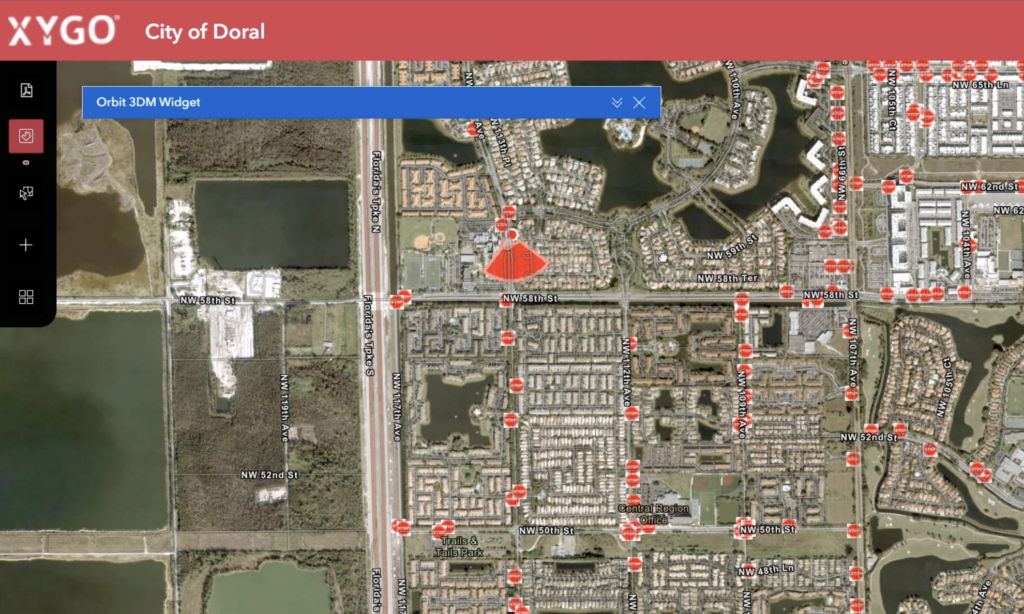
Consider for a moment, a humble sidewalk. One with dangerous cracks. Perhaps in Doral, for example.
For local officials, that crack represents risk, paperwork, and slow follow-up. For XYGO, a Chilean geospatial company with decades of experience across Latin America, it became a practical way to show how modern mapping tools can change how cities work day to day. And for Miami-based consultancy IMPACTIFI, it was the right example at the right time.
IMPACTIFI recently partnered with XYGO to support the company’s expansion into the U.S., starting in South Florida.
“What intrigued us is that they created almost, to simplify it, an overlay to the ESRI platform,” Camilo Padrón, IMPACTIFI’s Chief Global Officer, told Refresh Miami, referring to XYGO’s suite of tools for municipalities. “It’s one of the most commonly used platforms, but most local government entities don’t use it to its full capacity.”
That gap is where XYGO operates. Rather than asking cities to replace their systems, the company builds on top of existing infrastructure. In Doral, that meant scanning the city using bikes, cars, and drones, collecting data on sidewalks while also capturing information on street signs, light poles, and other assets. The process replaces clipboards and manual inspections with a live inventory that multiple departments can use.
“It sounds like not the most exciting thing,” Padrón said of sidewalk inspections, “but it is exciting in the sense that it is a very manual task.” He explained that the technology speeds up everything from identifying hazards to automating ticketing, while also helping cities manage legal exposure. “They can now go and fix that problem before something actually happens.”
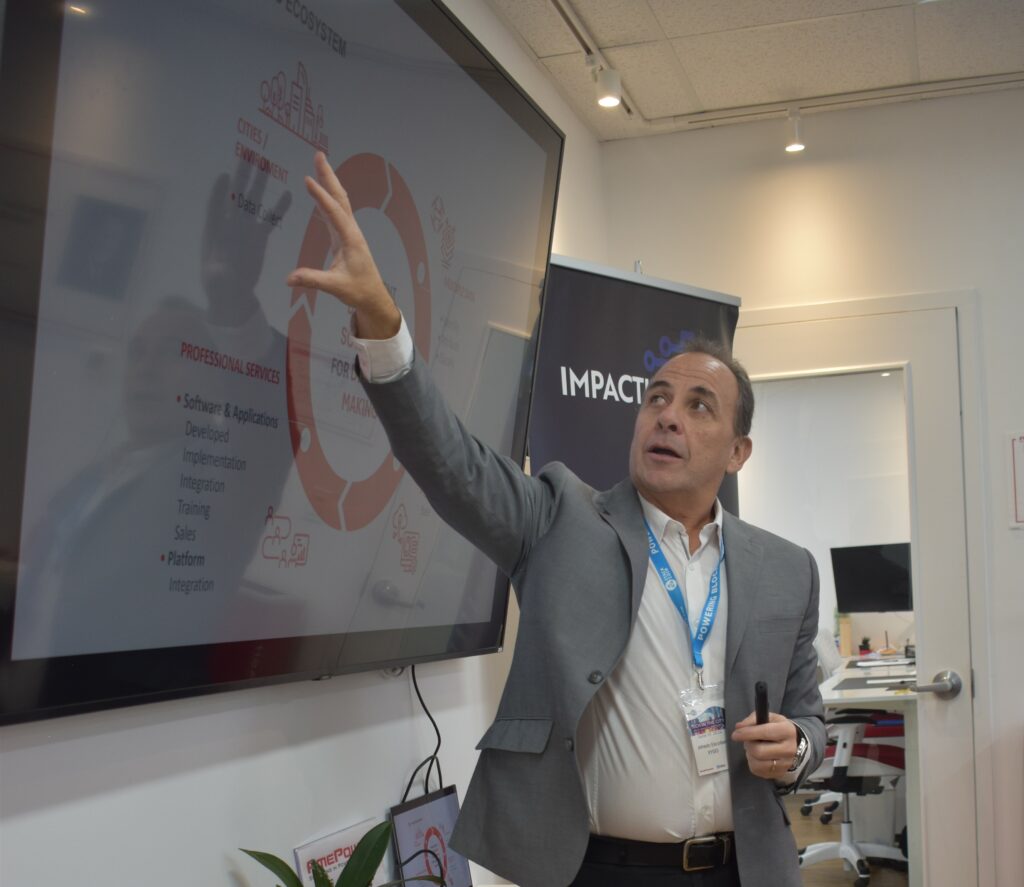
“Entering the United States is a natural step in XYGO’s evolution,” Alfredo Escobar, CEO of XYGO, shared in a statement. “After more than a decade supporting cities and utilities across Latin America with enterprise-grade GIS implementations, digital twin development, and advanced LiDAR mapping, we are ready to bring this proven expertise to U.S. agencies.” Escobar [pictured above] added that IMPACTIFI’s understanding of the municipal landscape would help speed up that process.
The Doral project helped validate XYGO’s approach in a U.S. context, but it also fit into IMPACTIFI’s broader role as a connector between international companies and local ecosystems. Much of the work happens before a single contract is signed.
“A lot of what we do as a company is sit with them, get a better understanding of what they do, what is the fit in the U.S. market, and then positioning,” Padrón said. That includes adjusting messaging for American audiences and making introductions to municipalities that have been searching for solutions like this for years.
Behind that work is a larger push by IMPACTIFI to formalize how global companies enter South Florida. Teresa Grandal Cusse described how the firm has been building internationalization programs with trade councils and global partners, often centered on hands-on immersion rather than surface-level networking.
“We did our first one last year. It went very well,” Grandal Cusse said, referring to a pre-conference program tied to eMerge Americas. “We had 11 countries. We had 101 registered attendees.” The program, which ran with limited lead time, is now being expanded for its second year.
Those efforts matter for companies like XYGO, which has over 100 employees and already operates across Chile, Argentina, Peru, Colombia, and parts of Mexico. The U.S. is not its first international step, but it is its most complex. IMPACTIFI’s plan is to help XYGO land several initial projects, then support a deeper local presence, including staff on the ground.
As cities face tighter budgets, aging infrastructure, and growing legal and safety pressures, the demand for better data is becoming harder to ignore.
For IMPACTIFI, the partnership with XYGO is one example of how Miami continues to function as a gateway, not just for capital or talent, but for ideas that have already been tested elsewhere. And if those ideas keep proving themselves on the ground, the next city to benefit may already be scanning its streets without most residents ever noticing.
READ MORE IN REFRESH MIAMI:

I am a Miami-based technology researcher and writer with a passion for sharing stories about the South Florida tech ecosystem. I particularly enjoy learning about GovTech startups, cutting-edge applications of artificial intelligence, and innovators that leverage technology to transform society for the better. Always open for pitches via Twitter @rileywk or www.RileyKaminer.com.
Latest posts by Riley Kaminer (see all)