
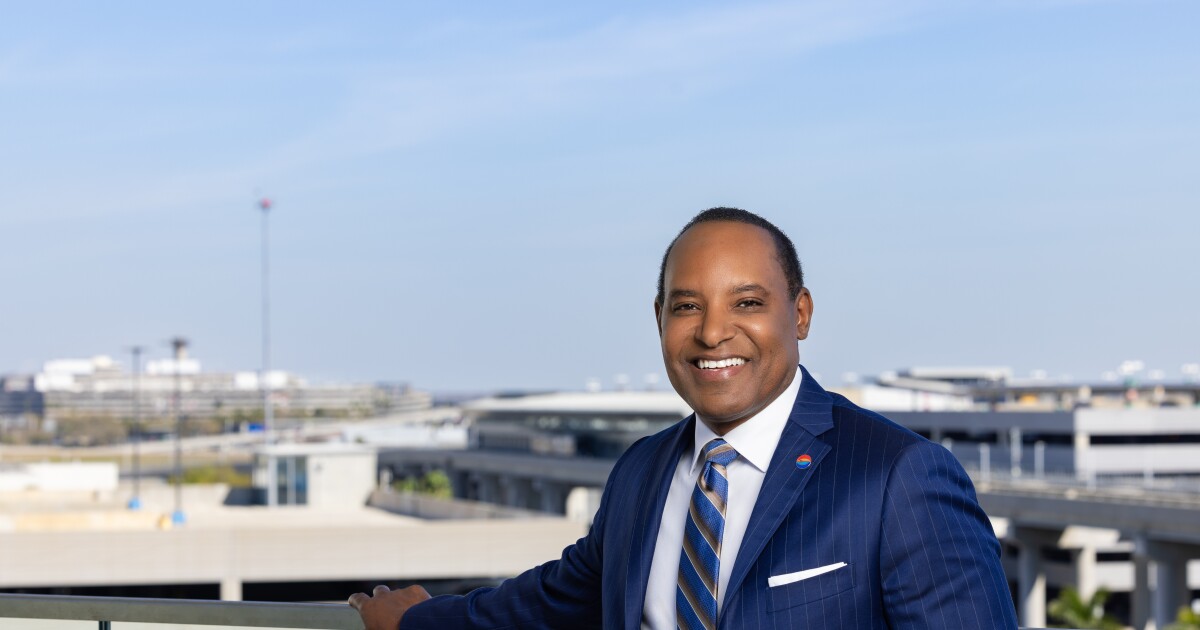
The pungent smell of jet fuel and the movie “Top Gun” marked Michael Stephens’ journey into aviation — a catalyst for becoming Tampa International Airport’s CEO.
TPA is the fourth busiest airport in the state, as more than 24 million passengers trek past the airport’s renowned giant flamingo mascot Phoebe every year.
Stephens began his role in April 2025, following the retirement of former CEO Joe Lopano. But he’s no stranger to how this airport functions. He spent the past decade as the airport’s general counsel and executive vice president over various departments, according to a release.
ALSO READ: ‘We did it’: Tampa International Airport CEO reflects on over a decade of service
On “Florida Matters Live & Local,” Stephens dug into his early career beginnings, how the airport navigated a federal shutdown late last year, his sights on the future and more.
Childhood spark turns into lifelong career in aviation
Stephens’ journey in aviation started when he saw the movie “Top Gun” with Tom Cruise as a kid. It ignited a desire to be a fighter pilot. So, he enlisted in the Air Force fresh out of high school.
His first time on a commercial aircraft didn’t come until basic training — and that’s when he was hooked.
Courtesy
/
Tampa International Airport
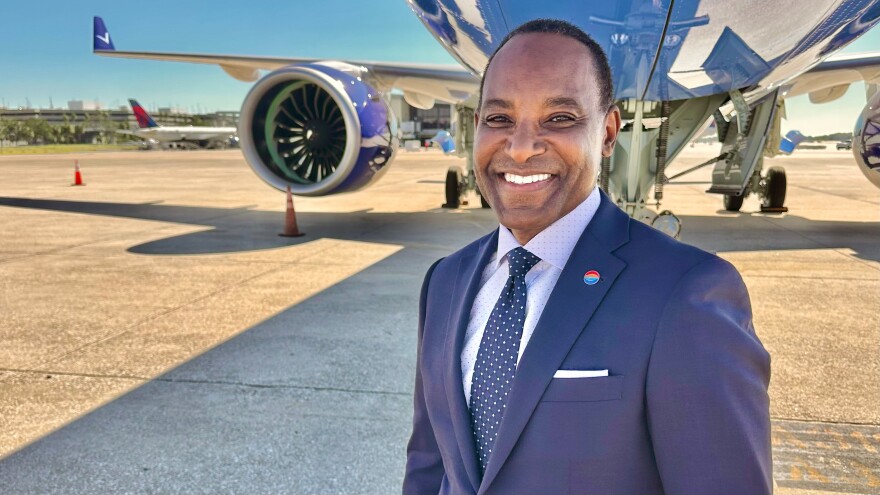
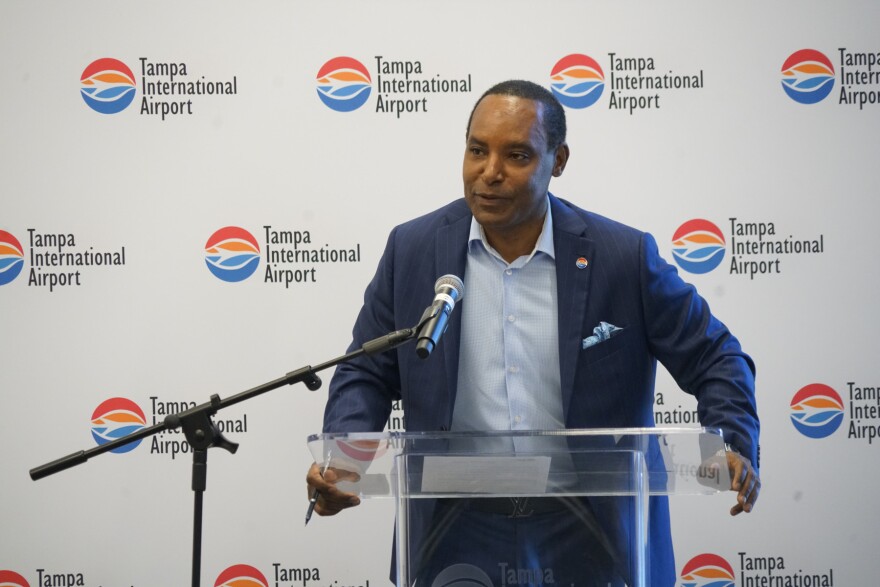
Tampa International Airport CEO Michael Stephens says running an international airport is an “incredibly complex operation.”
“Once you get out on a flight line somehow and smell the jet fuel and all that, aviation gets in your blood, and 25-30 years later, it’s still been in my system,” he told Florida Matters Live & Local Host Matthew Peddie.
Although being a fighter pilot “wasn’t in the cards for him,” he became an air traffic controller in the military. He described how mentors and people along the way helped steer him to exactly where he was supposed to be.
“I never would have imagined, though, that I would have gone from being a young enlisted guy in the Air Force as an air traffic controller to running America’s favorite airport, and I’m grateful for it every day,” Stephens said.
Navigating a government shutdown, complex daily operations
Stephens’ tenure as CEO has not been without its challenges, as six months into his position, the longest federal government shutdown ever kicked off.
Courtesy
/
Michael Stephens
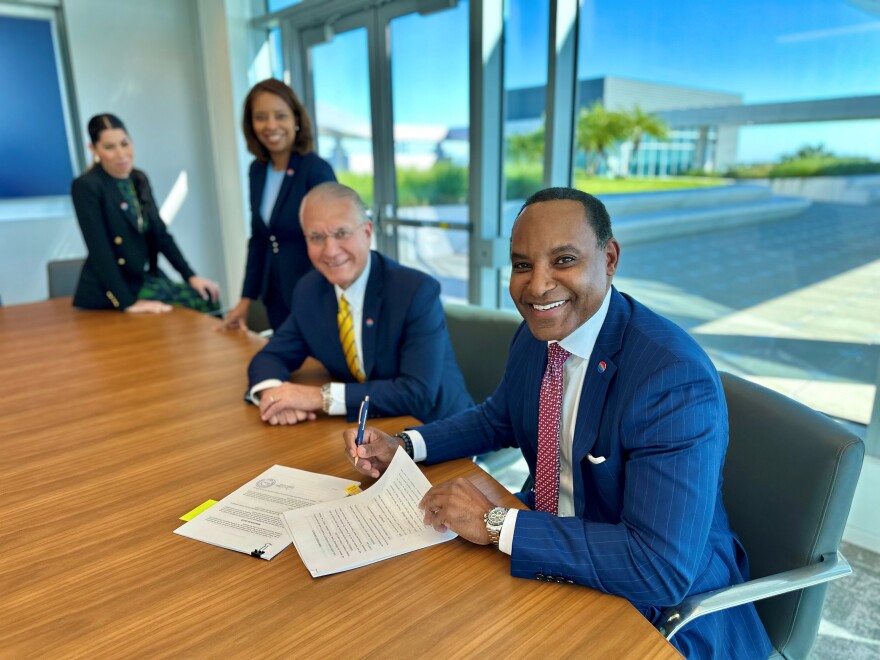
Michael Stephens went from being an air traffic controller in the military to Tampa International Airport’s CEO.
He said they faced it through “coordination, communication and support” to help alleviate the impacts.
“We’ve done the same things that we’ve done in any type of circumstance like that that we face that impacts our operations, and that is really coordinating amongst our fantastic team of not only Tampa International employees, but the multiple partners at the federal and partnership level that we have with our vendors — all of those folks — just making sure that we were doing whatever we can to coordinate to alleviate the impacts of that shutdown on our passengers,” Stephens said.
He added they came through with “flying colors.”
Stephens admitted the shutdown was stressful at times — especially since they were coming up on Thanksgiving. Since there were federal employees coming to work without pay, Stephens said they coordinated with partners in the region for assistance.
“It is a tightly coordinated dance that we do every day to make this such a tremendous experience for people coming through.”
Tampa International Airport CEO Michael Stephens
“For example, reaching out to our friends at TECO to get some abatement when it came to utilities payments, looking at how we can do things like being able to allow our federal partners — particularly our lower perhaps compensated TSA folks — to be able to get fuel to be able to make it to work,” he said. “Doing things with Feeding Tampa Bay. So it really was one of those all-hands-on-deck efforts where the airport was acting as coordinator to kind of help get as much support as we could.”
Stephens said running an international airport is an “incredibly complex operation.” He explained that almost 25 million people a year come through the airport, comparing it to managing a crowd at Raymond James Stadium every day.
“Most of us experience it just as the consumers,” Stephens said. “You come in, you maybe grab a cup of coffee — something to eat — you go to your plane, you get on the plane, and it’s done. There’s so much that happens behind it.”
Courtesy
/
Tampa International Airport
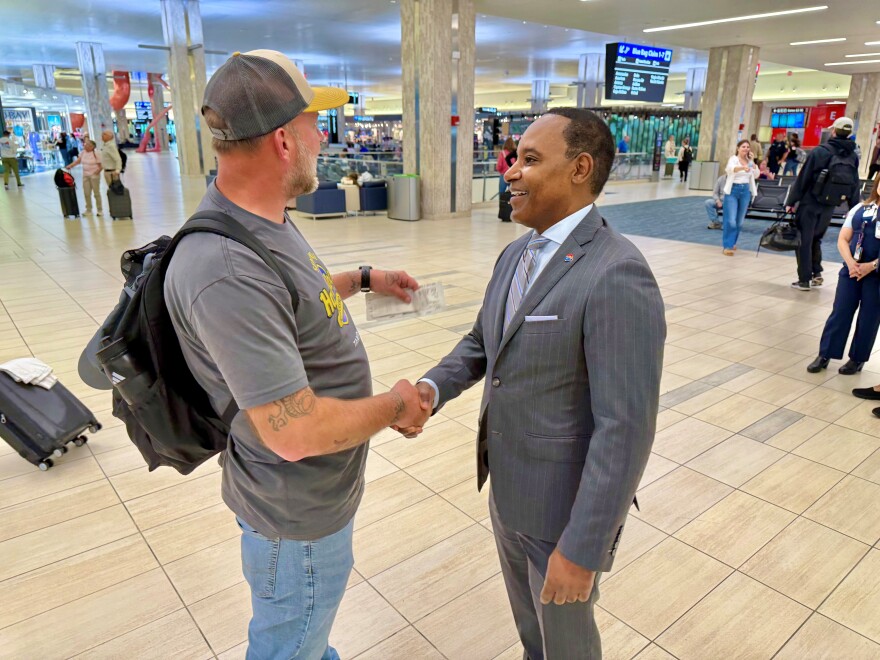
Tampa International Airport CEO Michael Stephens speaks with a passenger on his first week on the job in April 2025.
He said they make it happen through hiring “some of the best people around” and coordination efforts with around 10,000 people who work there — everyone from bag handlers and ticket agents to baristas at coffee shops.
“It is a tightly coordinated dance that we do every day to make this such a tremendous experience for people coming through,” Stephens said.
In addition, Stephens and the executive team are out on the front lines to see what’s happening. He mentioned how when he started his new gig, he did job shadowing for various roles.
“Literally, I had on the traffic officer uniform, and I was down on the curb with a whistle around my neck doing whatever it needed to be done to help get our passengers where they were going,” Stephens explained. “And you learn a lot by doing that type of stuff. So it’s not just for show. It’s an actual, real strategic reason in being out there with your people and seeing what they’re experiencing and what your passengers are experiencing.”
A growth-minded focus toward the future
As time ticks on, Stephens’ eyes are focused on accommodating more passengers — and with that comes expansion.
One of those projects is Airside D, which is anticipated to cost an estimated $1.5 billion and is scheduled to open in late 2028. Stephens said it’s the first airside in 20 years. It will have 16 gates and its own customs facility. He said it will be critical in handling the increased volume of passengers and attracting additional nonstop international flights from around the globe.
“We’re anticipating there are going to be 10 million more passengers traveling through Tampa International Airport in the next 10 to 12 years. So being able to accommodate that volume,” he said. “Also, the region is growing tremendously. We’re expecting that same period of time about three-quarters of a million new inhabitants and residents living in the Tampa Bay region.”
ALSO READ: New renderings put Tampa International Airport’s future Airside D coming into sharper focus
Stephens said they have the potential capacity, based on studies, to go north of 40-plus million passengers per year over the next 20-plus years.
“And depending on what technologies are out there and what happens in the region, potentially even beyond that includes very, very, far, far far long-range opportunities for another runway, if that should become a requirement to enable growth,” he said.
Overall, Stephens is the airport’s fourth CEO in its 98-year history and the first African American CEO for TPA. He said he’s very grateful to lead the organization.
“I think in the Tampa Bay region, at this point in time in its history, is worthy of big dreams and big ideas, and I’m glad to be able to continue that,” Stephens said.
You can listen to the full interview with Michael Stephens in the audio player above. This story was compiled from interviews conducted by Matthew Peddie for “Florida Matters Live & Local.” You can listen to the full episode here.
Tampa International Airport
Michael Stephens is the CEO of Tampa International Airport.