
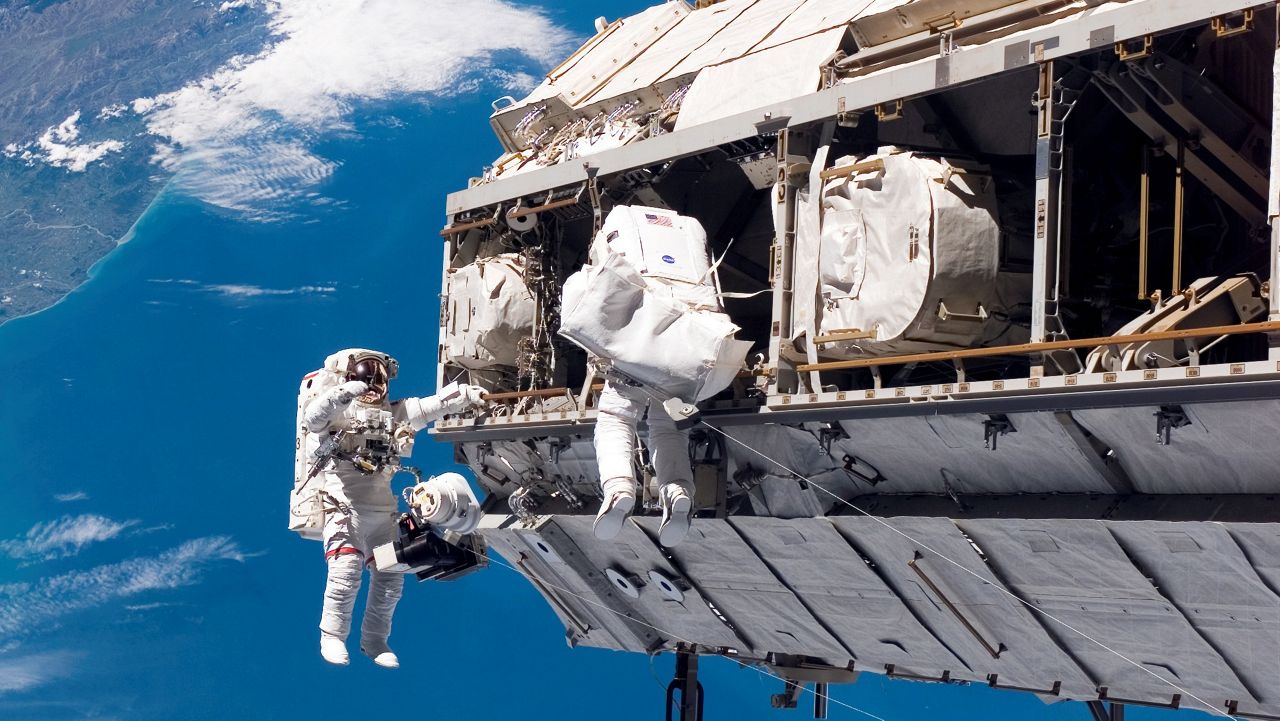
CAPE CANAVERAL SPACE FORCE STATION — After a Crew-11 astronaut suffered a medical episode on the International Space Station, a University of Central Florida space medicine expert gives insight into the medical capabilities of the crew and what is on the station.
What You Need To Know
Dr. Emmanuel Urquieta describes what type of training an assigned crew medical officer goes through
He also shares what type of medical tools and equipment are onboard the International Space Station
He was the chief medical officer of the NASA-funded Translational Research Institute for Space Health
RELATED coverage: Crew-11 mission cut short after astronaut has medical issue
Dr. Emmanuel Urquieta, vice chairman of UCF’s Aerospace Medicine and associate professor of medicine, would not speculate as to what happened to the unnamed astronaut, but he shared what type of training the space station crew does and what equipment is onboard to help assist in the care of crew members.
NASA has health standards for its astronauts as they need to meet a health requirement, plus training, before going to space. But each expedition — which means the current crew in the International Space Station — assigns a person to be a crew medical officer (CMO), explained Urquieta on Friday afternoon.
“The CMO is not always a physician, but receives extensive preflight medical training in trauma care, medical emergencies, dental care, ultrasound imaging, and clinical decision-making in isolated settings. All crew members receive basic emergency medical training to support the CMO,” he stated to Spectrum News.
Astronaut medical training is mission-specific and risk-based, with the CMO receiving advanced simulation-based training that focuses on stabilizing a patient, autonomous care and coordinating with medical teams back on Earth, stated Urquieta, who was the chief medical officer of the NASA-funded Translational Research Institute for Space Health before joining UCF.
In fact, he stated that NASA helped pioneer telemedicine, where a patient and a doctor can speak during a video call. The medical care that takes place on the space station relies heavily on telemedicine.
Urquieta says some of the benefits of telemedicine include, “Crew members can transmit medical data, images (including ultrasound), and live communications to flight surgeons at Mission Control. Medical support is available 24/7, with dedicated flight surgeons assigned to each mission.”
To assist the CMO, the International Space Station is equipped with various tools to provide medical care.
“The ISS carries a Crew Health Care System (CHeCS) that includes diagnostic tools (ultrasound, physiologic monitoring), emergency and trauma equipment, airway and resuscitation supplies, and a formulary of medications covering pain, infection, cardiovascular, and other common conditions. These systems are designed to manage most expected medical events in orbit,” he described in an email.
If a health issue comes up that is severe and beyond the scope of the CMO, NASA can activate medical contingency protocols, Urquieta said, who also spoke to Spectrum News in a separate article about the importance of space health and medicine in 2024.
“These include real-time consultation with flight surgeons and medical specialists on the ground and, when indicated, early return to Earth using the docked spacecraft. From the ISS, evacuation can occur within hours,” he described.
In fact, that is what is happening with the unnamed astronaut who had an undisclosed medical issue. On Thursday, NASA Administrator Jared Isaacman announced that the Crew-11 mission had been cut short so the astronaut could come back down to Earth to receive full medical care.
NASA is currently working to determine when the Crew-11 member can undock from the space station and return to Earth.
Crew-11 is made up of NASA astronauts Cmdr. Zena Cardman and pilot Michael Fincke, along with mission specialists Japan Aerospace Exploration Agency (JAXA) astronaut Kimiya Yui and Roscosmos cosmonaut Oleg Platonov.
All four members will be returning.
Urquieta also shared that NASA uses a probabilistic risk-assessment tool called the Integrated Medical Model (IMM). The tool uses simulations to assess millions of hypothetical missions and calculate the incidence, severity, and timing of medical events.
“For long-duration missions in low-Earth orbit, early IMM analyses predicted a high probability (>50%) of at least one medical event requiring evacuation over the lifetime of the ISS program, with expected occurrence on the order of 30,000–60,000 cumulative crew-days. In practice, after over 25 years of continuous ISS operations and well beyond 100,000 cumulative crew-days, no evacuation has occurred for an acute life-threatening medical emergency,” he stated.
He continued, “This outcome has been substantially better than IMM predictions, underscoring the impact of rigorous astronaut selection, aggressive prevention strategies, continuous physiological monitoring, and real-time telemedical support by ground-based flight surgeons.”