
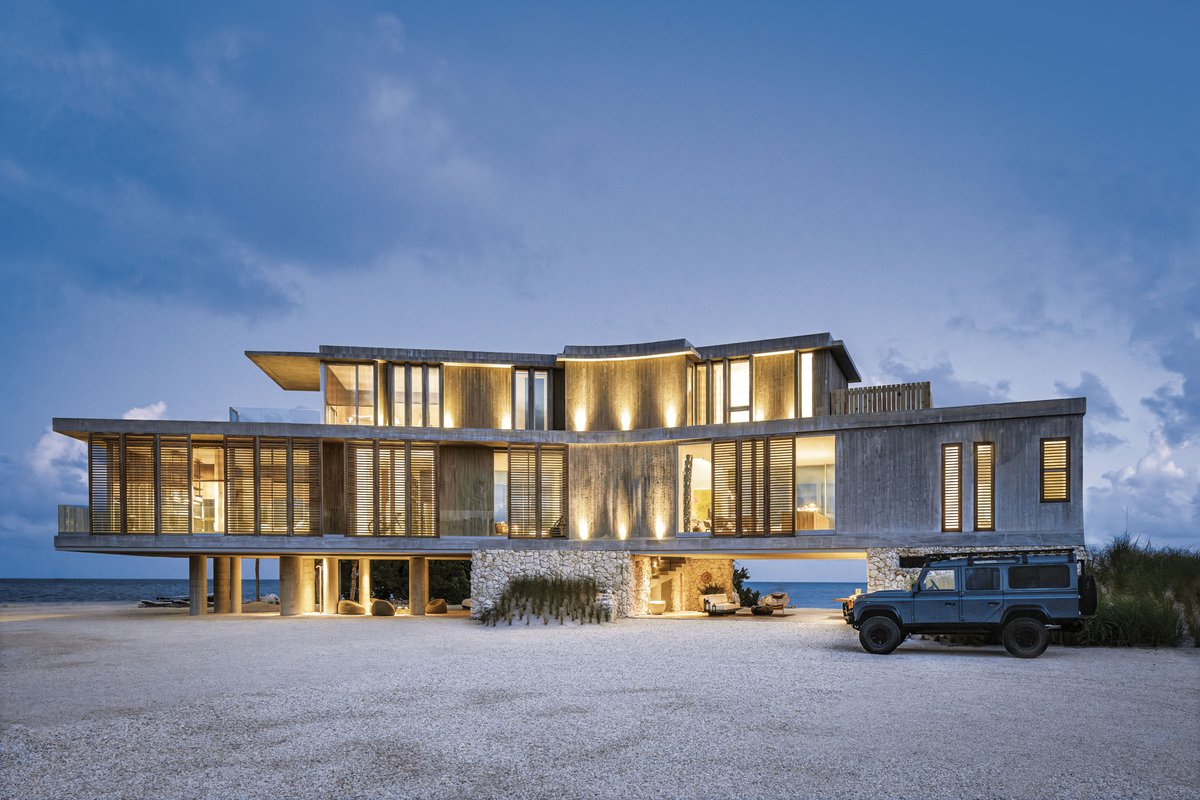
Across the Gulf Coast, resilient design has become less about creating a fortress and more about working with the forces that shape its environment. When Hurricane Ian struck in 2022, followed by Helene and Milton two years later, Southwest Florida started building from a new baseline. Our homes needed to withstand a Category 5 hurricane—and recover as quickly as possible afterward. “Resilience has to do with how [a building] performs after the storm passes,” says Naples sustainable architecture champion David Corban.
The shift expresses itself in a new design language for the coast. Now, homes are more porous and adaptable at ground level and heavier at the core—they hold where they must and yield where they should. Interior finishes are kept to a minimum, reducing the number of fail points.
In practice, designing for resiliency begins at the ground level, where landscape architects map wind, sun and water, and shape the land accordingly to minimize impact. Leigh Gevelinger, of Sanibel-based Coastal Vista Design, says a site’s native grade, soil composition and drainage patterns determine what happens during a surge or a week of heavy rain.
Rather than imposing a landscape onto a property, Gevelinger organizes plantings to stabilize the ground and manage the movement of water. “Resiliency takes a layered approach,” she says. “Each technique compounds on the other.” In one of her recent Sanibel Island projects, native spartina, muhly and lovegrass create a dense, fibrous root system. Meanwhile, clusters of gumbo-limbo and seagrape trees provide shade year-round and help diffuse wind pressure before it reaches the home. Many landscape architects also install narrow chambers buried beneath driveways, so water can settle and seep without altering the visual landscape. Throughout, low areas are raised just enough to block neighboring runoff, and subtle contours are added to hold and absorb stormwater onsite rather than pushing it toward downstream homes.
Some master planned communities take things further. Babcock Ranch has installed Smart Pond systems from National Stormwater Trust, which use live weather data and automated valves to assess available storage and lower water levels ahead of a storm. Before Hurricane Ian’s first bands reached the coast, one Tampa Smart Pond drew down its lake by 4 feet, creating enough capacity to prevent discharge into nearby neighborhoods.
As the landscape absorbs and deflects, the structure above must anchor. Forward-thinking architects have long traded wood for concrete, but Ian accelerated the shift from recommendation to expectation. Naples-based Michaela Reiterer Henning of Naples’ HLevel Architecture opts for Omni Block—a cementitious masonry unit similar to insulated concrete forms (ICFs) but better suited to hot, humid climates. The block delivers structural strength, energy performance and sound control in one. On top, fiber cement siding can preserve the look of classic cladding without bending to the elements.
Architect Joyce Owens, Sanibel and Captiva Islands’ resiliency evangelist, uses concrete all the way down to the home’s deepest layer, even when it’s not required by code. She drives the concrete pilings deep below grade and ties them together with over-reinforced grade beams. Above it, steel-hardened concrete shear walls rise perpendicular to the water, lifting her homes’ primary living level well above flood thresholds. She places rebar at 2-foot intervals, rather than the code minimum of 4. “These houses that we are building now are going to last hundreds [of years],” she says. Following each of the recent years’ storms, Owens surveyed her sites. While neighboring homes were tattered or even leveled, hers stood with only the landscape impacted. “We design to allow Mother Nature to do what she’s going to do,” she adds.
In a humid, coastal climate, long-term resilience isn’t just about impact ratings, but keeping moisture out of the structure year-round. For an additional layer of protection, Schenkel Shultz’s principal architect, Nathalie White, may utilize a rainscreen—a thin, ventilated layer of cladding that allows exterior walls to breathe and shed moisture. “Imagine building another wall in front of your wall,” she says. To keep roofing in place, architects have myriad solutions—from utilizing aerodynamic designs that reduce uplift to employing premium synthetic underlayments. However, materiality rules. Short of building a full concrete roof, standing seam aluminum remains the gold standard for creating a tight envelope that resists corrosive, salty air.
As the main structure strengthens, the ground level stays intentionally minimal. Breakaway walls remain a smart way to enclose flood-risk rooms, but Owens prefers to keep most of the undercroft open, capturing it as sheltered outdoor living. “We don’t like the sun as much as we used to,” she says. “Now we want plenty of protected space outside.” Post-storms, the areas can be rinsed clean with nothing critical at risk—plus, they’re resistant to the daily tread of sandy feet, she says. Any necessary ground-level rooms receive composite trim that mimics wood or fully tiled walls in lieu of wooden baseboards.
Inside, materials are chosen for recoverability as much as aesthetics. Porcelain flooring, waterproof plaster walls and native cypress for millwork can withstand repeated wetting without swelling or warping. Concrete appears in more places, too—sometimes incognito, treated with stains, microtoppings or thin plasters that take on the warmth of wood or stone. Elsewhere throughout the home, outlets rise higher on the wall; marine-grade sealants protect window and door openings; and mechanical systems migrate to upper levels, where they stay dry and serviceable.
In the most progressive projects, the team ensures the home can operate even when the grid is down, a move that also lowers the home’s environmental footprint. Solar paired with reinforced battery storage is moving from novelty to expectation, with low-profile Tesla panels increasingly covering Southwest Florida’s roofs. Rainwater-capture systems provide an additional layer of independence, utilizing cisterns and on-site filtration to supply irrigation and some potable water when utilities fail. Meanwhile, advances in laminated, impact-rated glass further tighten the shell, reducing heat gain and improving long-term stability. “You’re creating a skin that keeps heat out and AC in,” White says.
Most of what has become best practice today isn’t new. Architects have long advocated for elevated living, tighter structural cores and landscape-driven hydrology. But the past few years of storms advanced the conversation. Clients stopped questioning the need for resilient design and began asking how far it could go. “It’s only gonna get better,” Owens says. “Even if climate change gets worse, we’re going to try to adapt and evolve.”