
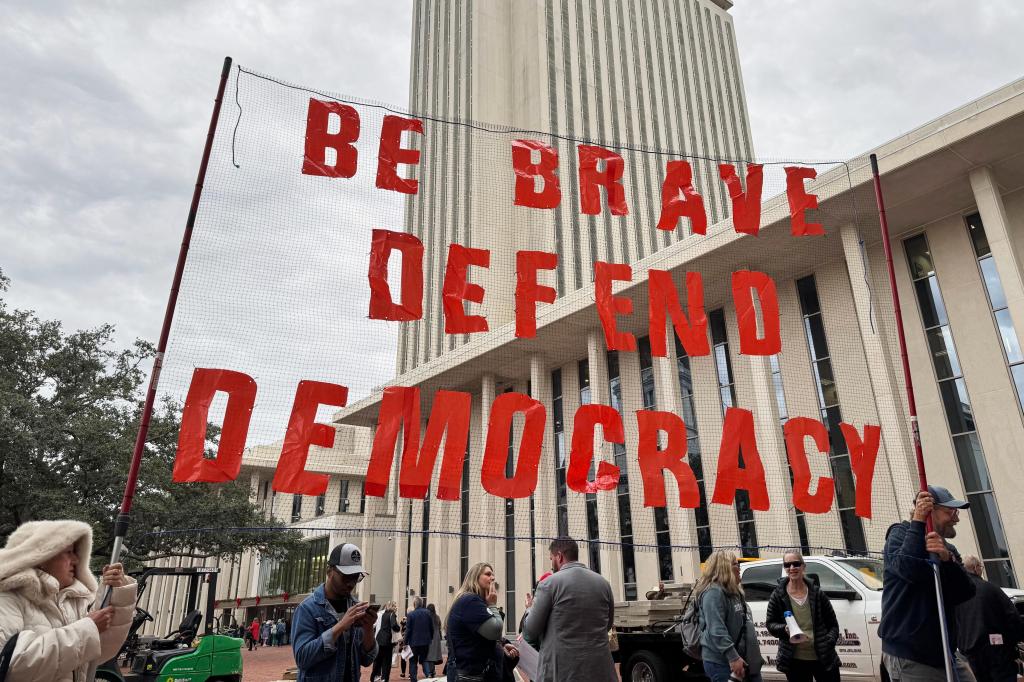
There have been times in Florida’s history when state officials could boast about their commitment to integrity, ethical behavior and transparency.
This, sadly, is not one of those times. Critical safeguards — meant to protect taxpayers and keep public officials in the sunshine and on the straight and narrow — have been significantly weakened by the Legislature.
Lawmakers have a handful of recommendations to consider in the session that starts Tuesday. Some of them are good ideas, though relatively mild. If legislative leaders really want to take a stand for openness and honesty, they’ll go bolder — starting with legislation aimed at the heart of recent Florida scandals.
They have good reason to do so. Florida’s accountability and integrity laws have been gradually eroded over the past decade or so, even before Gov. Ron DeSantis started treating the state budget like his personal political piggy bank. Blatant violations — such as people serving on critical regulatory boards who work for, or own, businesses that do business with that state agency — have mingled with behavior that looks ugly, but isn’t prohibited by state law (such as DeSantis’ penchant for paying top dollar to outside law firms for disputes that could be easily handled by attorneys on the state payroll).
The Ethics Commission has jurisdiction over supposed ethics-law violations, but the Legislature significantly eroded the law in 2024, requiring that anyone filing an ethics complaint have “personal knowledge” of the facts that support their allegations. That’s a high standard to meet: People can’t base complaints partially on government audit reports, for example, or investigative journalism reports. And the new law has been applied retroactively, to impact investigations that were already underway before the law changed. As a result, some cases have been dropped that might otherwise have been determined to be genuine violations.
In its legislative recommendations for the 2026 session, the Commission on Ethics is not asking for a repeal of that law. It should have. This law ripped a hole in state integrity rules that will only get wider as the years go on.
The Legislature should also consider the fact that Florida’s public integrity laws are all too frequently ignored. That includes public records and open meetings laws that once made Florida a beacon of sunshine. Over the past few years, multiple state agencies have been sued after failing to provide basic information about the money they’re spending or the impacts of their activities. (The Orlando Sentinel is currently suing the state Department of Transportation for records surrounding its decision to remove a rainbow-painted crosswalk that is part of the Pulse memorial site.)
The same slide toward non-compliance can be seen in the number of officials who don’t file required financial disclosure forms, despite generous grace periods that include gentle reminders from the Florida Commission on Ethics. These reports are simple and straightforward, intended to record any potential conflicts of interest.
Yet in 2024, the number of “delinquent” filers hit an all-time high of 1,266 — more than double the previous year’s violators. That could be partially explained by a switch to electronic reporting. But that alone can’t account for the massive leap. And while some elected officials and government employees did eventually submit the required paperwork (and paid their fines, which accrue at a rate of $25 a day after a generous three-month grace period), the commission had to resort to the inelegant solution of referring some scofflaws to collection agencies.
In its legislative recommendations, the Commission on Ethics requested a provision that would waive fines for first-time offenders so long as they came into compliance. We’re not sure that’s a good idea — and apparently, neither do lawmakers. We don’t see a bill filed to that effect.
But lawmakers ought to pay attention to another bill (SB 92/HB 139) that would, at long last, protect for public employees who report wrongdoing at their own agencies from retaliation, along with employees who cooperate with ethics investigations. This bill comes back year after year, but has yet to pass. This year, it should.
Finally, they should pick up on one request that the Ethics Commission has made in previous years, and give the small agency the ability to investigate reports of wrongdoing on its own, without waiting for someone to file a complaint. The commission’s staff knows ethics laws better than anyone. It is uniquely positioned to expose wrongdoing that others might be too afraid — or too unfamiliar with state law — to bring forward.
These are relatively modest changes. But there’s one more bill that deserves attention — and it’s a doozy. HB 593, filed by Rep. Alex Andrade, R-Pensacola, is an arrow aimed straight at the heart of the Hope Florida scandal, where money received from a lawsuit over Medicaid overbilling was redirected to a non-profit, and then funneled into political campaigns. (Its companion is SB 802, was filed by Sen. Debbie Mayfield, R-Melbourne.)
The bill is meant to explicitly prohibit that kind of shady transaction. For good measure, it would also strengthen the law forbidding public officials, at any level of government, from using their “official authority” to influence others to make political contributions, and tighten expense-reimbursement rules to specify that public employees or elected officials can’t be paid for the cost of travel between their homes and their official workplaces.
We will be following this bill in particular as the session gets going, and we hope Andrade (who is also sponsoring a bill that would force government officials to respond in a timely manner to public-records requests) pushes hard to get it heard and onto the House floor. If it passes there, we suspect it also has a good chance of passage in the Senate.
Passage of HB 593, and adoption of other modest, sensible ethics-law reforms, should be an easy decision for lawmakers. Either they support strong ethics provisions — or they don’t. They can respond to current scandals by supporting new laws meant to make the government fair, honest and uncorrupted by special interests.
The Orlando Sentinel Editorial Board consists of Opinion Editor Krys Fluker, Executive Editor Roger Simmons and Viewpoints Editor Jay Reddick. Use insight@orlandosentinel.com to contact us.