

In his first year as Florida’s young and powerful speaker of the House, Miami Republican Daniel Perez created a new political dynamic in the Sunshine State, in which legislators began to claw back the power they had ceded for so long to Gov. Ron DeSantis and reassert their control over policy and the purse.
Lawmakers in the Florida House launched explosive inquiries into the DeSantis administration’s spending and decisions. They spearheaded the first ever override of DeSantis’ vetoes. And, working with the Senate, they largely bucked his agenda, letting some of his priorities languish.
But that was last year. Heading into Perez’s second and final session in charge of Republicans’ agenda in the House, the dynamic has changed, and Perez may be the odd man out.
Perez, 38, says his relationship with the governor — who he says isn’t returning his calls — remains icy. And he doesn’t seem optimistic about his once-warm relationship with Senate President Ben Albritton following a blowup last year over taxes and spending that appeared to push the leader of the Legislature’s upper chamber closer to the governor.
With Florida’s legislative session beginning Tuesday, that evolving power dynamic is a wildcard that could affect the state’s ability to lock in more than $100 billion in spending, address the pressing problems facing Floridians and set in stone some of the GOP’s priorities, like drawing new congressional districts and cutting property taxes.
More than a dozen interviews with Republican members of the Legislature and players in the political process revealed just how fraught the relationship between the House speaker and Senate president remains — though both say they are looking forward.
“It doesn’t have to be a tough environment,” Perez told the Herald/Times this week in an interview. “It’s just a matter of having a willing and able partner, which, right now, doesn’t seem like something that’s feasible.”
The governor’s office didn’t respond to a request for comment.
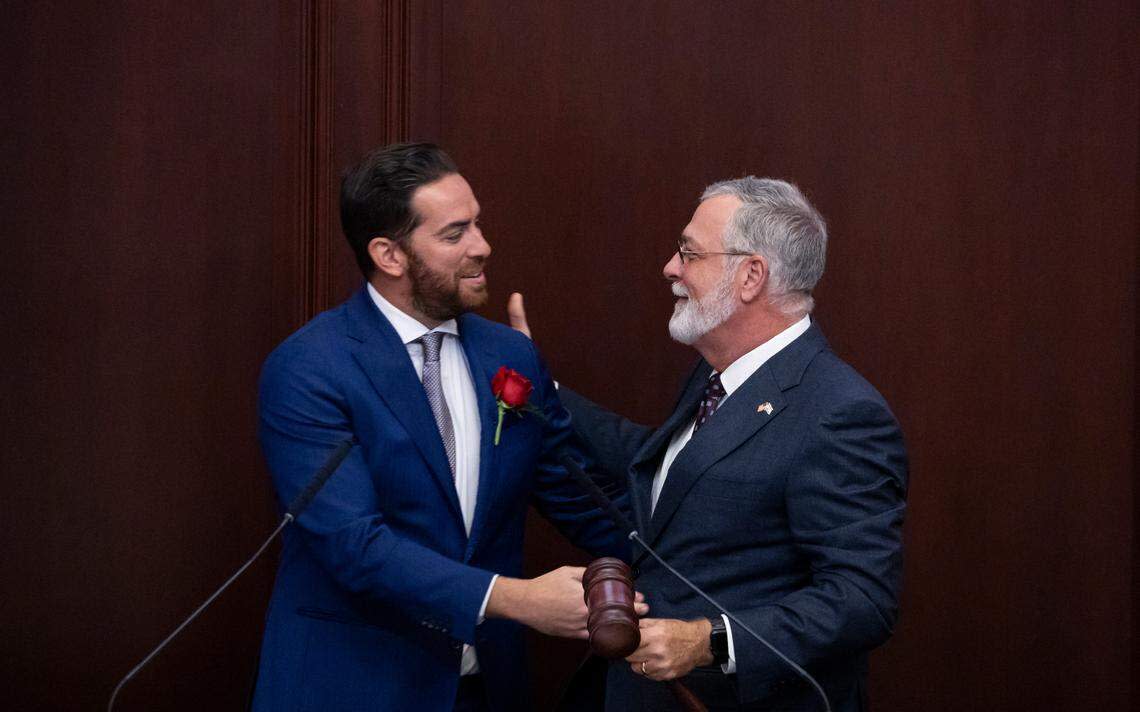
Florida House Speaker Daniel Perez, R-Miami, hands Florida Senate President Ben Albritton, R-Wauchula, the gavel during the first day of the legislative session at the Florida State Capitol on Tuesday, March 4, 2025, in Tallahassee, Fla.
Priorities and Politics
Just like last year, Perez, a lawyer by trade, is playing his cards close to the vest.
He has no legacy bill that he is shepherding through the process. He says he believes the state has put the necessary changes in place to fix Florida’s property insurance crisis. And he has resisted calls from cash-strapped condo owners to overhaul the building-safety law he championed after the fall of the Champlain Towers South in Surfside.
His main goal, he says, is to pass a conservative budget that is smaller than last year’s, potentially setting up another difficult negotiation with the Senate, which is concerned with revenue shortfalls.
“This will be the first time that there will be a back-to-back cut in the budget coming out of the House since the recession,” Perez said. “And we’re proud to voluntarily take that task on.”
It’s hard to discern what measures Perez personally wants to pass. He isn’t sharing his preferences. And while he is addressing the governor’s priorities of redistricting and reducing property taxes, both issues have succumbed to the committee process with multiple proposals and much debate.
“We’re looking forward to that proposal if he were to ever have one,” Perez said of DeSantis’ desire to do away with property taxes for Florida residents with homestead exemptions on their primary residences. “And then I’m sure the Senate will soon thereafter follow his lead, so we’ll have that conversation at the right time.”
Just a year ago, the House and Senate appeared to be in lockstep, with DeSantis suddenly struggling to bend the Florida Legislature to his will.
That was clear before Florida’s regular 2025 legislative session. When DeSantis called for a special session on immigration, they called their own and passed legislation that they championed and he panned. Those battle lines appeared to persist when the House and Senate announced a plan for a state budget that would include billions in tax relief.
“I’m pleased to share with you that we have reached a framework for a budget plan,” Albritton said on the Senate floor on May 2. “As part of our agreement with the House, we will take up the most historic tax relief package in the history of our state.”
But Albritton says his Senate colleagues balked when it came time to whip votes on Perez’s specific plan to cut $5 billion from Florida’s sales tax as the policy was publicly denounced by the governor. He called Perez several days later and told him the Senate didn’t go for it.
“I can’t make the Senate do anything,” Albritton told the Herald/Times about the outcome.
Perez sent out a memo lamenting how the deal had been “blown up,” threatening a government shutdown as lawmakers approached the next fiscal year without a budget.
“The House and Senate had a deal on the budget,” Rep. Juan Carlos Porras, a Miami Republican, recounted to the Herald/Times this week. “And then over the weekend, the Senate president reneged on that deal, and that resulted in the numerous days that we didn’t have a budget.”
Ed Hooper, the Senate budget chairman from Clearwater, remembers it differently. The Senate was preparing a state budget for less economic growth in the future as fewer people retire in Florida, he said, and Perez didn’t give them heads up about the House’s planned tax cut.
“That was a $5 billion surprise,” Hooper said. “There was no deal agreed on a sales tax reduction.”
The dispute kept lawmakers for months from passing a timely budget, leading ultimately to a deal in June that required two extensions of Florida’s legislative session. In the fallout, the close relationship between Perez and Albritton frayed.
Albritton told the Herald/Times in an interview on Thursday that he was focused on the future, not the past.
“I do not have disdain for the speaker,” said Albritton, a Wauchula Republican.
A policy Albritton cares about will be an early test for that resolve.
Next week, the Senate will pass the president’s Rural Renaissance package. It is supposed to drive economic growth in sparsely populated regions of the state—an affordability agenda that could be a powerful message during the midterm elections centered on high costs of living.
Perez killed the bill last year as part of the budget blow up. He’s likely to do it again.
Herald/Times Tallahassee Bureau reporter Garrett Shanley contributed to this story.