
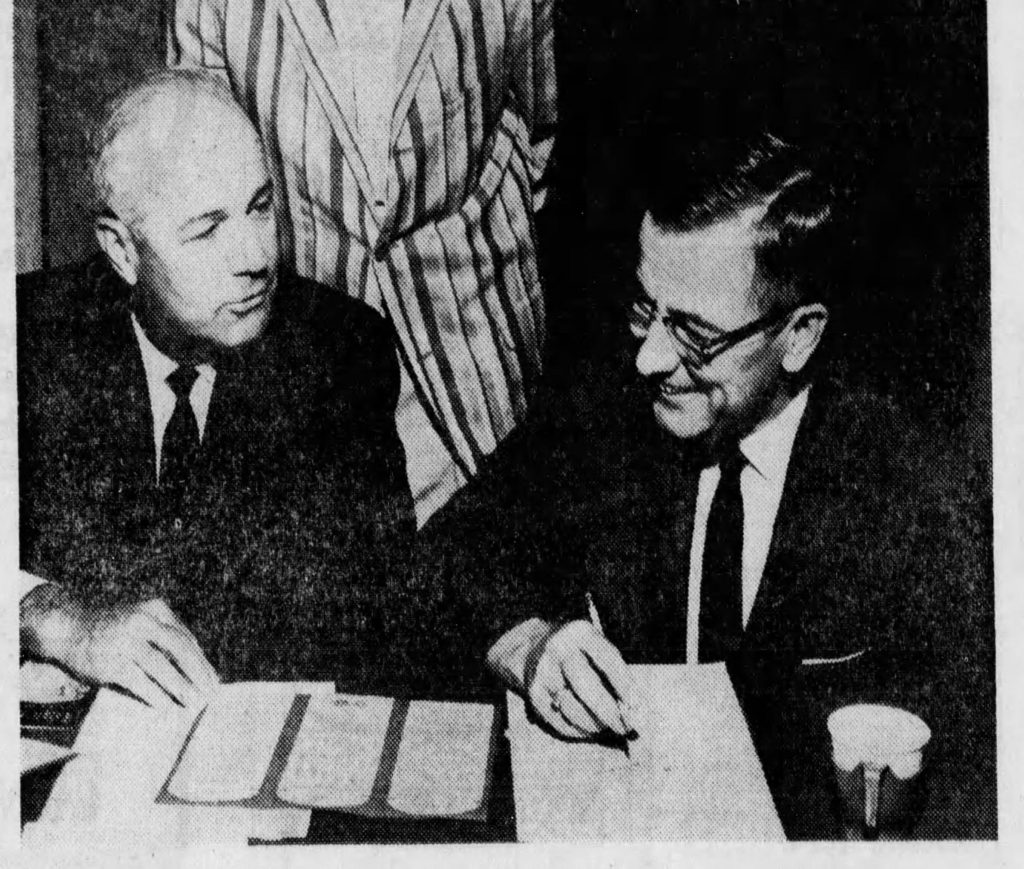
As part of the Orlando Sentinel’s 150th birthday, each month we’ll focus on a key topic that helped shape the Central Florida of today and how we covered that topic. January’s topic is higher education, and today look at our coverage of the opening of Valencia State College in 1967.
The school, known then as Valencia Junior College, had just 500-600 students enrolled on the school’s first day of classes on on August 21, 1967.
In the 2024-25 school year, Valencia State College reported that it had nearly 50,000 degree-seeking students. More than half of Valencia’s students are among the first in their immediate families to attend college, and nearly one out of four UCF students started at Valencia.
This story by reporter Gloria Meltzer appeared in our Florida Magazine the day before the school’s opening. The headline was “Instant College: Valencia opens tomorrow on a campus just three weeks old.”
Valencia Junior College happened in a hurry. Barely six months have passed since Dr. Albert Craig was named president. Tomorrow its 12 portable classrooms open to welcome a 500-600 member charter freshman class.
And it’s been a long, hectic summer for former St. Petersburg Junior College vice president Craig and his staff.
Students were virtually clamoring at their doorstep in May before VJC even had a temporary campus.
That prompted the decision to go ahead and locate on a temporary site while the search for a permanent site continued; hence VJC opens on what was formerly a portion of the Mid-Florida Technical Institute at 2908 W. Oak Ridge Road, sharing its administration building and labs.
Hundreds of textbooks came in before shelves were up in the bookstore in the administration building.
Then applicants came swarming in before catalogs were ready, and adding to the mid-summer madness, Mid-Florida Tech’s presses broke down, delaying catalog printing another week.
The school’s thousands of library volumes were all filed and indexed, but the portable library wasn’t scheduled to arrive until three weeks before classes started.
In fact, the major portion of the campus was just beginning to roll into the campus less than three weeks ago, starting with the student center, a double portable classroom that will resemble an automat with its vending machine array of the snacks college kids like to nibble and the sandwiches they thrive on.
But everything, believe it or not, was running on schedule. It’s just that the schedule was a pretty tight one.
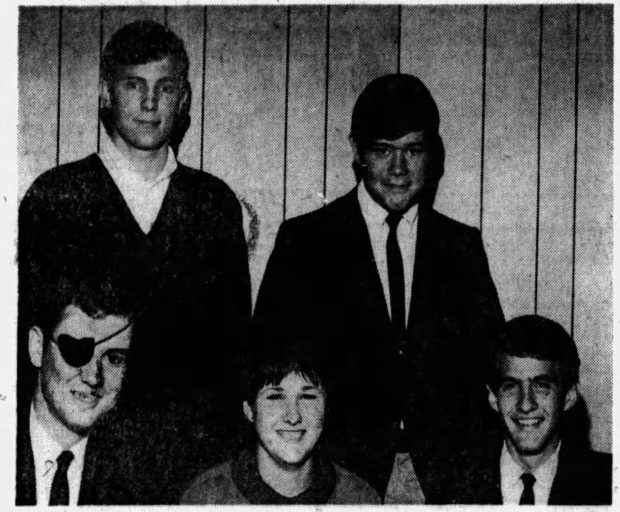 Valencia Junior College’s first student government officials meet in this November 1967 photo. They are, (seated, from left) Joseph Sanderlin, vice president; Kay Cory, corresponding secretary; Blakely Mason, president; (standing from left) Anthony Bidwell, treasurer and Tim McLaughlin, recording secretary. (Sentinel file)
Orange County’s first public junior college was slow aborning; it had been a gleam in the State Department of Education’s eye since 1961 when the legislature authorized it.
But once the Orange County School Board became aware of the pressing need for a new junior college, organized it in February and Craig was named president March 15, all systems were go.
State junior college administrators outlined a stringent series of deadlines the school would have to meet in order to open by this fall, and they met them.
Craig had to have his key staff lined up by May 1, some 5,000 library books ordered by July 1, not to mention getting a faculty for 500 students, designing a curriculum, selecting and ordering texts, even down to designing application forms, catalogs, etc.
Amid all this, he managed to have his faculty of 31 lined up by May 1.
Through all this Orange County School Supt. James Higginbotham and his staff provided back-up power, from applications to portable classrooms. And the Orange County School Board allayed the fears of Craig and finance dean Ralph Richard when junior college financing battles were raging in Tallahassee by committing itself to a share of VJC’s budget.
And the VJC staff seems to thrive on the hectic pace, for all agree, “It’s exciting to be in on the beginning of a college.”
Craig stresses repeatedly that the next two years will establish Valencia’s traditions and his faculty is excited about helping establish that tradition.
Registrar James Kellerman, Dr. James Gollattscheck, dean of instruction and Roy Kinnick, dean of students, all chorus that Valencia Junior College may be getting off to the fastest start of any so far, but it’s getting off to the best.
Other junior colleges have started with classes in old barracks, they point out, not brand new classrooms.
Other junior colleges faculties have found themselves in the lunchrooms of old public schools in one big “office.” VJC faculty has been provided pleasant, wood paneled offices in the former Mid-Florida Tech administration building. Excellent laboratory facilities will be shared with Mid-Florida Tech, as well as some business education classrooms. Every hurdle has been met and overcome, if at the last minute, and grandly.
Craig just grins and says that for years to come “There’ll never be a time when we aren’t running behind, there’ll always be limitations either in program or facilities,” he says, because of the enormous growth rate predicted for the school.
Craig plans to triple enrollment in VJC’s second year.
But as well as “running behind,: VJC officials are obviously having to run ahead of themselves, too.
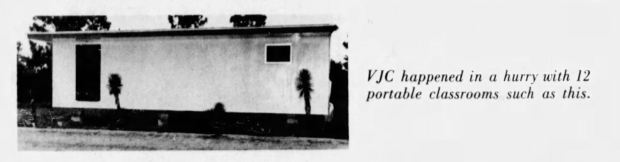 Valencia Junior College portable classroom is shown in this 1967 photo. (Sentinel file)
Groundwork for master planning for what may become a three-campus institution is being laid. Initial site purchase is still in the air while the State Department of Education mulls the feasibility of 16 sites. Then there will be the architect’s plans, and myriad of other details to catch up on.
Ultimately, Valencia Junior College will live up to its “community college” description completely by virtually offering something for everyone, Craig predicts.
Not only will it offer an academic program for those bound for bachelor degrees and more, but also it will offer occupational courses and continuing education for adults.
But one thing at a time. And first things first. That’s why the first year’s enrollment is limited to freshmen.