
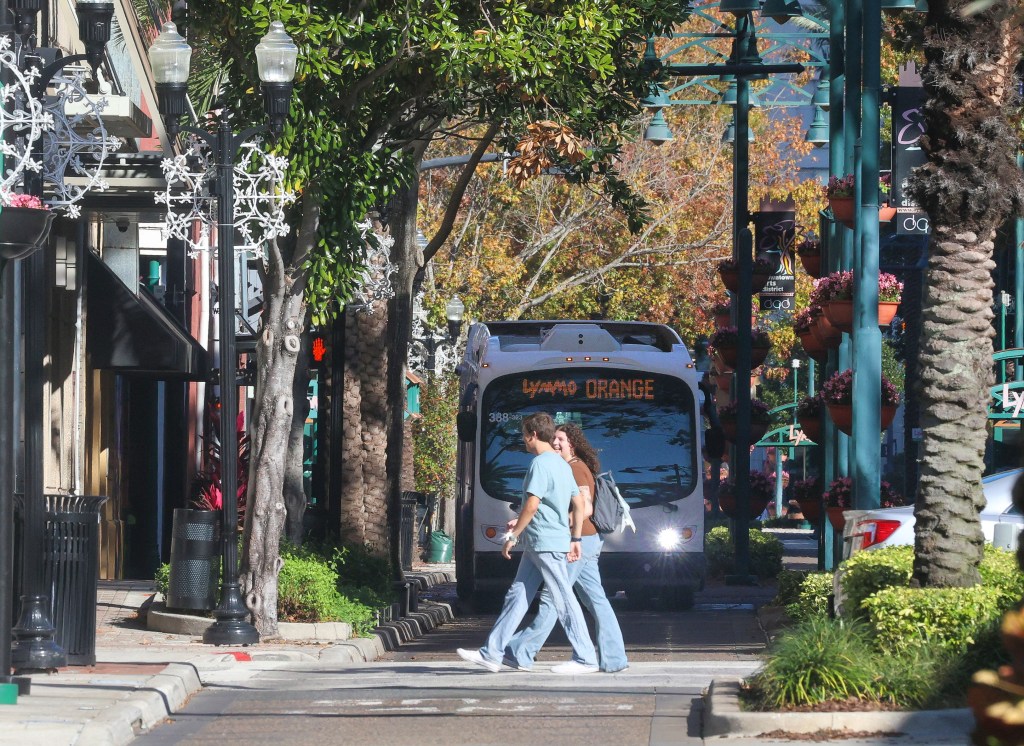
This year is expected to bring a $55 million slate of construction to downtown Orlando, including an overhaul of a street the mayor once declared had “no soul,” a signature entrance to Lake Eola Park, a new era for Church Street and a long-awaited park beneath Interstate 4 that has been a decade in the making.
The projects are designed to reshape the downtown with more park space, better transportation and a more interesting experience for people on the ground.
“Our plan is a plan for a walkable city,” said David Barilla, the executive director of the Downtown Development Board.
Barilla previewed the projects at a pair of public meetings last week, which drew a mix of business owners, downtown-area residents and workers.
And in just a few weeks, he said to expect shovels in the ground on Magnolia Avenue.
That one-way street is now lightly used along a stretch that essentially connects the Dr. Phillips Center for the Performing Arts to the Orange County Courthouse. It has a designated bus lane and a bike lane, but gets little traffic much of the day.
In a 2024 speech, Mayor Buddy Dyer contended Magnolia has “no identity and no soul” but said the new Magnolia could one day be the city’s Magnificent Mile, akin to Chicago’s premier shopping district.
Crews will begin working by early February on the south end of the road, tackling two-block increments moving north to create a street for two-way traffic. The new Magnolia will be a needed artery to help vehicles move through the area when, early next year, similar work begins on much busier Orange and Rosalind avenues, Barilla said.
The initial work on Magnolia is considered to be an interim upgrade that will remove the designated bus lane and medians, add on-street parking, and create a two-way street. Renderings show wider sidewalks along a tree-lined, shaded throughway with a dog park. Ultimately, the popular Lake Eola Farmer’s Market could relocate to a portion of the street to help bring throngs of people, which would also benefit businesses there as city leaders have tried for years to bolster retail offerings.
Mark Line, who lives in a neighborhood just south of downtown, said he was excited to see the work underway throughout the area.
“Particularly, I think it’s great because we’re going to see action this quarter,” he said.
Next up, in April crews are expected to begin transforming a dormant strip of Church Street, once the city’s party hub, into a festival street designed for pedestrians and hosting events.
The focus is from Garland Avenue to the train tracks. The work will remove the curbs to connect the 11-foot-wide driving lanes with the walkway and add better lighting and landscaping.
Unlike the sleepy Church Street of today, Barilla said he hopes the new design sparks people to return again.
“Hopefully you see an area … that you can start to see yourself,” Barilla said.
Just west of Church Street, this summer city crews are expected to begin “The Canopy”, the $30 million pedestrian and digital-art focused park planned beneath I-4.
In discussions for more than a decade, the plan spans about three city blocks, and Barilla said it will have the nation’s largest digital mapping and projection system. With such technology, the lighting and art could reflect a new theme at the push of a button, celebrating the nearby Orlando Magic or an upcoming holiday.
The Canopy will feature wide pedestrian paths, funky metallic trees and other amenities, with the highway providing shade.
The park’s planning has been controversial as the final design came to fruition.
Early drawings showed no parking spaces to serve athletic fields, a skate park and other community amenities, but later designs came to include 500 parking spaces. That irked some who thought the city was sacrificing park space for cars.
But before the multi-billion-dollar overhaul of the highway, the city had 900 parking spaces in the space under the hulking highway, and some worried eliminating all parking under I-4 would drive away visitors.
The eventual park – expected to take roughly two years to build – will join the mixed-use entertainment district called WestCourt planned just north of the Kia Center and Church Street as a shot-in-the-arm for that portion of the city.
“It’s really looked at to bridge that experience from all the development we’ll have with WestCourt in front of the Kia Center … and then the activity we’re starting on Church Street to really enhance that experience for the pedestrian,” Barilla said.
Toward the end of the year and into 2027, crews are expected to begin turning dirt on a pair of properties purchased two years ago as future park space. One, at 30 S. Orange Ave. is expected to be a small park on what is now a vacant lot, with trees, a shade structure and a water feature. The vision is for it to have a food truck, and places to sit day and night.
At another site, at the corner of Central Boulevard and Rosalind Avenue, the city aims to build a signature entrance into Lake Eola Park, as a means of better connecting the park to the Central Business District to its west.
This year the city-owned City Centre building at 215 E. Central Boulevard will be torn down to make way for the new entryway, which will include a plaza with a shade structure and a direct view of the famous fountain at the center of the lake.
While Jeff Thompson, who lives in Lake Eola Heights, is excited about the city’s plans for downtown, at one of the community meetings he urged Barilla to preserve the Lubbe House which stands next to the building the city intends to demolish.
The two-story Lubbe House was built in 1927 on the southwest corner of the park.
Barilla said the city was evaluating the house before determining its plans.
Thompson said the city should preserve its history, envisioning a use like Central Park’s Tavern on the Green in New York.
“I think it’s all moving in the right direction, I just hope they do it with sensitivity to the culture of Orlando,” he said. “There’s no better way of placemaking than celebrating your surviving architectural gems.”