
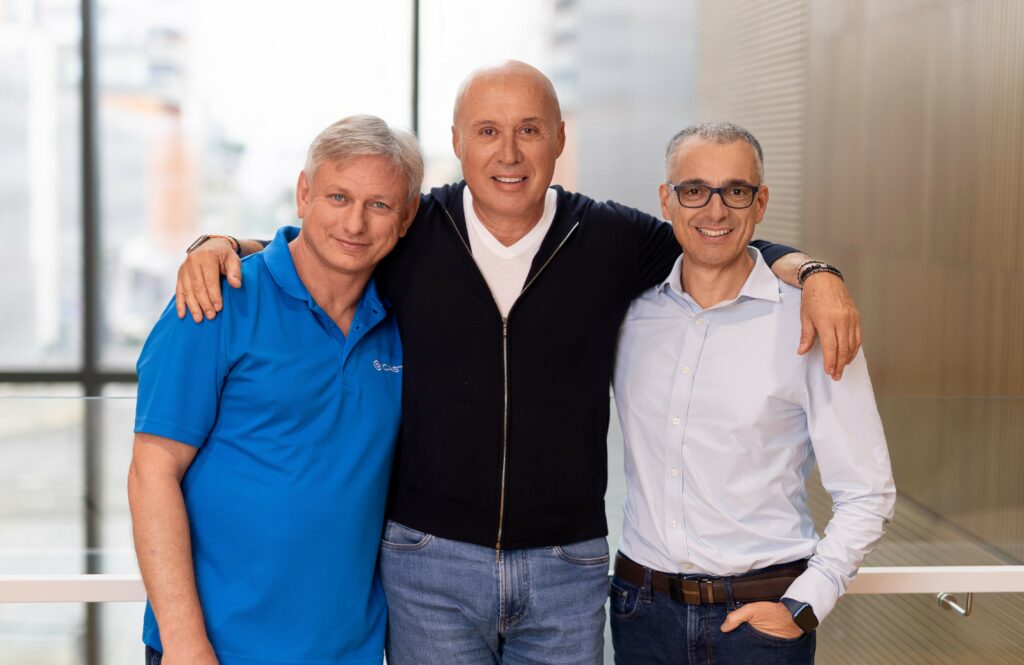
When Refresh Miami first wrote about Cast AI in 2020, the company had about 25 employees and a clear but modest mission: help engineering teams waste less money in the cloud. Today, Cast AI has more than 350 employees, a valuation north of $1 billion, and a new product that takes aim at one of AI’s biggest headaches.
That headache is GPUs.
“GPUs are essential for AI workloads,” said Laurent Gil, the company’s president and co-founder, speaking with Refresh Miami last week. “They’re very expensive, and they’re very hard to find,” he said.
Enterprises often discover that the GPUs they need simply are not available where their applications are running. A company might be operating in Paris on AWS, only to learn there are no GPUs available in that region. Moving production systems to another region or cloud provider is often the only option, and for large organizations, that is a painful, risky move.
“This actually prevents the use of AI workloads in production,” Gil asserted. “It’s a serious issue.”
Cast AI’s solution is OMNI Compute, a unified compute marketplace the company officially announced this week. Instead of forcing teams to move applications to wherever GPUs happen to exist, OMNI Compute finds available GPU capacity across clouds and regions and makes it usable without requiring any code changes or redeployments.
“My agent is able to find those GPUs in a different cloud provider and make them appear as if they are in yours,” Gil said. “The application keeps running where it is.”
That ability to deal with GPU scarcity, quickly and at scale, is what pushed Cast AI into unicorn territory. Alongside the OMNI Compute launch, the company announced a valuation exceeding $1 billion following a strategic investment from Pacific Alliance Ventures, the U.S.-based venture arm of Shinsegae Group, a South Korean conglomerate with more than $50 billion in annual revenue.
Demand has come fast. “I’m closing the biggest deals we’ve ever done for a product that’s only a month old,” Gil said.
Asia has been a major part of that momentum. Samsung became an early customer, helping validate the technology with other large enterprises watching closely. On the supply side, Oracle is the first major cloud provider making excess GPU capacity available through OMNI Compute, reflecting its growing role in large-scale AI infrastructure tied to companies like OpenAI.
The funding round itself reflects that ecosystem. Cast AI’s Series C was led by G2 Venture Partners and SoftBank Vision Fund 2, bringing total capital raised to more than $180 million. Gil said choosing investors who understood the GPU market was a deliberate move.
While the company operates globally, the entire executive team is now based in Miami. For Gil, Miami’s position on the East Coast, airport connectivity, and reliability make it a strong base for running a global business.
As Cast AI expands across Asia, Europe, and the U.S., Gil said the company feels like it has entered a new phase. “When you hit real product-market fit, you know it,” he said.
Unicorn status, he added, is already behind them. What comes next depends on whether Cast AI can keep making scarce GPUs show up exactly where AI teams need them.
Pictured above: Cast AI co-founders, left to right: Leon Kuperman, CTO, Yuri Frayman, CEO, and Laurent Gil, President.
READ MORE IN REFRESH MIAMI:

I am a Miami-based technology researcher and writer with a passion for sharing stories about the South Florida tech ecosystem. I particularly enjoy learning about GovTech startups, cutting-edge applications of artificial intelligence, and innovators that leverage technology to transform society for the better. Always open for pitches via Twitter @rileywk or www.RileyKaminer.com.
Latest posts by Riley Kaminer (see all)