
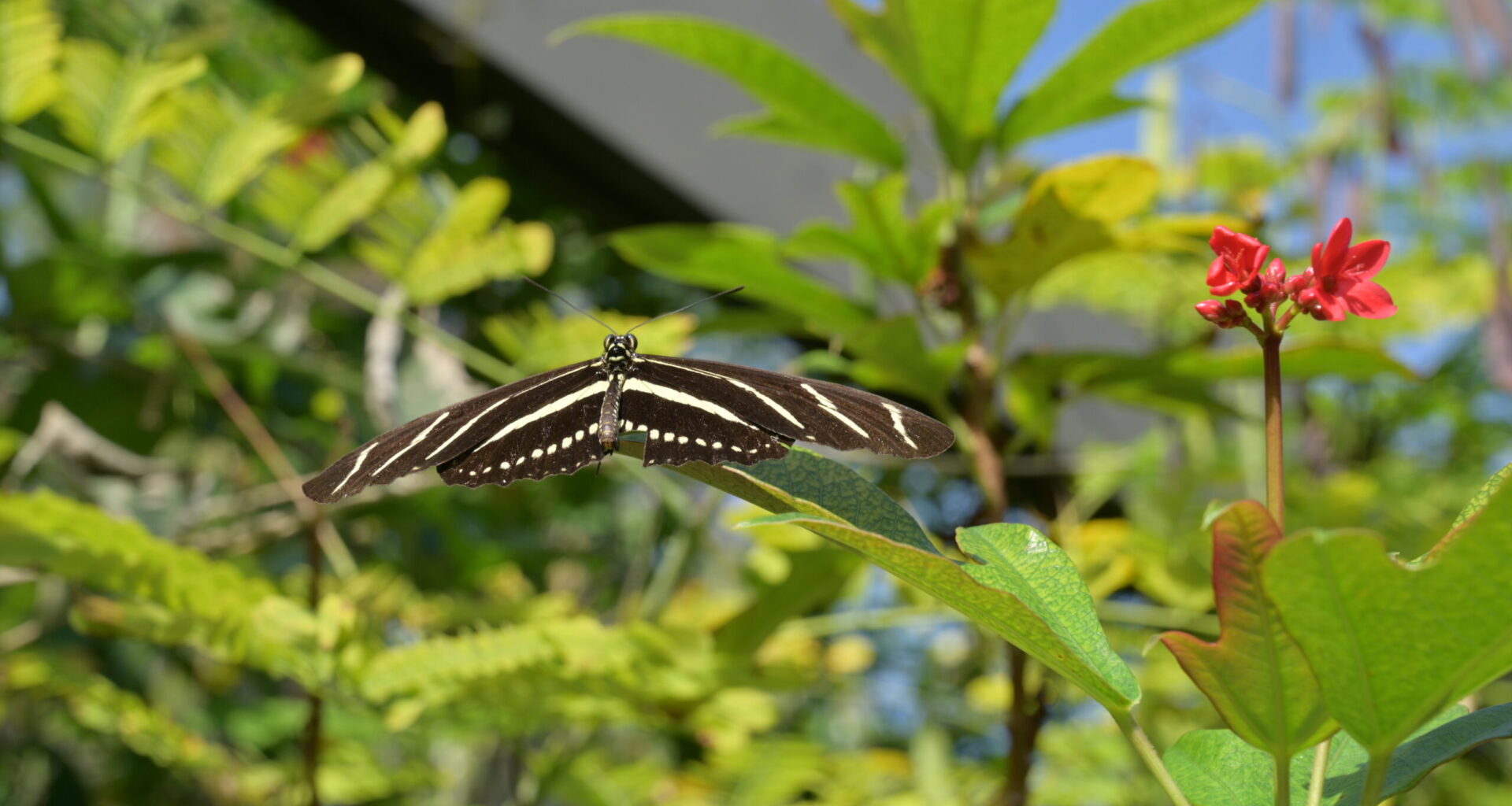
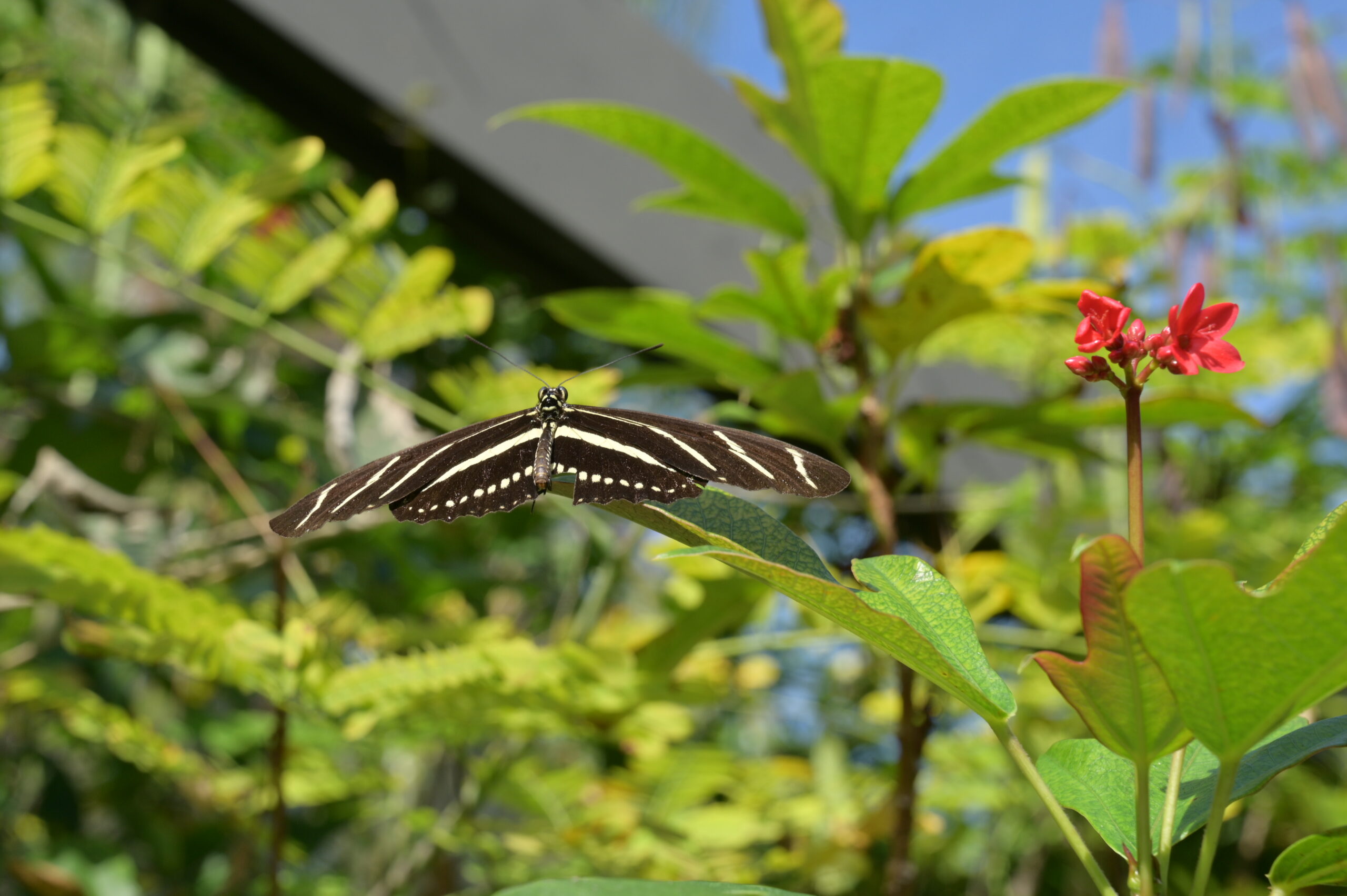
Florida’s state butterfly, the Zebra Long Wing, rests on a nectar producing plant inside of the Tom Allen Memorial Butterfly House at Rotary Park. -CASEY BRADLEY GENT / FLORIDA WEEKLY
For a story that began about migratory butterflies, this piece has undergone a significant metamorphosis. Southwest Florida, it turns out, is an ideal environment for butterflies. Our warm temperatures, rainfall and host plants are so ideal that the local species of brilliant orange and black Monarch butterflies do not even carry the migratory gene.
Our Southwest Florida Monarchs are happy right here! Multiple butterfly species – those who make Fort Myers, Sanibel, Cape Coral and Naples home – never actually leave this area during their roughly two to six-week lifespan. Throughout the area, there are a handful of lush gardens and parks where local butterflies gather. The Tom Allen Memorial Butterfly House – found at 5505 Rose Garden Road, Rotary Park in Cape Coral – is one local sanctuary brimming with butterflies and butterfly experts. Deb Spangler, who volunteers weekly at both the Tom Allen Butterfly House and Butterfly Sanctuary at the Charlotte Harbor Environmental Center in Punta Gorda, began honing her butterfly knowledge 11 years ago. Today, she is an expert.
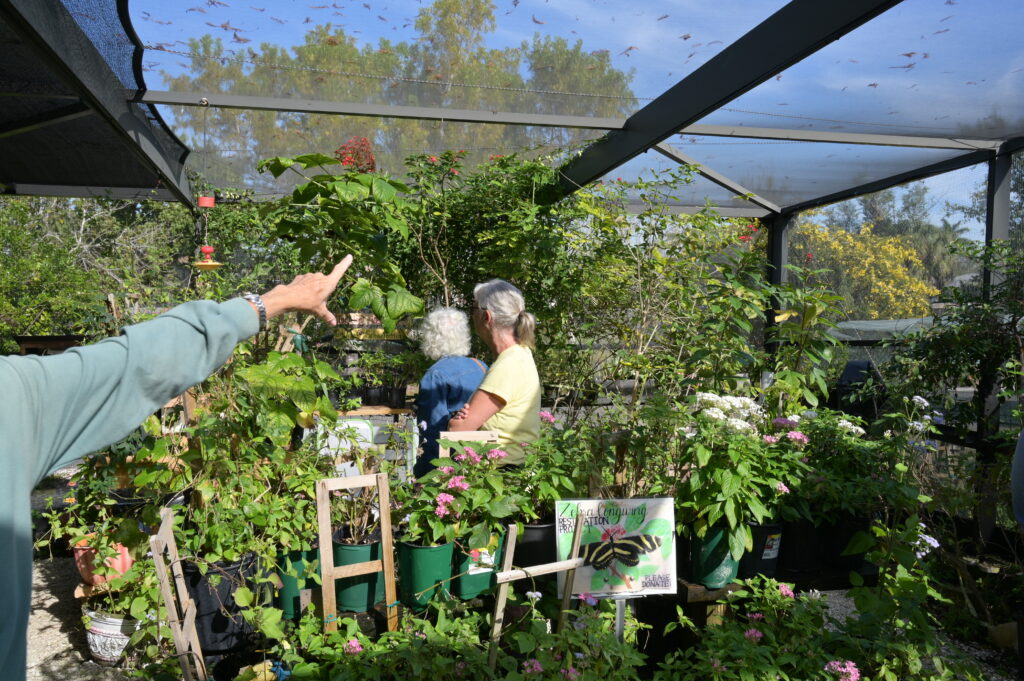
Inside of the Tom Allen Memorial Butterfly House, butterflies roost on the wire screen and drink from nectar filled plants. Visitors are pictured observing several species of native butterflies. -CASEY BRADLEY GENT / FLORIDA WEEKLY
Inside of the Tom Allen Memorial Butterfly House, the sun streams through protective screens. The morning chill is replaced by sunshine, and the resident mascot – a 25-year-old red-footed tortoise called Captain Red Foot – is carried by volunteer Debbie Cerrito to the lawn for a morning walk. While volunteer Debbie Cerrito manages The Captain, gently scratching his shell and smiling as he tilts his face to the sun, four other volunteers begin checking the undersides of varying species of leaves for tiny eggs. “Look right here,” Spangler directs.
She has spotted tiny lime green dots – specs the size of a single pepper flake – underneath a milkwood leaf. On an adjoining stem, she points out a caterpillar. Within three minutes, Spangler identifies eggs, caterpillars, five chrysalises and a brand-new butterfly! Butterflies in all stages of their metamorphosis can be found in the butterfly house. Spangler is quick to point out that butterflies will only thrive when the right vegetation is in place. Her first butterfly garden, planted more than a decade ago in memory of her mother, was a flop.
“There is a saying: Right plant. Right place,” Spangler said. “In my first butterfly garden, I planted loads of hibiscus. Well, butterflies won’t come near hibiscus. What I have learned from volunteering is that butterfly gardening in Southwest Florida requires both host plants and nectar plants.”
Cape Coral Friends of Wildlife created a list of host plants and nectar plants. The Tom Allen Memorial Butterfly House volunteers hand out copies of the list to visitors.
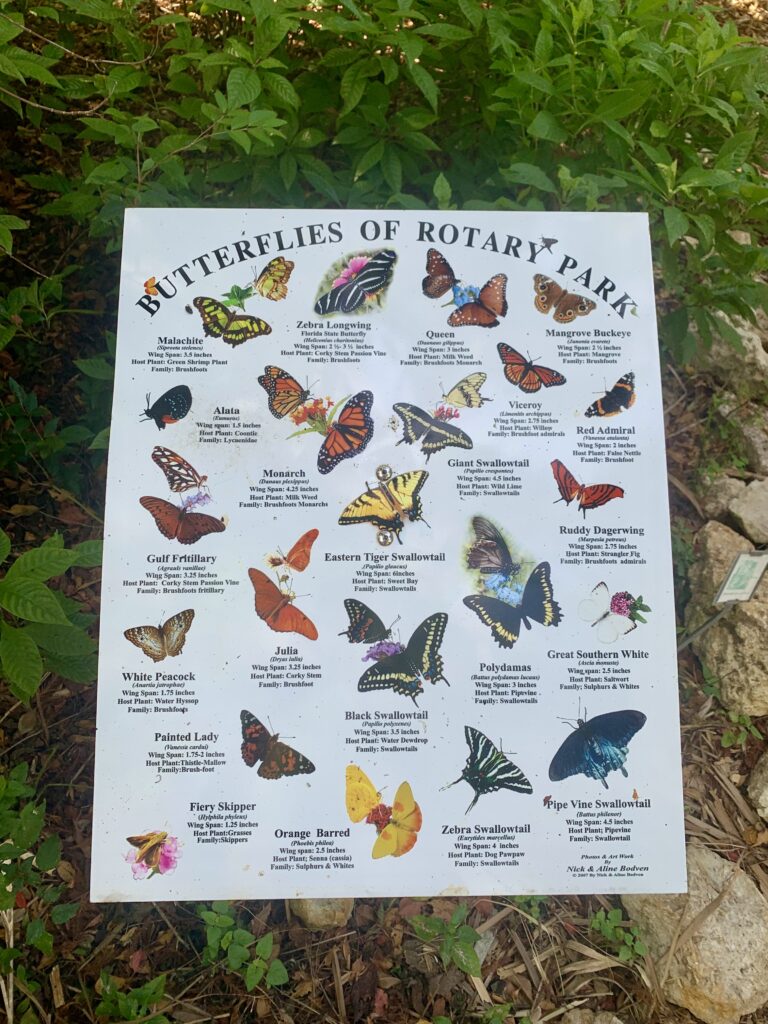
Parks throughout Southwest Florida provide signs like this one, which offers detailed drawings of native butterflies visitors are likely to spot in area butterfly gardens. -CASEY BRADLEY GENT / FLORIDA WEEKLY
“We also use the list as a sort of encyclopedia,” Lori Haus explained. She is another loyal volunteer who eagerly pointed out a spent chrysalis. A spent chrysalis is the shell-like proof of life for a butterfly. Within an inch of the empty chrysalis -. hanging right before the eyes of gathering volunteers, appeared a Malachite butterfly. Spangler immediately named the species with identifying brown tipped, mint-colored wings; wings so new, the butterfly had yet to stretch them out and fly.
Specific butterfly species are particular about the host plants they choose for depositing their eggs. Florida’s state butterfly, the Zebra Longwing, was decimated following Hurricane Ian. Today, because of efforts from volunteers, the Tom Allen Memorial House is once again aflutter with these black butterflies sporting symmetrical white stripes.
Haus pointed out multiple stems of Maypop and Corky Stem Passionvine, host plants chosen by the Zebra Longwings to lay their eggs. The availability of host plants is crucial to the first stage in the life cycle of a butterfly. After the butterfly lays her first eggs, it takes about ten days for the eggs to hatch. Stage two is the caterpillar stage. Spangler explained, “The caterpillar eats leaves from the host plant for another ten days. Stage 3 involves the caterpillar spinning into a chrysalis. The chrysalis hangs for roughly 10 more days. If it’s cold, the chrysalis stays in this phase longer.”
When the butterfly emerges from the chrysalis, the cycle is complete. Nectar plants are critical to the life of a brand-new butterfly.
Southwest Florida has an abundance of native nectar plants. Jacquemonia – a red flowering plant – and Scarlet Milkweed flourish at Rotary Park. Cheryl Anderson, wearing a butterfly baseball cap and a butterfly embroidered shirt, is the most veteran volunteer. She has been honing her knowledge of butterflies in and around the Cape for 15 years. As she shares butterfly facts, Anderson wanders around the park following Captain Red Leg. On Mondays, Fridays and Saturdays at 10:30 a.m., Anderson, Spangler, and Haus offer free guided tours inside the Tom Allen Memorial Butterfly House. Additionally, plenty of native butterflies may be observed seeking nectar outside of the house.
Spangler was an advisor for the newer sanctuary in Punta Gorda. “I had two requirements for the sanctuary at the Charlotte Harbor Environmental Center. One, I designed it with ADA-compliant walkways for people with disabilities. Two, I designed it with raised flower beds, because my volunteer knees are getting too old for ground-level gardening,” Spangler said. Each of the volunteers is retired. Age does not deter them from gaining the latest information applicable to their passion for promoting butterflies.
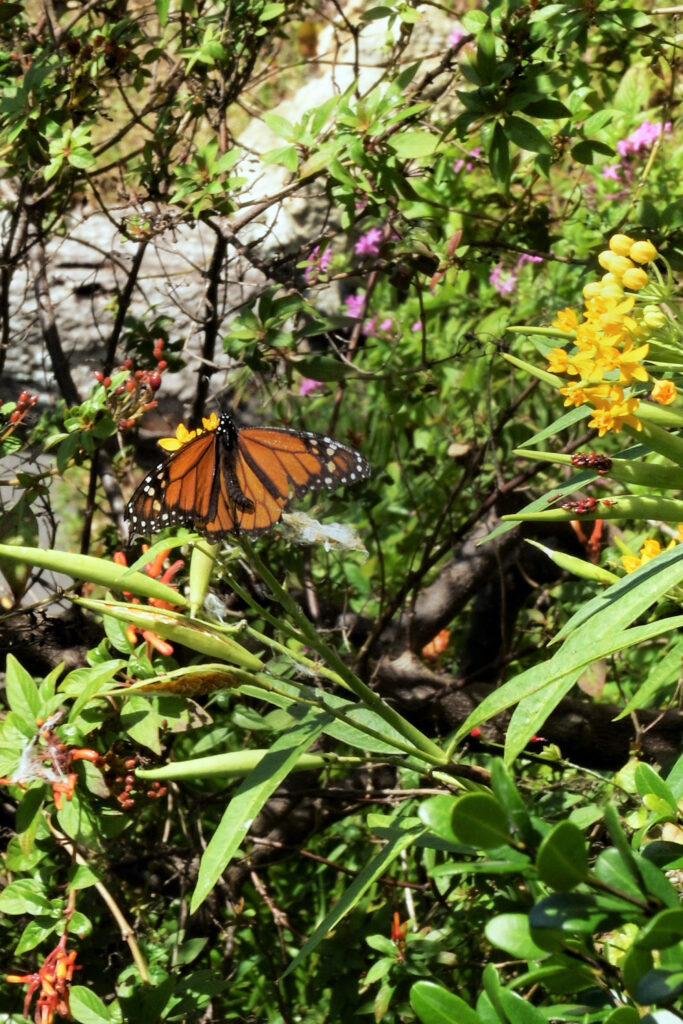
Rotary park provides an excellent habitat for Monarch butterflies, like the one pictured. -CASEY BRADLEY GENT / FLORIDA WEEKLY
“We’re learning more about butterflies almost every day,” Anderson said, excitedly. “I never really thought Southwest Florida was on a migratory path. But scientists recently tracked four Monarchs from Ontario, Canada, and they stopped here on their way to Mexico. Nobody thought this was happening. It’s amazing!”
To be clear, migratory Monarchs carry a gene that the local Monarchs do not carry. The rule of thumb is that Monarchs south of Lake Okeechobee do not migrate. These tiny creatures embody big information. Butterflies are either male or female. Spangler pointed out a male Monarch outside of the butterfly house, noting specific black dots on his hind wings. She said the male butterflies are also more vibrant than the females. “However, each species of butterfly has unique traits. When I arrive in the mornings, and the sun isn’t out, the Zebra Longwing butterflies are resting in groups,” Spangler added. She said Florida’s state butterfly is unique because the Zebra Longwings roost like chickens. “They do better as a congregation,” she shared.
Both Spangler and Anderson agreed that 2025 has been unique for the resident butterflies. “It is unusual for malachite butterflies to hatch in December,” Spangler pointed out, “Several are floating through the butterfly house now, warming themselves in the sunlight, and others are hanging as chrysalises.” Among the species being spotted locally this Christmas season are Zebra Longwings, Monarchs, Gulf Fritillaries and Malachites. Spangler thinks the winter butterflies have to do with Florida’s hurricane-free fall and winter. Butterfly diagrams are posted throughout Fort Myers and Cape Coral public parks. Regardless of the season, you are likely to spot several butterflies during the sunniest hours of the day.