
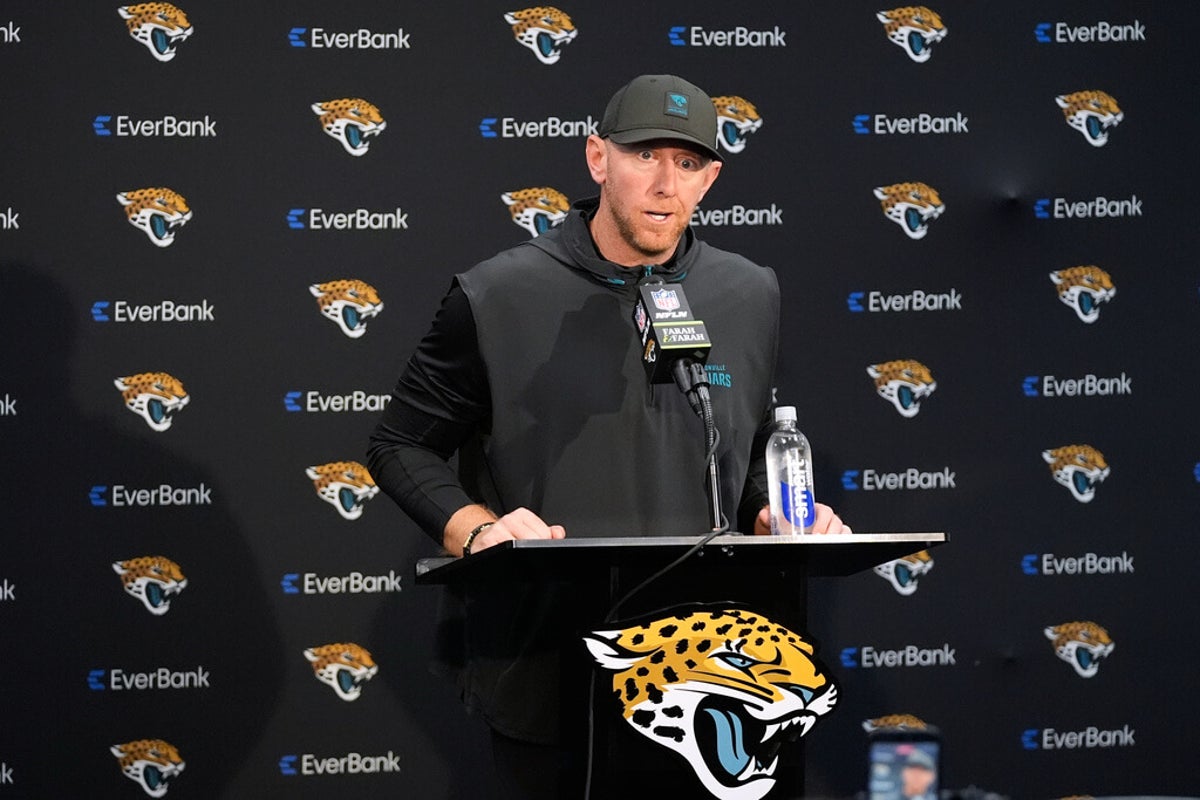
The Jacksonville Jaguars lost a close wild-card playoff game at home Sunday to the Buffalo Bills, shattering their Super Bowl dreams. But an unexpected moment in the postgame news conference made headlines and inspired a deluge of social media posts, when a reporter from the Jacksonville Free Press, a Black weekly, offered words of encouragement to head coach Liam Coen instead of asking a question.
Lynn Jones, who has worked as a reporter for more than three decades, spoke Monday with The Athletic to explain why she used her time with the microphone to support Coen. The 23 seconds Jones spent speaking sparked backlash from journalists over what is considered appropriate in postgame news conferences, igniting an online debate about journalistic ethics amid limited access to sports figures.
“I just want to tell you, congratulations on your success, young man,” Jones said to Coen. “You hold your head up, all right? You guys have had a most magnificent season. You did a great job out there today. You just hold your head up, OK? Ladies and gentlemen, Duval, you the one. Keep it going, we got another season, OK? Take care, and much continued success to you and the entire team.”
Coen answered, “Thank you, ma’am.”
Some reporters objected to praise of the exchange, explaining that it’s a journalist’s job to gather and disseminate information, not to become emotionally invested with the people they cover. Others found it heartwarming and a sign that sports reporters take their roles too seriously.
Nothing “awesome” about fans/fake media doing stuff like that. It should be embarrassing for the people who credentialed her and her organization, and it’s a waste of time for those of us actually working. https://t.co/sP2vAEJYj4
— Mark Long (@APMarkLong) January 11, 2026
On Tuesday, the National Association of Black Journalists responded to criticisms of Jones.
“For nearly 200 years, the Black Press has been central to American journalism, documenting history, challenging power, and serving communities long excluded from mainstream coverage,” NABJ president Errin Haines said in a statement to The Athletic. “Journalists from that tradition bring deep institutional knowledge, community trust, and decades of professional rigor. Debate strengthens journalism. Disparagement does not. Dismissing that work as ‘fake’ or unprofessional is not a defense of standards — it is an act of erasure that reinforces inequity within our industry.”
Jones said she had not initially planned to attend the news conference but changed her mind when she was encouraged to go as she was leaving the stadium.
What was going through your mind in that moment right after the Jaguars’ loss that led you to speak as you did?
There are no protocols for a press conference. We do not receive any type of information saying, ‘Hey, you can’t say this, you can’t say that.’ Because I noticed that’s what the controversy is right now. The fact that they’re saying, ‘She motivated him.’ … I’m going to talk minorities. I mean, I’m the only person of color, I’m a senior reporter. I’ve been doing this for more than 30 years. There’s not many women on the front line when it comes to sports in these type of atmospheres. It’s more now. So when I was given the mic, it just came out. It just came out, the encouragement. This man here was carrying the weight of this city, his team, his family, the players.
As someone who lives in Jacksonville and covers the Jaguars, do you feel that supporting the local team comes naturally to you? Was that moment more about showing empathy?
Definitely, I was employed (with the Free Press) under Tom Coughlin. I was with the (team in its) first season (in 1995). My heart is in this town. I’ve been here a long time. I’m Detroit-made, but definitely the spirit — you can’t be always in a tear-down mode. So in our city, we wanted this championship, and it had nothing to do with race. I mean, all of us was together and when we won together, we lost together. So this loss was for the city, it was for everybody. And I think that’s why it’s going viral, because people are a little upset because they didn’t win.
How have the reactions — both criticism and praise — affected the way you feel about your decision to speak that way? Some reporters argue that time in those settings is limited and should be used to address sports-related questions rather than personal opinions. Will this change how you approach news conferences moving forward?
No, I’m not getting ready to get into no rules and regulations and what you can and cannot say and cannot do. We have enough of this going on already. We’re in communications, we’re in a field. … There’s nothing wrong with expressing how you feel and being emotionally invested.
On social media, your message has clearly resonated with the community. What does this mean to you?
Well, as an African American newspaper that’s been around since 1986, and we’re one of the more than 230 African American newspapers (that) are still printed in this country. The bottom line is keep your head up all the way around. I don’t care what you do, keep your head up. You’re going to go through problems, situations in your career, but you have to keep your head up. Regardless, this was not just for Liam. This was for all of us. This was for even us as a nation to keep our heads up.
Have you had any personal interaction with Coach Coen, or is your impression of him mostly from afar? Some might wonder if that’s why you didn’t ask him any questions.
I’ve seen Coach, but we’ve never (interacted); the intricacies of the NFL (are) totally different now. Thirty years ago, our players would come into communities, now they don’t come into communities like that. You have to make an appointment. … It just was compassion; let this man know this is going to be OK. We take this sport so seriously. … Why do I need to ask a question of what happened on the field? Party’s over, the season is over.
Looking back at that moment, what’s the one message you would want both your supporters and critics to take away about the gesture you made?
It was a defining motivational moment, and it was a moment that resonated throughout the city. … We have calls from all around the world. I’m understanding what it means to go viral, OK? And we are a small market, but we have big hearts. The message is stay focused, get in the game. … Because it just happened to me. I didn’t prepare anything, a speech or anything like that. I hadn’t even said in my mind, ‘I’m going to tell him, I’m going to say, you need to know.’ It just happened.