
By Sarah Sell, University Communications and Marketing
Most people never see the quiet cleanup crew beneath Central Florida’s sandy soils,
but USF graduate student Anne Sawl is working to change that. Through her research,
she is shining a spotlight on a leggy creature found nowhere else in the world.
Sawl studies the rare Florida scrub millipede (Floridobolus penneri), which resides along the Lake Wales Ridge. Like other arthropods, the Florida scrub
millipede has an exoskeleton, a segmented body and more than 100 legs. One of the
largest in North America, it can grow up to 4 inches long and spends most of its life
underground, emerging at night to move through Florida’s dry, sandy terrain.
The millipede plays an important role in the state’s scrub ecosystem.
“They are crucial to nutrient recycling,” Sawl said. “By feeding on dead leaves and
plant material, they digest it and excrete nutrients that fertilize the soil and support
plant growth in these otherwise nutrient-poor sands.”
As part of USF’s conservation biology master’s program, Sawl’s research has taken
her on overnight trips to the Lake Wales Ridge, where she carefully excavates living
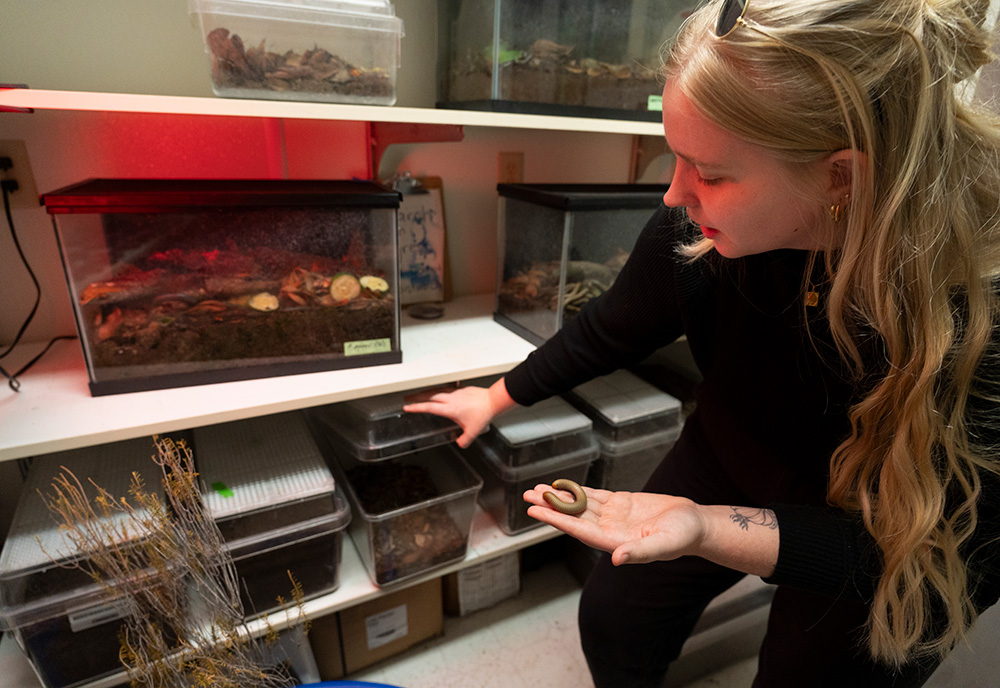
specimens. Several of the millipedes are now housed in a lab on the St. Petersburg
campus.
Recently in the lab, she came across an unexpected discovery: baby millipedes hatched
in captivity.
“One day, I was moving dirt near the roots of the plant and noticed a tiny white speck,”
Sawl said. “It caught my eye. I picked it up and realized it was a baby millipede.
After so much trial and error in the lab, I was completely flabbergasted that they
had reproduced.”
Getting the millipedes to reproduce was not easy. Sawl experimented with different
groupings, but nothing worked. Success finally came when she moved the millipedes
into a kiddie pool filled with native plants collected from the ridge.
That breakthrough marked a welcomed surprise for a species that scientists know little
about. The Florida scrub millipede is endemic and considered imperiled due to extensive
habitat loss. Sawl discovered they had not been comprehensively surveyed in nearly
two decades. By documenting where the millipedes still exist and how many remain,
Sawl’s research is filling a critical knowledge gap and could lay the groundwork for
future conservation efforts.
Florida has a millipede found nowhere else in the world. That alone makes it worth
studying and saving.
Deby Cassill, associate professor of Integrative Biology at USF
Sawl’s work examines the abundance and distribution of the Florida scrub millipede.
She compares it with a more widespread species, the smoky oak millipede (Narceus gordanus), which ranges as far north as the Carolinas. The two species live side by side in
central Florida’s dry, infertile, quartz-rich sands.
Millions of years ago, fluctuating sea levels transformed Florida’s ridges into isolated,
island-like systems. Species stranded on these ridges evolved independently, resulting
in today’s high concentration of rare and endemic life in this region.
The Lake Wales Ridge, the oldest and highest of these systems, is now among the most
heavily altered by development. Since pre-settlement times, Sawl said an estimated
85 percent of the ridge’s natural habitat has been lost to agriculture, housing and
roads.
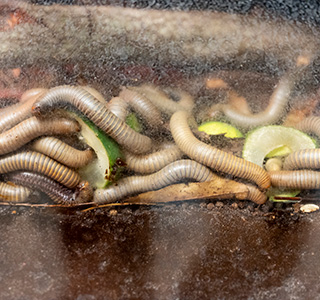
Florida scrub millipedes feed on cucumber slices inside the lab habitat on campus.
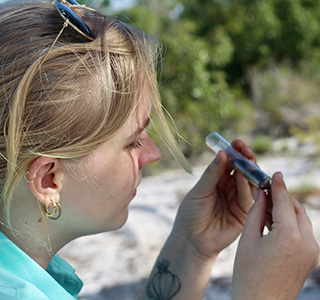
Sawl, with help from USF undergraduate students, collected the rare millipedes from
the Lake Wales Ridge.
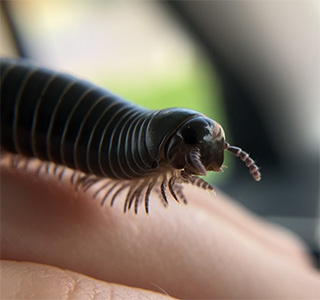
One of the millipedes collected in Central Florida. The legs help push through dense
soil as they burrow underground.
Sawl’s fieldwork spans both preserved and developed sites along the ridge. Preliminary
findings indicate that the more widespread smoky oak millipede occurs in higher numbers
at each site. In contrast, the Florida scrub millipede remains more restricted, persisting
in mostly developed areas. Sawl also found that both species share a mite previously
thought to be host-specific, and that the millipedes favor fungi and mushrooms over
some plant material scientists once expected.
Sawl’s adviser and mentor, Deby Cassill, praised her work.
“Anne has taken a group of animals most people overlook and produced multiple chapters
of publishable research with brand new information,” Cassill said. “Millipedes might
not be glamorous, but they are ecological champions in these fragile habitats.”
The appearance of baby millipedes in the lab has opened an exciting avenue for future
research. Cassill is already applying for grants to support Sawl after she receives
her master’s degree this spring, allowing her to continue her work at USF at the doctoral
level.