
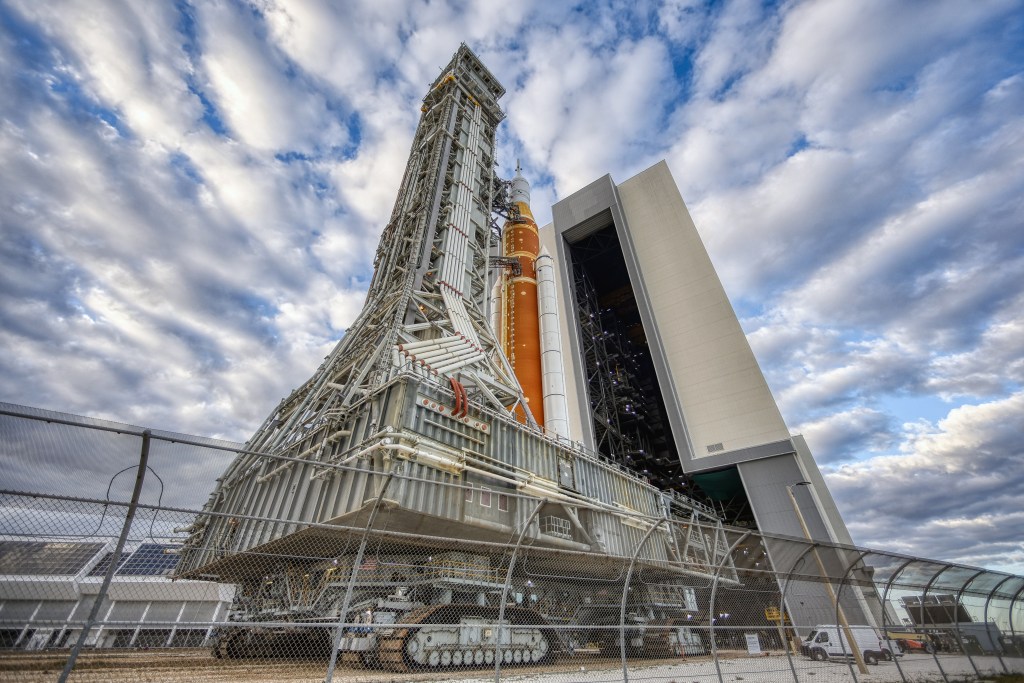
KENNEDY SPACE CENTER — Humanity’s return to the moon began Saturday morning before dawn — at less than 1 mph.
That was the top speed NASA’s rocket for the Artemis II mission hit during its ride atop the massive crawler that inched out of KSC’s Vehicle Assembly Building on its way Launch Pad 39-B.
It was a 4-mile trip mission managers hope will lead to 600,000 more on a voyage past the moon, a destination crewed missions have not ventured in more than half a century.
“This vehicle, along with about 8.8 million pounds of thrust, is going to accelerate the Artemis II crew here to near Earth-escape velocity,” said NASA Administrator Jared Isaacman, speaking alongside the four crew members for the Orion spacecraft. “So just under 25,000 mph, farther into space than we’ve ever sent humans before, around the moon, back here safely to Earth.”
The Space Launch System rocket has flown once before, in the Artemis I mission back in 2022, and remains the most powerful rocket ever to put something into orbit. The Orion spacecraft, named Integrity, will be flying with crew for the first time: NASA astronauts Reid Wiseman, Victor Glover and Christina Koch along with Canadian Space Agency astronaut Jeremy Hansen.
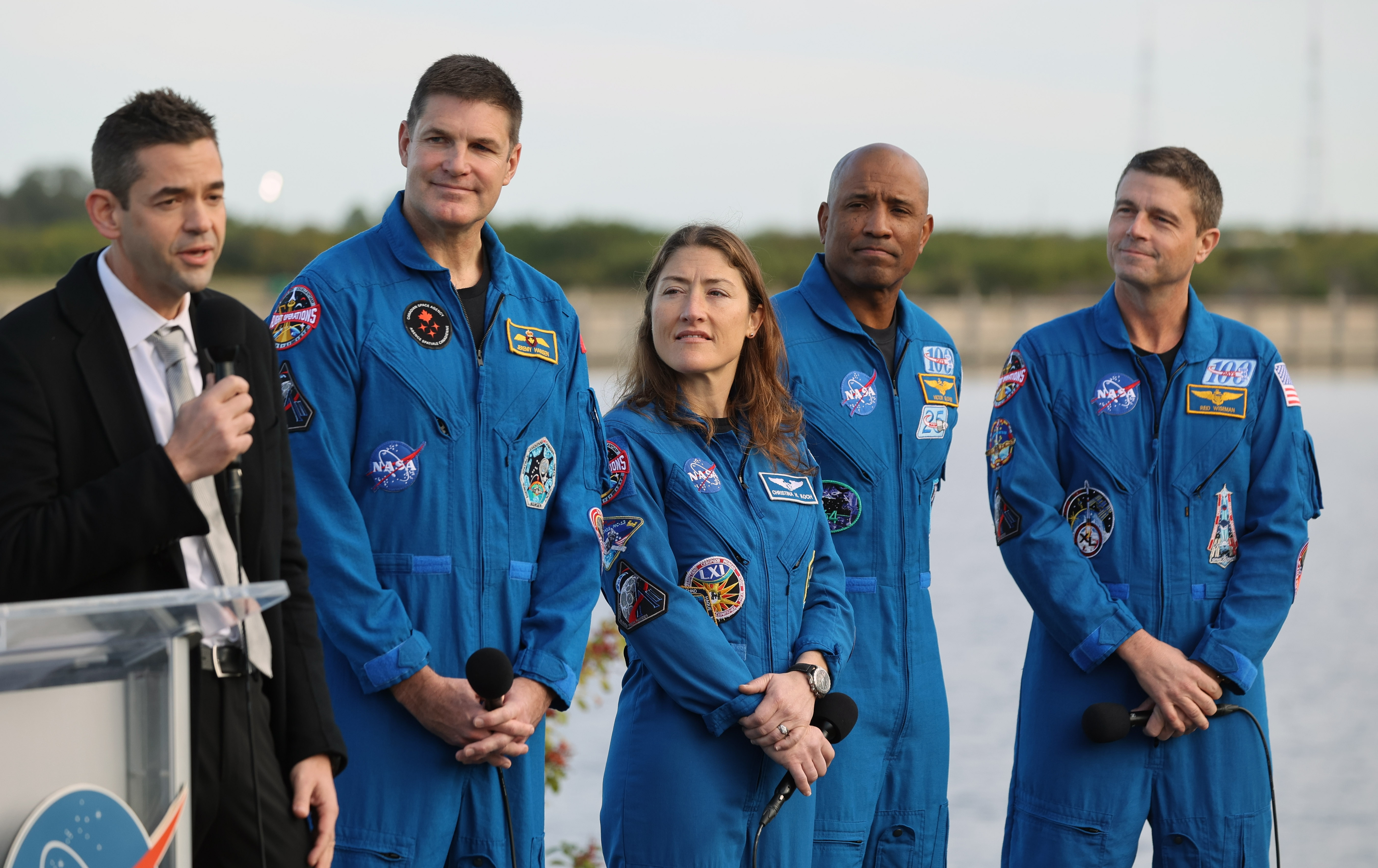
NASA administrator Jared Isaacman talks to the media as the Artemis II crew: Jeremy Hansen, mission specialist, Canadian Space Agency; Christina Koch, mission specialist, NASA; Victor Glover, pilot, NASA; and Reid Wiseman, spacecraft commander, NASA; look on, as the Artemis II rocket rolls out to Launch Complex 39-B at the Kennedy Space Center, on Saturday, January 17, 2026.
(Ricardo Ramirez Buxeda/ Orlando Sentinel)

Left to Right, Artemis II crew: Reid Wiseman, spacecraft commander, NASA; Victor Glover, pilot, NASA; Christina Koch, mission specialist, NASA; and Jeremy Hansen, mission specialist, Canadian Space Agency; pose for photos as the Artemis II rocket rolls out to Launch Complex 39-B at the Kennedy Space Center, on Saturday, January 17, 2026. (Ricardo Ramirez Buxeda/ Orlando Sentinel)
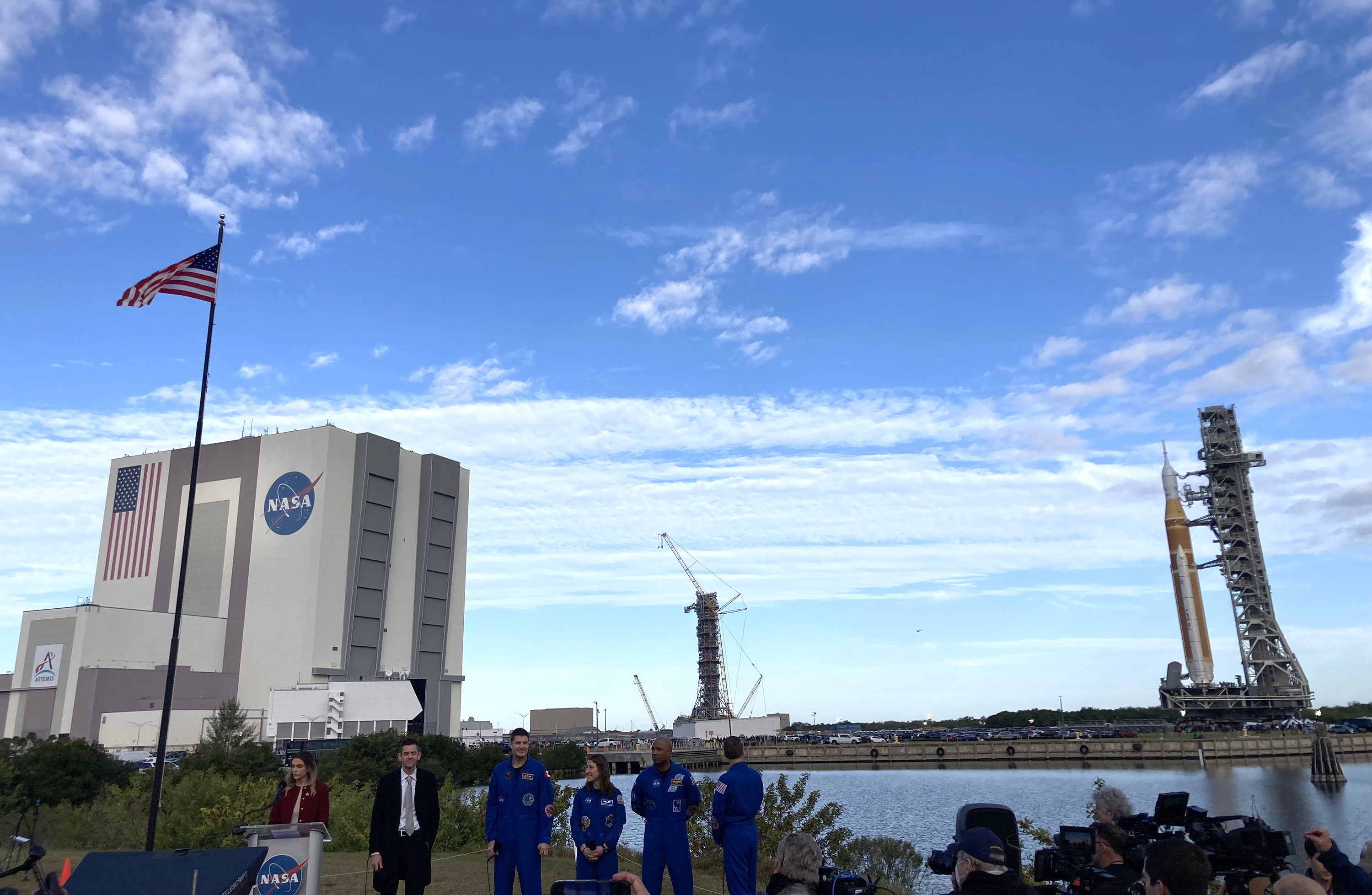
NASA Administrator Jared Isaacman, left, stands with the four astronauts of Artemis II, from right, NASA astronauts commander Reid Wiseman, pilot Victor Glover, mission specialist Christina Koch and Canadian Space Agency astronaut and mission specialist Jeremy Hansen as the Space Launch System rocket topped with the Orion spacecraft, rolls on the crawler-transporter 2 away from the Vehicle Assembly Building at Kennedy Space Center on its way to Launch Pad 39-B on Saturday, Jan. 17, 2026. (Richard Tribou/Orlando Sentinel)
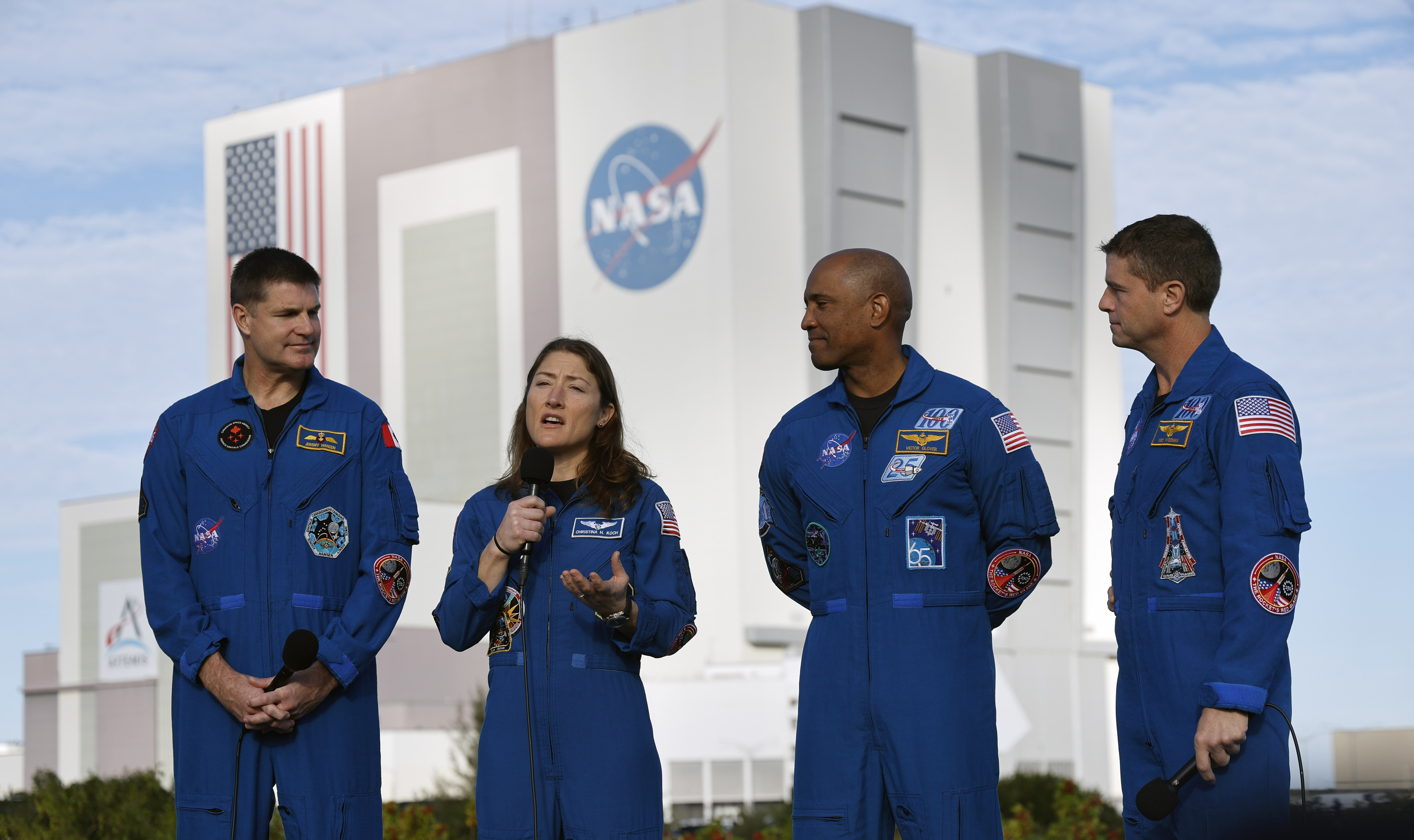
Left to Right, Artemis II crew: Jeremy Hansen, mission specialist, Canadian Space Agency; Christina Koch, mission specialist, NASA; Victor Glover, pilot, NASA; and Reid Wiseman, spacecraft commander, NASA; talk to the media, as the Artemis II rocket rolls out to Launch Complex 39-B at the Kennedy Space Center, on Saturday, January 17, 2026.
(Ricardo Ramirez Buxeda/ Orlando Sentinel)
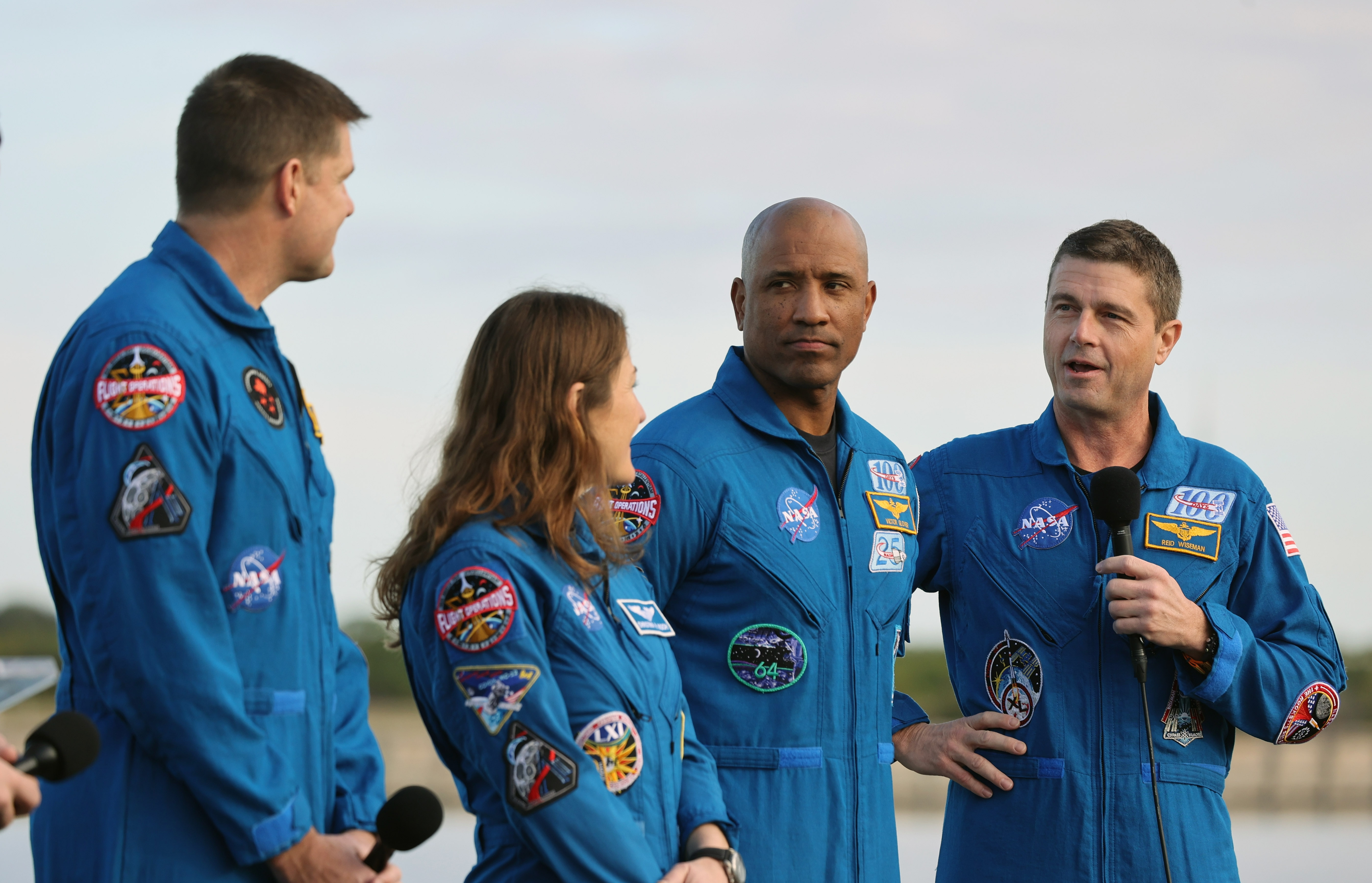
Left to Right, Artemis II crew: Jeremy Hansen, mission specialist, Canadian Space Agency; Christina Koch, mission specialist, NASA; Victor Glover, pilot, NASA; and Reid Wiseman, spacecraft commander, NASA; talk to the media, as the Artemis II rocket rolls out to Launch Complex 39-B at the Kennedy Space Center, on Saturday, January 17, 2026.
(Ricardo Ramirez Buxeda/ Orlando Sentinel)
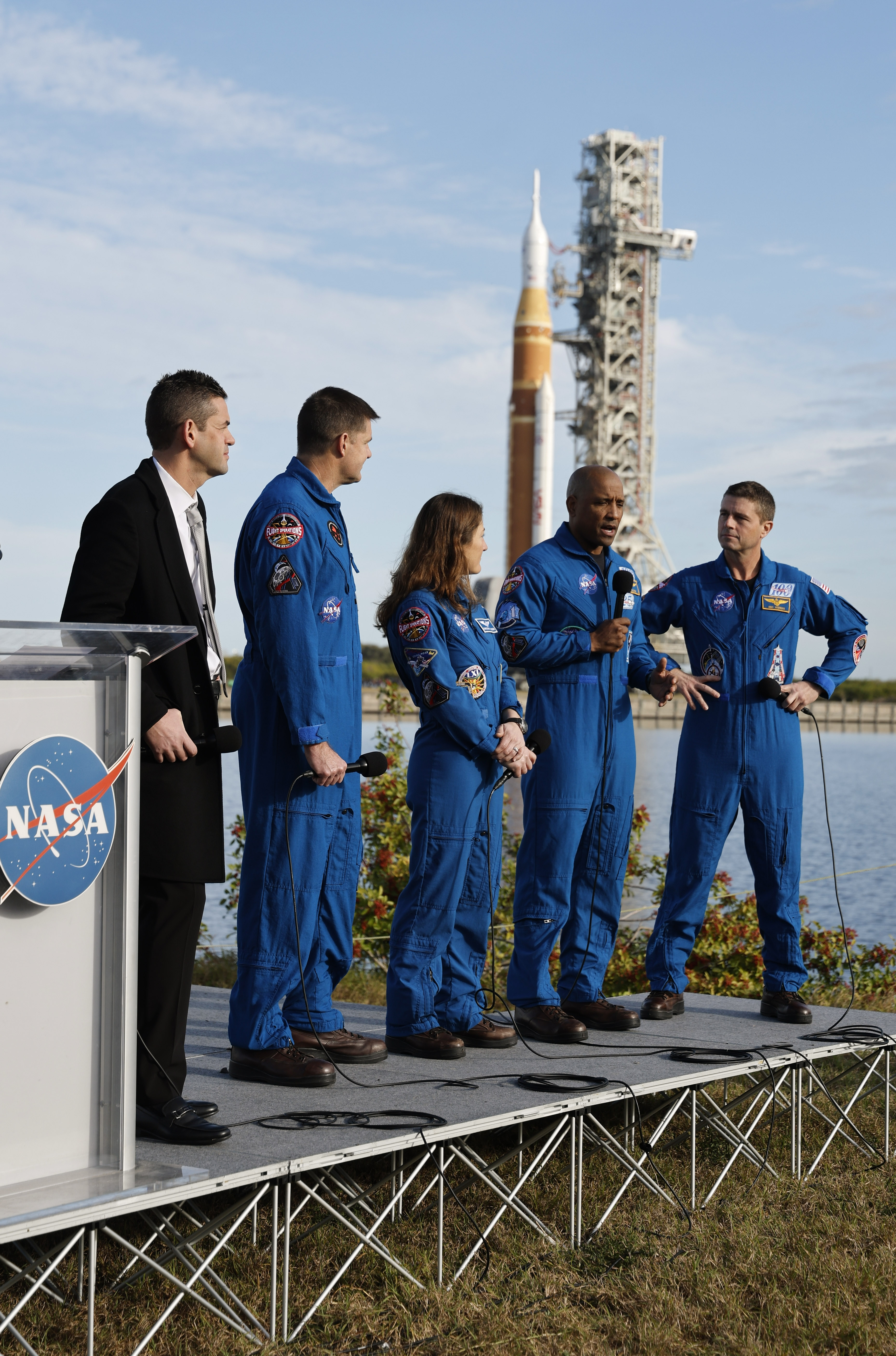
Left to Right, NASA administrator Jared Isaacman; the Artemis II crew: Jeremy Hansen, mission specialist, Canadian Space Agency; Christina Koch, mission specialist, NASA; Victor Glover, pilot, NASA; and Reid Wiseman, spacecraft commander, NASA; talk to the media, as the Artemis II rocket rolls out to Launch Complex 39-B at the Kennedy Space Center, on Saturday, January 17, 2026.
(Ricardo Ramirez Buxeda/ Orlando Sentinel)

NASA administrator Jared Isaacman talks to the media as the Artemis II rocket rolls out to Launch Complex 39-B at the Kennedy Space Center, on Saturday, January 17, 2026.
(Ricardo Ramirez Buxeda/ Orlando Sentinel)
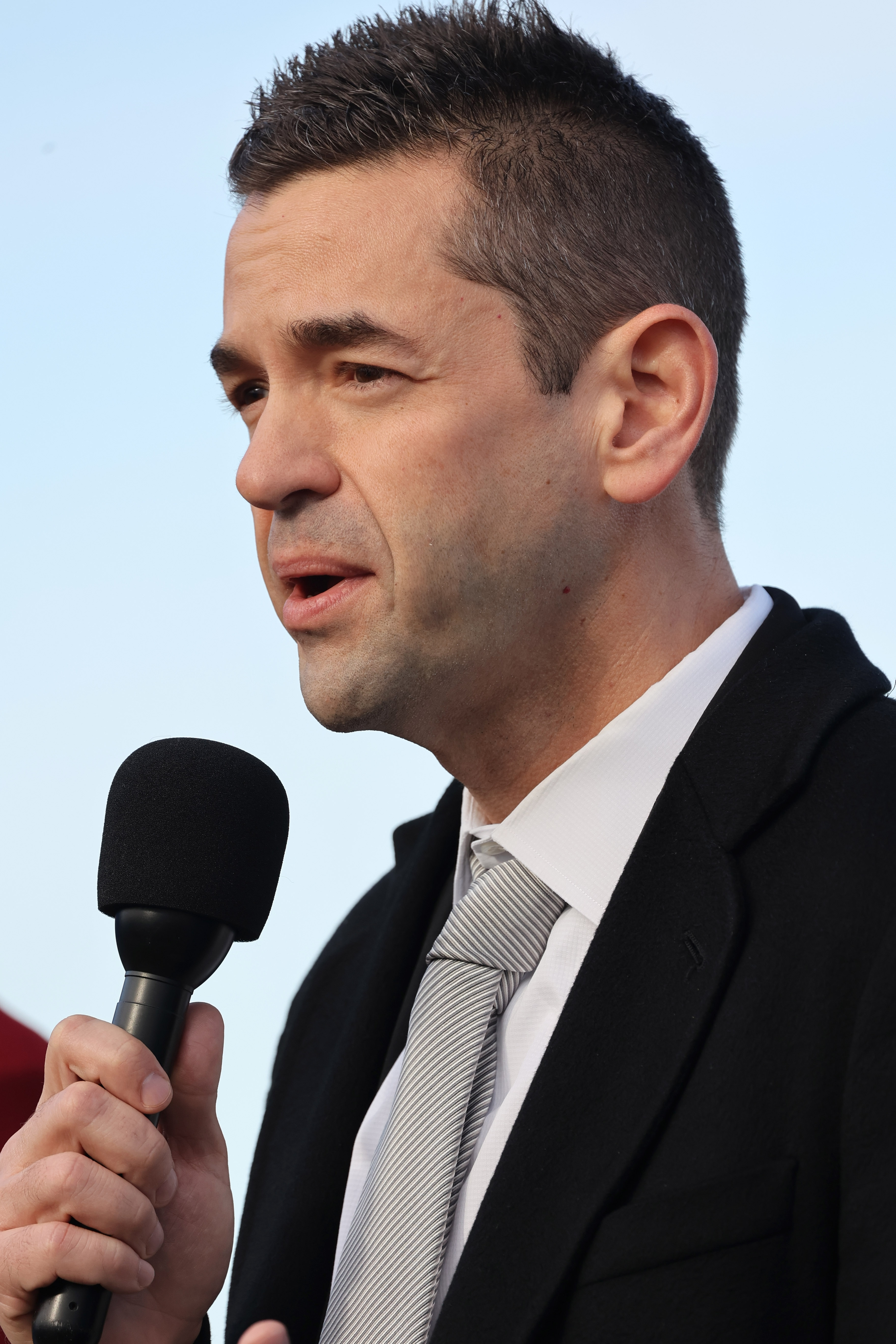
NASA administrator Jared Isaacman talks to the media as the Artemis II rocket rolls out to Launch Complex 39-B at the Kennedy Space Center, on Saturday, January 17, 2026.
(Ricardo Ramirez Buxeda/ Orlando Sentinel)

NASA administrator Jared Isaacman talks to the media as the Artemis II rocket rolls out to Launch Complex 39-B at the Kennedy Space Center, on Saturday, January 17, 2026.
(Ricardo Ramirez Buxeda/ Orlando Sentinel)
Show Caption
1 of 9
NASA administrator Jared Isaacman talks to the media as the Artemis II crew: Jeremy Hansen, mission specialist, Canadian Space Agency; Christina Koch, mission specialist, NASA; Victor Glover, pilot, NASA; and Reid Wiseman, spacecraft commander, NASA; look on, as the Artemis II rocket rolls out to Launch Complex 39-B at the Kennedy Space Center, on Saturday, January 17, 2026.
(Ricardo Ramirez Buxeda/ Orlando Sentinel)
Speaking near the countdown clock at KSC’s press site, the quartet kept craning their necks to catch glimpses of their ride as it crept along in the distance.
“We see this beautiful hardware behind us, the SLS, the Orion, but for this crew, we’ve been on this journey for about 2 1/2 years, and we just, we truly look at that and see teamwork,” Wiseman said.
Combined, SLS, Orion and its mobile launcher top 11 million pounds sitting on the crawler-transporter 2, the tracked vehicle the size of a baseball infield that has been used for more than 50 years. It has ferried Apollo’s Saturn V rockets and space shuttles around the space center.
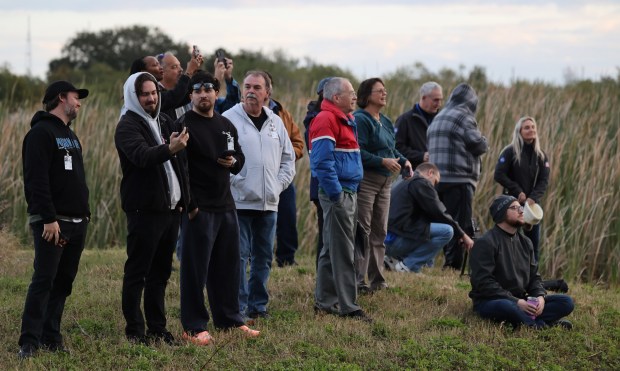 People look as the Artemis II rocket rolls out of the Vehicle Assembly Building to Launch Complex 39-B at the Kennedy Space Center, on Saturday, January 17, 2026.
(Ricardo Ramirez Buxeda/ Orlando Sentinel)
Several thousand KSC employees and their guests gathered before sunrise Saturday, huddled in blankets and hoodies as temperatures had dropped into the 40s overnight. They lined the fields adjacent to the crawler way under an expanse of billowed clouds slowly lit by the rising sun.
The 322-foot-tall rocket emerged from the VAB at 7:05 a.m. lit by floodlights, and logged its first mile over the next few hours as the skies cleared.
Pictures: Artemis II rocket rolls to the launch pad
Artemis II could fly as soon as early February, but has launch windows also planned in early March and April.
Before that happens, though, NASA has to sign off on the rocket at the pad. A big part of the process will be a so-called wet dress rehearsal during which NASA will load the rocket and spacecraft with all the fuel needed for launch while running a test countdown.
“We’ll go through our terminal count, and we have a planned cut off at T-minus 29 seconds,” said Artemis Launch Director Charlie Blackwell-Thompson during a press conference Friday. “We’ll take some time after wet dress, we’ll review the data and then we’ll set up for our launch attempt.”
The first potential launch date is Feb. 6, with additional opportunities falling on Feb. 7, 8, 10 and 11. The next launch window would offer options on March 6, 7, 8, 9 and 11. The last of the launch windows announced so far includes April 1, 3, 4, 5 and 6.
“Launch day will be pretty similar to wet dress. There’ll be two big differences. One is that we’re going to send the crew to the pad, and the other one is we’re not going to stop with 29 seconds,” Blackwell-Thompson said.
The four astronauts are set for a 10-day journey that will take them first around the Earth for a day, then out past the moon and back. They will fly farther away from Earth than any human has before, besting the 248,655-mile distance the crew of Apollo 13 hit during their flight in 1970.
“We’re making history,” said John Honeycutt, Artemis II mission management team chair. “This one feels a lot different, putting crew on the rocket and taking the crew around the moon. This is going to be our first step toward sustained lunar presence on the moon.”
The primary goal of Artemis II is to prove Orion can protect astronauts for future missions, including Artemis III that looks to return humans to the lunar surface for the first time since Apollo 17 in 1972.
“I’ve got one job, and it’s a safe return of Reid and Victor and Christina and Jeremy,” Honeycutt said. “I consider that a duty and a trust. And it’s one I intend to see through.”
One of the biggest concerns that surfaced with the Artemis I mission was damage done to Orion’s heat shield upon reentry, as the spacecraft endured temperatures of 25,000 degrees Fahrenheit coming in at 5,000 mph.
“Anytime you got this much energy that you put into a system like this and a lot of dynamic events, you know, there is some risk. It’s our job to either understand those risks and make sure that we mitigate those in a way that we feel comfortable with and we can execute the mission,” he said. “That’s just part of cheating gravity.”
NASA has signed off on an altered return trajectory to avoid the fist-size holes that were created in the heat shield’s protective coating on Artemis I.
After the rocket is connected to the propellant and electrical lines at the pad, the astronauts later this week will do a walk-through before finally getting to the wet dress rehearsal.
“I’m not going to tell the agency that I’m ready to go fly until I think we’re ready to go fly,” Honeycutt said.
Isaacman declined to nail down exactly when liftoff is likely, but didn’t rule out February.
“We have, I think, zero intention of communicating an actual launch date until we get through wet dress. But look, that’s our first window, and if everything is tracking accordingly, I know the teams are prepared. I know this crew is prepared. We’ll take it,” he said.
Wiseman added, “We like that answer.”