
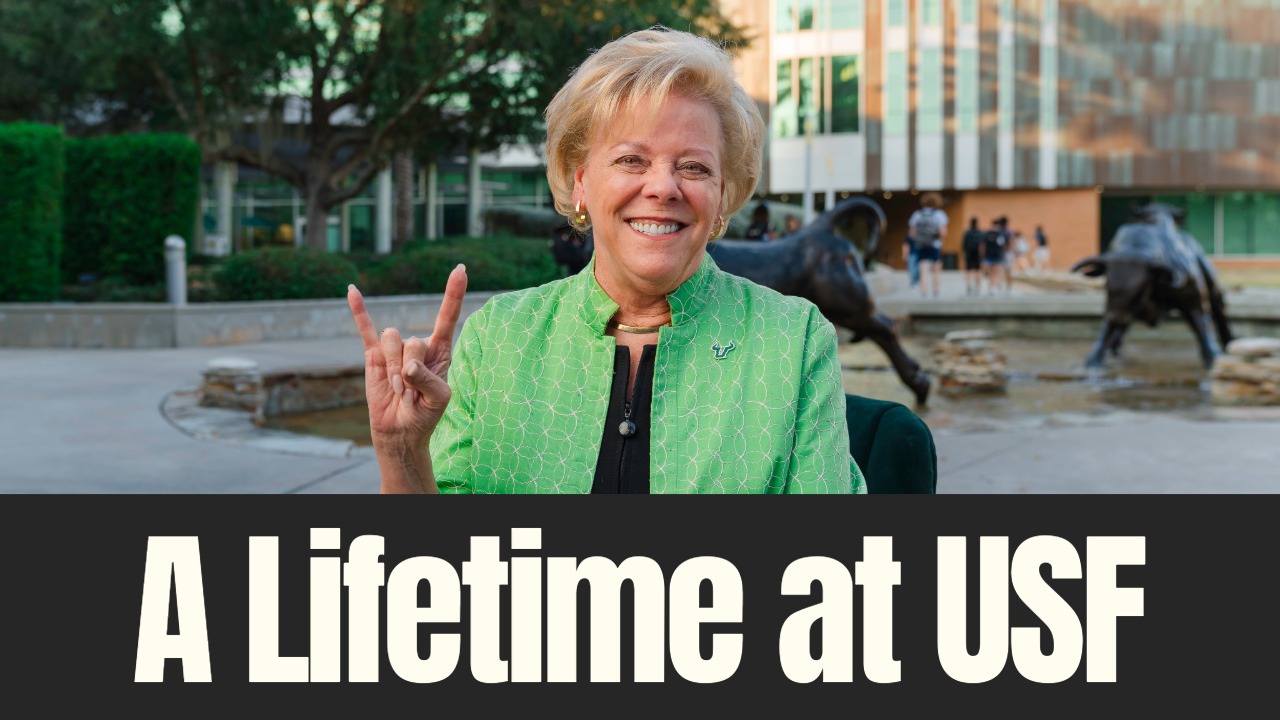
When Dr. Rhea Law looks at the University of South Florida, she does not see a chapter.
She sees a lifetime.
“I’ve been part of the University of South Florida for decades,” Law said. “If you look at the amount of time that I’ve either worked there, volunteered there or been on boards there, I’ve got over 40 years involved with USF.”
That perspective shapes how she measures success. Not by singular milestones or moments of recognition, but by responsibility carried over time and the consequences that follow growth.
Law became USF’s eighth president in March 2022 after serving as interim beginning in August 2021.
She is also the first university graduate to lead it, a distinction that underscores both continuity and accountability.
“I was there when the very first president, John Allen, was there,” she said. “I worked with every president the university has ever had.”
What she describes now is not triumph so much as stewardship.
“I am grateful for having had the experience to start at such an early point with the university and see the incredible growth and achievements it has made in such a short period of time,” Law said.
From a small campus to 50,000 students
When Law began working at USF in 1968, the institution was still defining its role.
“My first job was enrolling all the grants and contracts for the university,” she said. “When I left in 1977 to go to law school, we had just reached $10 million. I remember thinking if we could ever get to $100 million that would be the most amazing thing.”
In 2025, USF surpassed $750 million in research funding.
The scale of that growth reflects more than expansion. It reflects a shift in institutional ambition.
Once envisioned as a commuter school serving the surrounding region, USF now enrolls more than 50,000 students and operates as a multi-billion-dollar public university with national research standing.
“I am really gratified to say that we’ve got 50,000 students being given opportunities to succeed in their lives,” Law said. “That has been one of the most fulfilling things I’ve ever done.”
Growth, she said, also brings weight.
Recognition that took decades
For Law, the most difficult institutional challenge was not facilities or funding. It was perception.
“The hardest thing to move institutionally was getting recognition not only inside the university but outside of how good we really are,” she said.
That effort culminated in 2023 when USF was invited to join the Association of American Universities, placing it among the top research institutions in the United States and Canada.
Institutions cannot apply for AAU membership.
“They do their own research,” Law said. “If you meet their metrics, they invite you.”
READ: TAMPA BAY BUSINESS NEWS
The goal was set years earlier while Law served as chair of the Board of Trustees.
“I asked what the pinnacle of academic excellence is,” she said. “And the answer was AAU. So we asked about the metrics. Who is responsible? Where does the funding come from? What milestones do we need to meet?”
USF followed that blueprint for more than a decade.
“When I came back as interim president, I went to see our statistician on day one or two,” she said. “I asked where we were. And he said we’re there. I said show me.”
The invitation arrived two years later.
“That tells you sometimes it takes a long time to achieve your goals,” Law said. “But we did something that thousands of institutions have not been able to do yet.”
AAU membership, Law acknowledged, is not a finish line.
It raises expectations around research output, faculty recruitment and sustained funding that must now be met every year, not just once.
Academics first, athletics later
Law attributes USF’s rise to a deliberate prioritization.
“Our focus was on academic excellence and research excellence,” she said. “That meant taking care of our students and taking care of our faculty.”
Athletics came later.
“We spent more time on academics than athletics,” she said. “Now we’re catching up.”
That shift includes construction of an on-campus football stadium and the rapid creation of the College of Artificial Intelligence, Cybersecurity and Computing, the first of its kind in Florida and among the first nationally.
RELATED: USF reveals new renderings of Football Operations Center
“We opened it in less than a year from conception to launch,” Law said. “We don’t let the grass grow under our feet.”
Speed, she said, is cultural.
“It’s a mindset,” she said. “We will not be hampered by the way things were done in the past.”
That approach also carries risk.
In a public university, moving quickly can collide with procurement rules, governance structures and political scrutiny.
Law describes those moments as learning opportunities that require reassessment rather than retreat.
“If you go down the wrong path, you own it and you fix it,” she said.
Running a university like a complex business
Law draws a direct line between her legal career and her academic leadership.
“Every bit of my law background helped me,” she said. “Running a law firm was very helpful in running a university.”
As former CEO and chair of Fowler White Boggs, she led professionals accustomed to clarity, speed and accountability.
“You’re dealing with people who are extremely smart and brilliant in their fields,” she said. “They want issues resolved quickly. Once you respect that and align around a shared vision, there’s nothing you cannot do.”
READ: USF NEWS
USF’s scale, however, adds complexity beyond any private enterprise.
State funding cycles, national competition for faculty and rising student expectations all shape the institution’s operating reality.
Law sees her role less as a sole driver than as an integrator.
“This transformation didn’t happen because of one person,” she said. “It happened because people stayed focused on a shared vision over a long period of time.”
Opening the front door
When Law arrived, business and civic leaders often expressed the same concern. They wanted to work with USF but did not know how.
The university felt too large, too decentralized and too difficult to navigate.
Her response was structural. Law created the Office of University Community Partnerships as a single point of entry for external engagement.
READ: ST. PETERSBURG BUSINESS NEWS
Whether the goal was research collaboration, internships, scholarships or philanthropy, the objective was speed and clarity.
“If it meets the needs of our students, we’re going to move quickly and get it done,” she said.
The result, Law said, was deeper trust and more sustained partnerships across the region.
Leadership without labels
Law said she rarely thought about gender while building her career.
“When I became president, I was the only woman running a large law firm in Florida,” she said. “You don’t think about that. You think about the job.”
Perspective came later.
“I was the first in my family to go to college,” she said. “My parents didn’t understand why it mattered.”
Education changed her trajectory.
READ: TAMPA BAY REAL ESTATE NEWS
“If I hadn’t had the education I got at USF and the encouragement of faculty and staff, I wouldn’t be here,” she said.
One mentor stands out.
“Dr. Bill Taft,” Law said. “He encouraged me every day.”
She recalls freezing before a speech until he stopped her.
“He said, ‘You know this subject. Just talk about it,’” Law said.
The lesson stuck.
“That’s how I try to lead,” she said. “Encouraging people and helping them believe they belong at the table.”
A legacy still unfolding
When asked how she hopes to be remembered, Law does not cite rankings or buildings.
“I hope they remember me as someone who encouraged them every day,” she said.
Her career required risk. She left a job she loved and cashed out her retirement to attend law school, uncertain of the outcome.
“It was scary,” she said. “But opposition gave me fuel.”
USF’s transformation followed a similar arc. Progress came through sustained belief, long timelines and acceptance that growth carries responsibility as well as opportunity.
As Law prepares to step away, USF enters a more demanding phase of its evolution, one where confidence must now be matched by consistency, scale and execution.
Law has been present for nearly all of the institution’s modern history. What comes next will test how durable that legacy truly is.
Stay Informed