
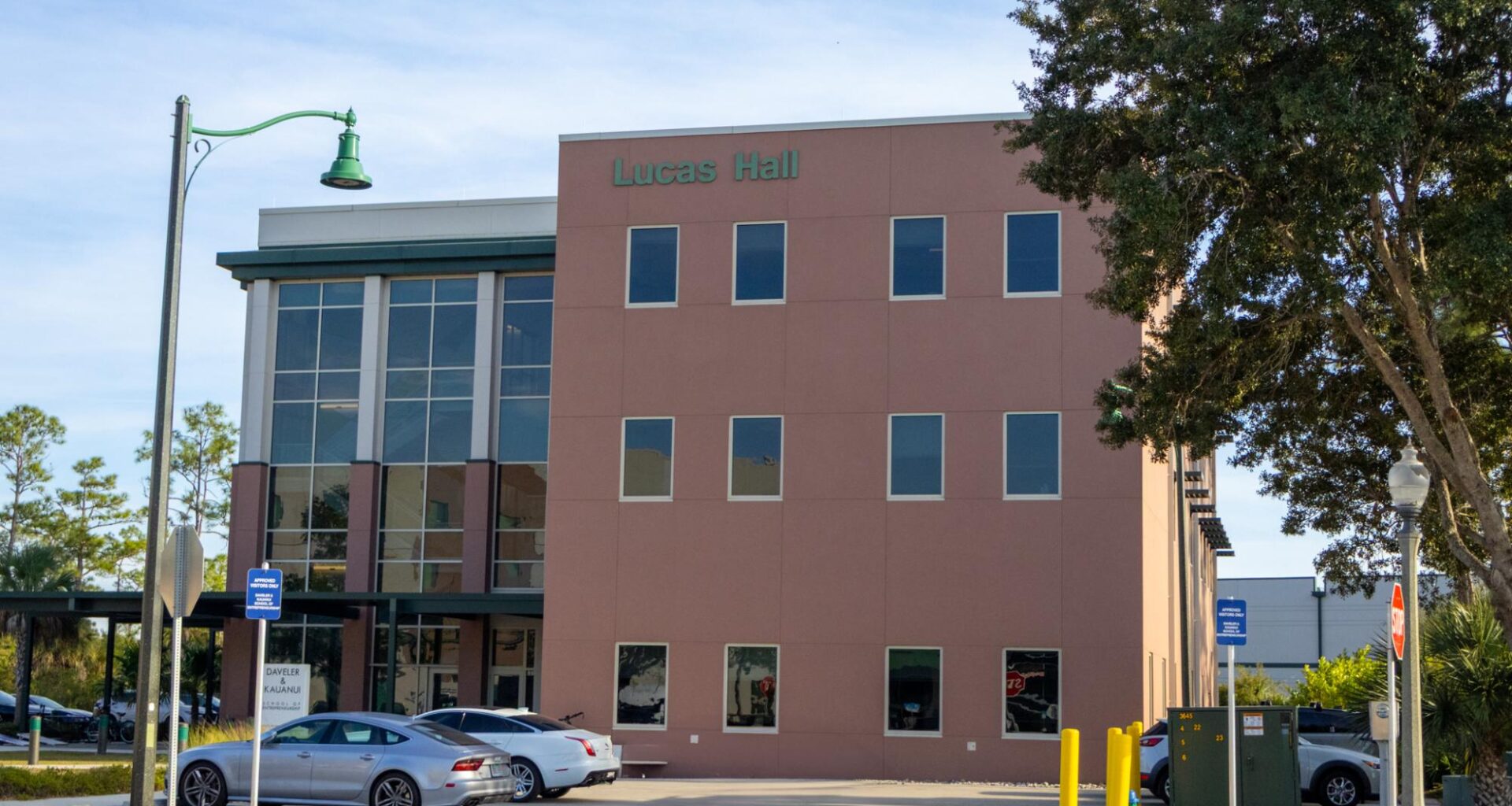
Through the doors of Lucas Hall lies an opportunity that can give breath to any idea.
The Runway Program at FGCU is a semester-long program for students of all majors and alumni with business ideas. Through the program, participants build their business and prepare for a final pitch, where they could earn equity-free seed funding.
The program started in Fall 2016 and was developed by Scott Kelly, who is now the assistant director. It first started as a pitch competition and has evolved into an evidence-based program with two pathways: the Incubator and the Accelerator.
“[This is] one of those things I wish existed when I was a student,” said Kelly. “So, that’s kind of the brainchild. It was like, ‘what could we have used if we were students doing this again?’”
Story continues below advertisement
The Incubator is the first stage of the program. This phase of the Runway Program focuses on the fundamentals of building a business by finding a target market, gaining validation and designing prototypes.
To join the program, applicants must fill out an application found online on FGCU’s website under the Runway Program. It consists of questions asking about the business idea, the target market and how many hours are invested in the business.
Senior Jordan Campo is currently enrolled in the Incubator. Campo is working on his business, Gear Guard, an athletic gear odor eliminator. His idea formed from his own experience with his hockey gear after practices and games.
“It’s very intimidating with all the stuff that’s on there for you to look at,” said Campo. “But it’s also a reminder, it’s a lot going into a business and you need to know everything before you do it.”
While working on the modules, participants attend workshops or “fireside chats” to discuss how to interest people in a product and how many contacts were collected from people interested in purchasing it.
It is also recommended for a participant to find and connect with a mentor to assist and guide the participant through their experience in the Runway Program.
Following this process, participants move forward to the final pitch with the opportunity to earn seed funding to start up and work on their business or product.
The final pitch involves a “Shark Tank” style panel of judges and all the participants watching in the room. There are between three to five judges.
“Those judges range from anyone that’s owned and run a business to Angel and VC investors to community members with, you know, a genuine love and curiosity for entrepreneurship education,” said Kelly. “So, we’ve got a whole gamut of judges, and all kinds of people that are interested in this kind of stuff.”
The judges change every semester, but at least one or two of the judges are from the Daveler and Kauanui School of Entrepreneurship Advisory Council.
This past spring, senior Dillon Rosenthal earned $3,000 through the final pitch for his business, BounceBack Pickle, a recycled pickleball ball company. With the seed funding, Rosenthal has been able to purchase recycling bins to place at pickleball courts to collect broken pickleballs. With the free broken pickleballs, Rosenthal can use the rest of the funding for shipping and manufacturing.
“I spent $50 to get it grounded up, another $50 to ship it to Arizona, $200 to get it pulverized [there], another $200 to ship it back, and then $1,200 to ship it to China, and then it’d be another $800 to manufacture in China and ship it back here,” said Rosenthal.
With the seed funding, Rosenthal signed an agreement with FGCU that the money would go toward the business and that the university would be kept updated on revenue and growth. This agreement also allows FGCU to use Rosenthal’s information and share his growth.
As BounceBack Pickle developed, Rosenthal moved forward in the Runway Program to the Accelerator. This section of Runway is for businesses that are formed and being pursued.
The Accelerator phase is highly evidence gated. This section of the Runway has a more competitive point system than the Incubator. Racking up points for generating revenue, gaining customers, having a mentor and competing in external pitch competitions to rank within the top individuals of the Accelerator.
“Those who succeed, they fall in love with the problem and not the solution,” Kelly said.
This year, as the Runway program continues to expand, the program added a sustainability challenge. This fall was the first semester for this three-round challenge.
The first round is the application process. After being accepted to the challenge, participants move forward to the second round: a trade show.
In the trade show, 25 applicants are accepted to participate. Each participant has a table setup in the School of Entrepreneurship where information is shown about their company and their prototypes.
Sophomore JT Sims participated in the trade show with her business, Potter and Clay, a pottery company. Sims displayed a variety of handmade dishware she made with clay.
“I’d love to go into something that I’m passionate about,” said Sims.
This tradeshow was open to the public to vote. Students of FGCU and members of the community poured into the building, and each voter was given a QR code to vote for their top businesses in the show. The top six businesses in the challenge moved forward to the final pitch.
“So, you bring your business, you bring some things you’re doing and you just talk with people for a couple hours,” Sims said.
Senior Kalyssa Kennelly also displayed her business, Thrift and Sip, a mobile pop-up coffee shop and thrift store.
“That was the first time Thrift and Sip had something like a physical pop-up,” said Kennelly. “I had a bunch of thrifted clothing items that were for sale, and then also a cold brew station setup, and then I had a bunch of informational flyers and stuff that people could take.”
Kennelly and five other businesses moved forward to the third round, the pitch.
Each participant stood before a panel of five judges and pitched their idea for roughly six minutes. The top three businesses from the pitching round earned seed funding.
Kennelly earned the top prize of $10,000, second place earned $7,500 and third place earned $5,000.
“The sustainability challenge was just a way for me to really discover how I could incorporate sustainable practices into people’s everyday lives by being accessible to them and affordable, because that’s really what people need,” said Kennelly.
With a variety of opportunities, the Runway Program strives to help young aspiring entrepreneurs get started early on a concept and reach their goals, so an idea can thrive in the business world.
“FGCU School of Entrepreneurship is going to be on the map soon in the entrepreneurship world,” said Rosenthal.