
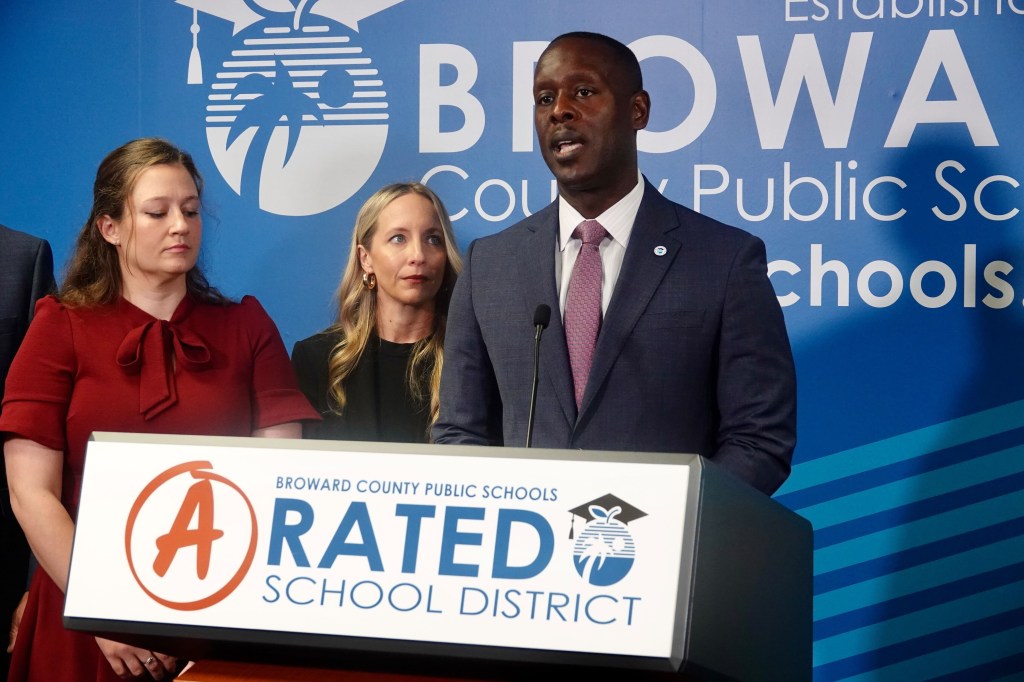
Broward voters have mixed views about the performance of the Broward school district and its superintendent, and it’s largely divided by race, a new poll has concluded.
The poll of 1,039 registered voters also finds support for the district’s “Redefining Broward County Public Schools” effort to close or find new uses for low-enrolled schools, as a final decision on that is scheduled for Wednesday.
Overall, 45% of voters polled from Dec. 19 to Dec. 23 have a favorable view of the school district, with 24% disapproving, according to the survey, released Tuesday by MDW Communications, a national political strategy and public relations firm based in Plantation.
“There is a narrative that Broward voters are overwhelmingly upset with the direction of our schools,” Michael Worley, CEO and partner with MDW, told the South Florida Sun Sentinel. “That does not play out in the data.”
But there are stark differences among racial groups.
About 61% of Black voters strongly or somewhat approve of the job the school district is doing, while 16% disapprove. But among white voters, that drops to 42% approve and 27% disapprove.
About 42% of voters who identified as Hispanic approved, while 26% disapproved.
“What the data tells us is that there are many voters who are upset about the direction of the School Board, but there’s a racial divide there,” Worley said. “It’s very clear in the data that white voters have more concerns with the direction of the School Board than Black and Hispanic voters.”
Voters had an 11-point net positive rating of Superintendent Howard Hepburn, but this also differed by race. The net favorability rating among Black voters was 40 points, compared to one point for white voters and seven points for Hispanics.
“I think it speaks to some of the visibility and leadership of Dr. Hepburn and being seen as a prominent Black leader of the (school district) who is working hard to make changes,” Worley said. “I think that definitely resonates. But beyond that, I think that there is a certain level of pride that Black voters have in our public schools, especially among ones who have had or still have children in the school system. They want to see them get better and want to see them improve.”
About 28% of Black voters sampled have children in the school system, while only 10% of white voters do, Worley said.
Some voters with no children in the school district “see all of the controversy with the school system on the local news, and it leads them to believe that the school system is just completely in tatters and not functioning properly,” Worley said. “I think that narrative has grown really quickly on the west side among the white voters, especially the older white voters.”
Worley said he thinks some of the racial divide can be traced back to the mass shooting that happened nearly eight years ago at Marjory Stoneman Douglas High in Parkland, which killed 17 students and staff.
“It’s the biggest tragedy in our school system’s history, it is the biggest failure in our school system’s history, and it happened in a school that is predominantly white,” Worley said. “And the echoes from that tragedy can still be heard, and you hear it in the polling.”
The mass shooting was the impetus for a statewide grand jury report, which ended up focusing on the district’s poor management of an $800 million voter-approved bond referendum. As a result of the report, Gov. Ron DeSantis removed and replaced four School Board members.
The district has gone through four permanent and two interim superintendents in the past five years. And while the district is now A-rated based on student performance, it continues to face numerous controversies related to its operations. These include a canceled office rental lease, a botched search for a management company to oversee construction work and the revelation this month that senior administrators received large bonuses from money voters approved to help teachers and lower-paid employees.
The poll has a sample size of 1,039 of voters who are likely to vote in the general election and has a margin of error of plus or minus 3%, the results state. Voters were contacted by text messages and email.
Worley’s firm represents several candidates running for a seat on the Broward School Board during the elections, which will be held in August and again in November if there are runoffs. The main purpose of the survey was to get voters’ views on the district’s redefining schools effort to close or repurpose schools, he said. The School Board plans to hold a vote on closing seven schools at a meeting on Wednesday.
About 63% of voters agreed that state-level school choice policies, such as the easy availability of vouchers for private and home schools, “have created an environment where a redefining effort is necessary,” the survey found. An overwhelming number, 88%, support converting closed schools into vocational and technical schools, while 73% voiced support for converting them to K-8 centers.
“This is something the board has pushed for since the beginning of the redefining effort,” School Board Chairwoman Sarah Leonardi told the Sun Sentinel. “These options strengthen public education, improve safety and focus on student achievement.”
Worley said he expected to see a much greater level of concern from voters about the district’s efforts to close or dramatically change schools.
“But what the data shows us is that voters understand the need for this. They understand why it’s happening,” he said. “They understand both the negative impacts, but also the potential positive impacts.”
Leonardi said the survey shows voters expect the school district to adapt to the realities it faces.
“They recognize that state-level school choice policies have put real pressure on public schools, and they want us to respond responsibly,” she said.
School Board member Allen Zeman, a staunch proponent of closing low-enrolled schools and investing the savings to improve the remaining schools, said he was heartened that voters overall support these efforts. He was happy to learn that a plurality of voters, 41%, said their top choice would be district-run schools if they were choosing a school for their child today.
About 33% listed private schools as their top choice, 15% charter schools and 5% home schools.
“That’s a thousand people in Broward County saying that our No. 1 choice would be public schools,” Zeman said. “If we can repurpose and close more next year and take that money and convert it into schools that have the right programs, the right teachers and the right kind of culture to them, we can win people back, and that’s very exciting.”