
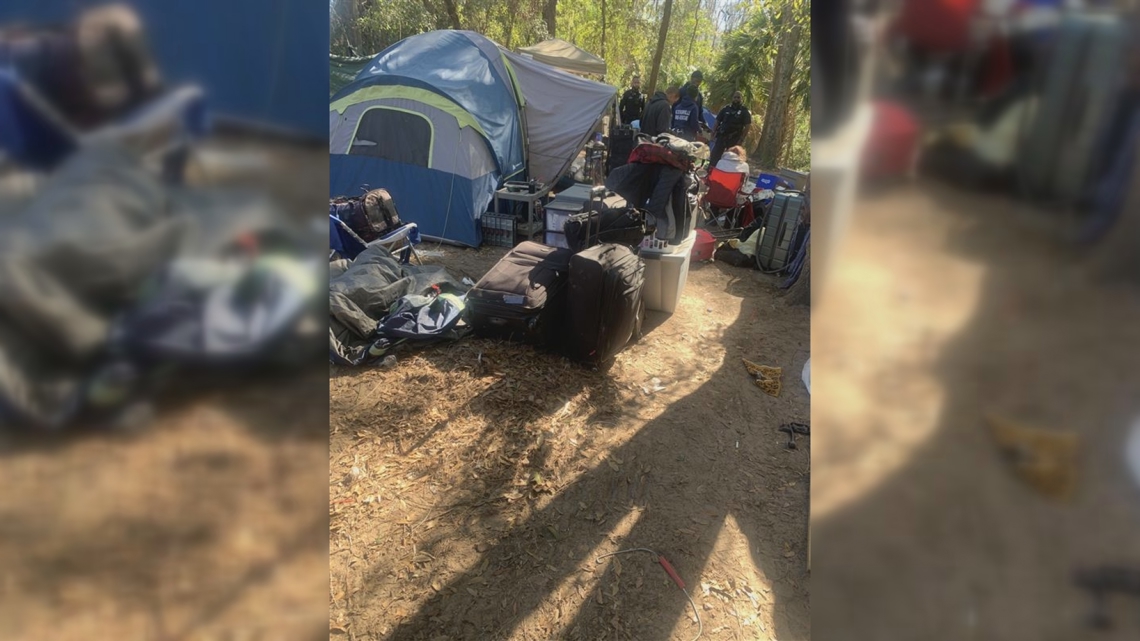
In Jacksonville’s Arlington area, City Council Member Ken Amaro highlights the challenges of homelessness.
JACKSONVILLE, Fla. — A Jacksonville City Council member is drawing attention to homelessness in the Arlington area after a recent walkthrough revealed tents, trash, and environmental threats.
Councilmember Ken Amaro, who represents District 1, tells First Coast News he joined the Jacksonville Sheriff’s Office on a walkthrough last Friday, where he encountered homeless encampments in his district.
“Your heart breaks, but then you look at the damage that’s been done,” Amaro said.
Amaro says he saw tents and debris during the walkthrough, adding that while homelessness is a complex issue, it presents challenges for both people experiencing homelessness and the surrounding community.
“Homelessness is, it’s a very complex issue and you want to be empathetic to meet the needs of the unhoused, but you also want to protect property and you also want to have community standards, if you will,” Amaro said.
Beyond quality-of-life concerns, Amaro says trash left behind at some encampments has created environmental issues. He says debris from one site reached Strawberry Creek, polluting the waterway.
“Two issues,” Amaro said. “You’re on someone’s property. And then secondly, they leave immeasurable blight behind, and at that location that I went to, some of that filth had gotten into Strawberry Creek, so now you’ve got a polluted waterway,” Amaro said.
When encampments are discovered, Amaro says the city relies on the PATH Team, a partnership with Jacksonville Fire and Rescue, to connect people with services rather than simply moving them along.
“We immediately call the PATH team and they go out there. It’s not a callous thing. They go out and they try to find resources to assist those who may be staying in these camps,” Amaro said.
Advocates say enforcement alone will not solve homelessness and stress the need for both outreach and housing options.
Dawn Gilman, CEO of Changing Homelessness, says her organization coordinates homeless services across Duval County and three surrounding counties by maintaining a centralized database used to connect people with available resources.
“We are the entity that keeps the database, which is a client-level repository of information on everyone that’s experiencing homelessness. It allows them to be referred to both services and to housing as is available,” Gilman said.
Gilman says emergency shelter plays an important role, but is not meant to be a long-term solution — and capacity remains an issue.
“Yes, we need beds, and not just emergency shelter beds, because emergency shelter is intended to be something less than 30 days. Someone’s in a crisis immediately. It’s a place to get stabilized and then move onto something more stable, whether it’s within that agency or at another agency,” she said.
As the city continues working with agencies and outreach teams, Amaro says residents in his district also play a role.
“In District 1, where there seems to be a number of these camps popping up here and there: if you see something, say something,” Amaro said.
Later this month, Changing Homelessness will conduct the annual Point-in-Time Count on January 29, a one-night count of people experiencing homelessness. The count is required for Jacksonville to receive federal funding and helps determine how resources are allocated moving forward.
RELATED: One year later: How Jacksonville is enforcing Florida’s anti-camping law