
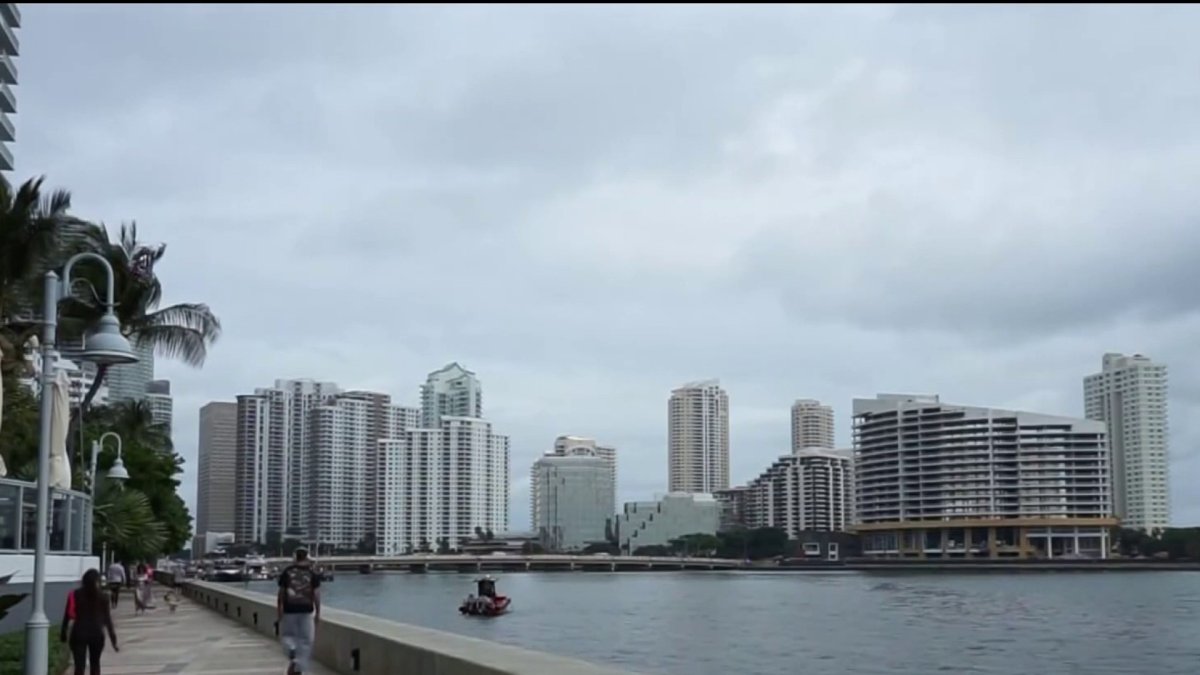
It’s a new year, and that means new developments coming to South Florida. But where are developers placing their bets?
Erik Rutter, Ana Bozovic and Daniel Kodsi are among the “must-knows” in South Florida’s real estate scene. And their predictions for where developers are placing their focus on opportunity for new development are right in Miami’s financial capital, Downtown.
“We’re very close to the site of the Citadel tower, which is now fully approved and will be the tallest office building in South Florida,” Bozovic, the founder of Analytics Miami, said from Brickell.
She described that Class-A space will be throughout that area.
“So we’re seeing development coming within proximity of the urban course of the places of commerce,” she said.
Rutter, the managing partner of Oak Row Equities, talked about a $520 million deal they closed back in December on 4.25 acres on Brickell Bay Drive.
“We’re one block away from where Citadel is building their new headquarters. We think Brickell Bay Drive is going to become like the Fifth Avenue of New York,” he said.
There are also other notable sites that are currently being developed in Downtown.
There is the Miami World Center, which is a 27-acre mixed-use space. There is also the Signature Bridge, connecting Downtown with the beach by car and providing more than 30 acres of park space to connect the urban core with Overtown and other surrounding neighborhoods.
“Developers, right now we’re focused on submarkets that are proximate to the urban core. To Downtown Miami, to Brickell, and to other office CBDs, but also provide high quality of life, have good walkability, have good food and beverage and other retail associated with them,” Rutter said.
“Areas like Edgewater will continue to grow,” said Kodsi, the CEO of Royal Palm Companies. “It’s a desirable place to live, you’re very close to transportation, even if you are going to use the I-95 and exit ramps and entrance ramps for right there, to get on and off. Wynwood is, you know, within a stone’s throw away or, you know, Downtown, Miami World Center. All of that is all within, you know, a few blocks.”
But what will development look like in these areas?
“What we’re doing today is we’re looking at a smaller type of product. Today, people care more about location- What’s downstairs, and what restaurants do I have? What shopping opportunities, transportation? And then the apartments themselves don’t need to be as large,” Kodsi said.
“I think that you’re going to see a number of Live Local Projects try to get out of the ground over the next couple of years. So that’s multifamily housing that includes a component of workforce housing. I absolutely think you’re going to continue to see condo development all over,” Rutter said.
And the people looking to live in these new developments, according to the experts, are new taxpayers who are moving to South Florida to take advantage of the capital here.
“It’s not just the ultra-rich. Ultra-rich people are moving to Miami. There’s no question about that. But all tax brackets are moving to Miami because it’s a great place to live. It’s a great place to work, and it’s a great place to raise a family,” Rutter said.
“The median incomes of people who are moving to Miami-Dade County are significantly higher than those are people who are moving out. And that’s going to be an ongoing pattern,” Bozovic said. “Look, it’s neither good nor bad. It just is what it is. When a place becomes seen as a place of opportunity and as a capital of the of the world of the 21st century world, it will keep attracting people.”
And one of the reasons this area of Miami is so desirable is the improvements to transportation.
“With the Brightline, we have the opportunity to travel to other major cities in South Florida and even smaller cities like Aventura, which has now a Brightline stop or Boca Raton,” Kodsi said. “So that’s where I think there’s going to continue to be growth, in the urban core around public transit. Just because the traffic is continuing to get worse and with more population growth, it’s not going to get better.”
But what could the challenges be to condo and apartment builds in Downtown?
“Because of the cost of land, the cost of construction, all these factors, it’s basically impossible to sell something to the consumer for under $1,000 a square foot. Even that doesn’t exist to the urban core, but below that, it’s virtually empty. It’s impossible,” Bozovic said.
“And so when you see projects starting at half a billion or studio apartments, this is a very important thing to consider that the vast majority of new product coming to market is what I’m calling ‘New and Prime.’ It’s more expensive than the area’s median pricing, largely due to the to the cost constraints,” she said.
And the cost of construction is what developers say is the biggest hurdle. So many will be trying innovative design approaches to try to keep costs low.
And other areas of focus that these three say are honorable mentions are neighborhoods like Coconut Grove, Coral Gables and South Miami. These three neighborhoods are already built out with single-family homes, so they are not getting new developments. But rather, those single-family homes are now being redeveloped.