
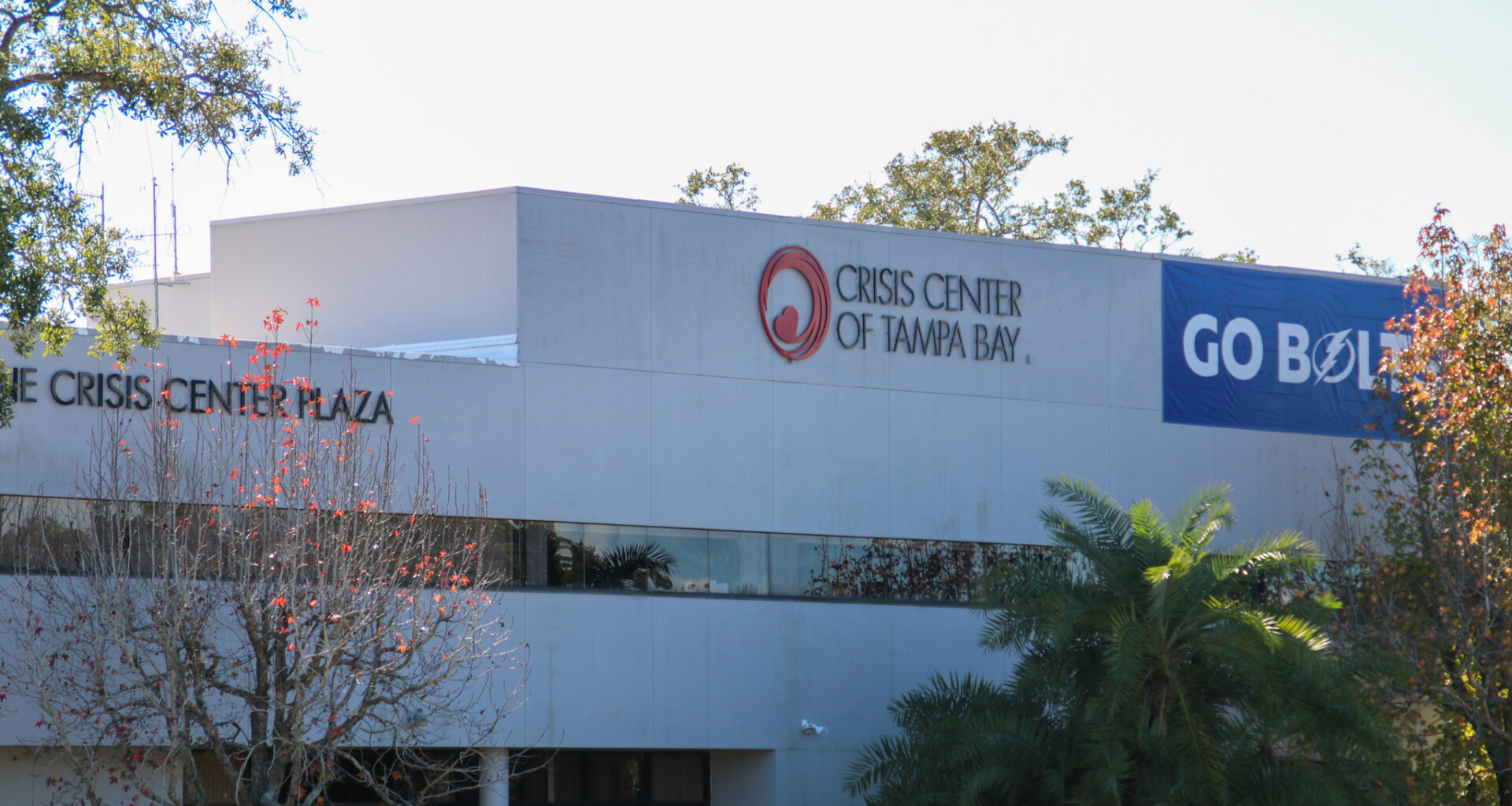
 The Crisis Center of Tampa Bay shared tips on recognizing and avoiding human trafficking. ORACLE PHOTO/ELLIE FROST
January is Human Trafficking Prevention Month, a time dedicated to raising awareness about a crime that often goes unnoticed but affects millions of people worldwide.
Human trafficking involves the use of fraud or coercion to obtain some type of forced labor, including domestic servitude or commercial sex acts, according to the U.S. Department of Homeland Security.
The United Nations’ International Labour Organization estimates 27.6 million people worldwide were victims of forced labor in 2025.
There were about 200,000 victims of sex trafficking and around 540,000 victims of labor exploitation or labor trafficking in Florida in 2024, according to a Florida Data Snapshot.
Additionally, more than 220 human trafficking cases were reported in Hillsborough County in 2025, which is more than anywhere else in the state of Florida, according to Tampa Bay 10.
While human trafficking is a global issue, USF faculty and the Crisis Center of Tampa Bay said students can stay safe and help victims by familiarizing themselves with warning signs.
Related: New platform developed by USF lab aims to fight human trafficking in Florida
The Crisis Center of Tampa Bay held a webinar on Jan. 21 to educate people about the signs of human trafficking.
The Crisis Center offers support services for various situations, including trafficking, sexual assault or abuse and domestic violence, according to its website.
Stephanie Barona, the human trafficking care coordinator for the Crisis Center, and Shayla Gonzalez, the mental health ambassador for the Crisis Center, led the webinar.
Barona and Gonzalez said human trafficking is a form of “modern” slavery.
They said human trafficking includes recruiting and transporting a victim through coercion, deception or abuse, and exploiting the victim for an intended purpose, including sex trafficking and forced labor.
Barona and Gonzalez said warning signs include behavioral changes, excess shame, guilt or fear, and appearing fearful or submissive.
They said support systems through friends and family are important to approach and de-escalate trafficking scenarios.
Related: USF event gives a safe space to sexual assault survivors
Human trafficking can happen to anyone, but certain variables — such as poverty, a lack of support or a history of abuse — can make someone more vulnerable to exploitation, according to the Mental Health Association of Columbia Greene Counties.
Still, Colby Lynn Valentine, an associate professor of criminology at USF, said trafficking is not restricted to these variables.
Valentine said anyone can become a victim — no matter their age, gender, status or wealth — which makes recognizing the signs of human trafficking even more important.
“Traffickers find a vulnerability or weakness and exploit it for their own benefit,” Valentine said.
But while human trafficking often exploits vulnerabilities, Valentine said there are ways to identify and avoid it.
Jodi Godfrey, a senior research associate at USF’s Center for Urban Transportation Research, researches and publishes work focused on ending human trafficking and increasing public safety.
Some of Godfrey’s published work includes employee safety reporting and onboard technologies to reduce accidents and incidents, according to her USF biography.
“Human trafficking can also be anything really used to control a person,” she said. “So forcing, taking away a person’s identification and then threatening them with harm if they were to try to leave permanently, or physical assaults.”
Godfrey said it is important for students to consider and verify whether something sounds too good to be true when they are presented with new job or internship opportunities.
“If it seems too good to be true, it likely is,” Godfrey said. “You should always check the legitimacy of opportunities and the resources behind them.”
Related: USF annual safety report shows surge in stalking, scooter theft
Klejdis Bilali is a fourth-year doctoral student of criminology and a graduate research assistant at the USF Trafficking in Persons Risk to Resilience Lab.
The Trafficking in Persons Risk to Resilience Lab researches, provides resources for and educates others on human trafficking and how to prevent it, according to its webpage.
Bilali said coercive abuse “thrives” in silence and isolation.
Thus, recognizing dramatic mood shifts, behavioral changes and abnormal habits is crucial to supporting another person who may be in danger, Bilali said.
Bilali said there are other resources for students to use and contact for support — such as the Crisis Center’s 211 line, the National Domestic Violence Hotline and 911 for immediate emergencies.
“Social support matters just as much as therapy,” Bilali said. “Survivors need safe people around them who can listen without judgment and help with practical support.”