
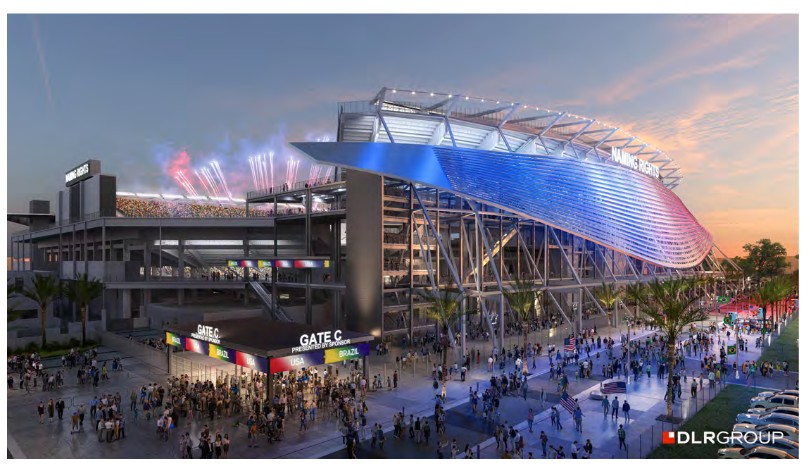
Orlando’s redesigned Camping World Stadium makes a statement with its ribbons of aluminum encircling the structure. And the new lighting package is the exclamation point.
DLR Group lead architect Ryan Freeland unveiled a new look at the $400 million project featuring color-changing LED lights during Thursday’s meeting at the city’s Appearance Review Board. The board unanimously approved the stadium expansion, which is slated to begin in early 2026.
Freeland said the lighting package is still a work in progress, but preliminary plans call for a programmable system that can light the stadium structure and incorporate downlighting to illuminate the metallic skin, causing a “lampshade” effect. The architects will be required to file a new lighting and signage plan once the city secures a naming rights deal for the stadium. Camping World’s contract expired in 2024.
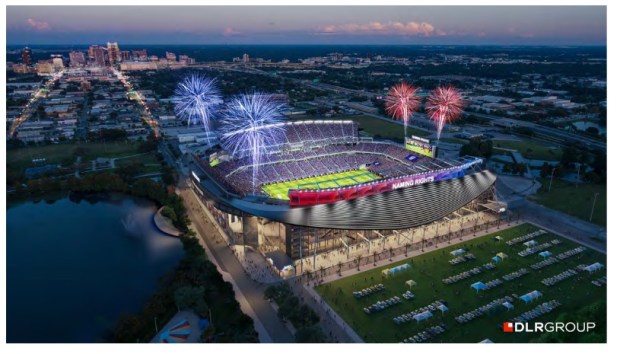 In this image, the LED lights are directed inward to illuminate the upper bowl of the stadium. (Rendering by DLR Group)
“We know there’s an ambition to bring colored light throughout the city, and so really want to tie into that effort, but we also want to create an opportunity to illuminate the underside of the bowl, so there’s kind of a dynamic to the lighting sequence, and whether it’s the underside of the bowl, whether it’s the outer skin, and how that can start to create kind of this adaptive or programmable facade,” Freeland said. “So, depending on the event, whether it’s (Electric Daisy Carnival), whether it’s a sporting event, whether it’s another festival, it can really kind of, again, carry that spirit of the event that it’s hosting.”
The design team also addressed the concerns ARB members raised during the courtesy review in July. Freeland and Adam Myerring displayed samples of the anodized aluminum that would be used for the metallic skin after members worried that it would reflect the sunlight into drivers’ eyes as they travel along S.R. 408 and I-4. “We’re looking at aluminum, a matte aluminum like this,” Myerring said. “So I know reflectivity was a comment, so we’re trying to minimize that for sure.”
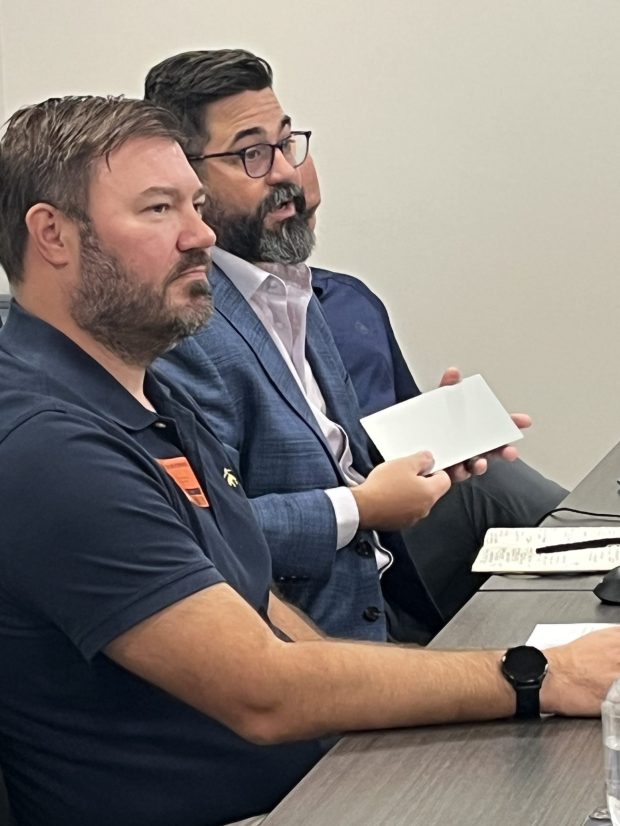 DLR Group architects Ryan Freeland and Adam Meyerring display a sample of the anodized aluminum that will be used for the bands wrapping the newly expanded stadium. They selected a matte finish to reduce glare from the sun. (GrowthSpotter staff photo)
Others were concerned about how the structural support beams for the new upper bowl would affect the streetscape along Church Street. The beams will reduce the width of the sidewalk on Church Street to about 5 or 6 feet. But ARB Director Richard Forbes said it shouldn’t hinder pedestrian movement because the street will be closed to traffic on days when there’s an event at the stadium.
Other components of the modernization project include new premium suites and amenities, updated building systems, code and fire safety updates to current standards, and a retractable stage pocket in a section of the south seating bowl to attract more and larger music events.
ARB members had asked the design team to explain how the renovations would improve the visitors’ experience at the stadium. Freeland said there was an emphasis on wayfinding, which includes using LED “ribbon board” lighting on the directional signs. The gates will be moved back to reduce congestion at the entrances. The team also raised by a few feet the connections of the cross bracing to the structural support beams to provide more clearance for pedestrians walking underneath.
“So we’re working through that with the structural engineer,” Myerring said. “We’re moving it up so we don’t have the head-knock issues, because yes, when you go through the gates, that will be a circulation path into the stadium.”
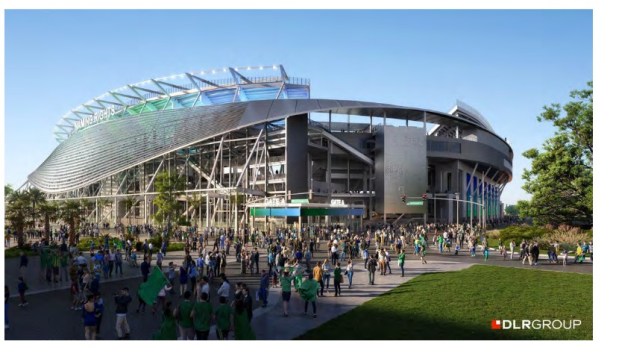 The city’s Appearance Review Board had requested renderings that would show the “fan experience” as they approached the stadium. This perspective shows the entrance at Gate A. (Rendering by DLR Group)
“I’d just like to say the wayfinding is a massive improvement,” ARB Chair Clarisse Gates said. “That’s personally one of my challenges when I visit this particular facility — a lot of people’s — and the renderings definitely help, as well as the sections to understand what’s going on. I was concerned, as well, about the head knockers in that one particular area with the bracing, so thank you for paying attention to that and trying to make it work better for all of our guests.”
When completed, the redesigned stadium will seat 65,000 guests — not including those in luxury suites — and the bench seating in the upper level will be upgraded with individual seats. Construction is expected to start early next year with a projected completion date of August 2027. The timeline allows for potential hosting of the Jacksonville Jaguars for the 2027-28 season while their home stadium undergoes renovations.
The project will be funded through Tourist Development Tax revenue, generated by a six percent surcharge on hotel rooms and short-term rentals in Orange County.
Have a tip about Central Florida development? Contact me at lkinsler@GrowthSpotter.com or (407) 420-6261. Follow GrowthSpotter on Facebook and LinkedIn.