

 As The Florida Bar marks its 75th year, the News is revisiting moments from the Bar’s formative years — debates that helped shape the profession Florida lawyers know today.
This week, we look back to the late 1930s, when the Bar was still a voluntary organization known as the Florida State Bar Association and the legal profession, like much of the nation, was struggling to recover from the Great Depression.
Economic hardship weighed heavily on lawyers across the state. Practices were shrinking, traditional sources of legal work were disappearing, and competition from banks, insurance companies, and other nonlawyer entities was intensifying. Against that backdrop, a once-settled ethical principle — that lawyers should not solicit business — came under fresh scrutiny.
In the pages of the Florida Law Journal, members of the Bar openly wrestled with whether long-standing professional norms could withstand modern economic realities. One camp argued that survival required lawyers to actively promote their services to a public increasingly unaware of how legal counsel could help them. The other warned that solicitation would erode public trust, cheapen the profession, and undermine the administration of justice.
What follows are two columns published in 1939, a month apart, under the Journal’s “The Forum” heading. Presented here as they originally appeared, they capture a moment when Florida lawyers were forced to confront a fundamental question — whether the practice of law was, or should become, a business like any other.
The Forum
LAWYER TROUBLE
EDGAR WAYBRIGHT, JR., Jacksonville
That the Bar is facing a serious economic and social problem today can no longer be doubted. That the Bar is now in the process of making serious and irrevocable adaptions to this problem is apparent to all of us. That these adaptions are often at cross purposes, each tending to destroy the effect of the other, to the detriment of the Bar as a whole, is apparent to any person willing to give consideration to the evidence at hand.
Therefore, I am submitting this article in the hope that it will stimulate others who read it into having their opinions published here, for the general enlightenment of the Bar and to aid us all in forming an intelligent public opinion about our problem.
I believe that our economic problem is part and parcel of our social problem. The economic problem is obvious: according to authoritative surveys by the American Bar Association, recently released, the average well trained attorney who has been practicing for ten years is enjoying an income of $2,500.00 per year. This amounts to about $210.00 per month. If said attorney has a home and a family, he is certainly not getting rich. In my own case, I have been practicing for four and one-half years. The first three years I practiced with my father, upon a small salary. For the past year my wife and I have been in our own office, hoeing our own row. For the twelve months from August 11, 1937, to August 1, 1938, we took in $2,030.00; or an average of $178.33 per month. After this experience we were able to balance our books and see exactly how much it was essential for us to average per month in order for us to keep our doors open and not file application with the W. P. A. We found that an income of $155.50 per month was absolutely necessary in order to stay open and live. We likewise found that we were faced with serious doubts about whether or not we would average that necessary income. For instance, our income each month charted against that absolutely essential income, looks as follows:
Percentage of income based upon necessary income of $155 per month
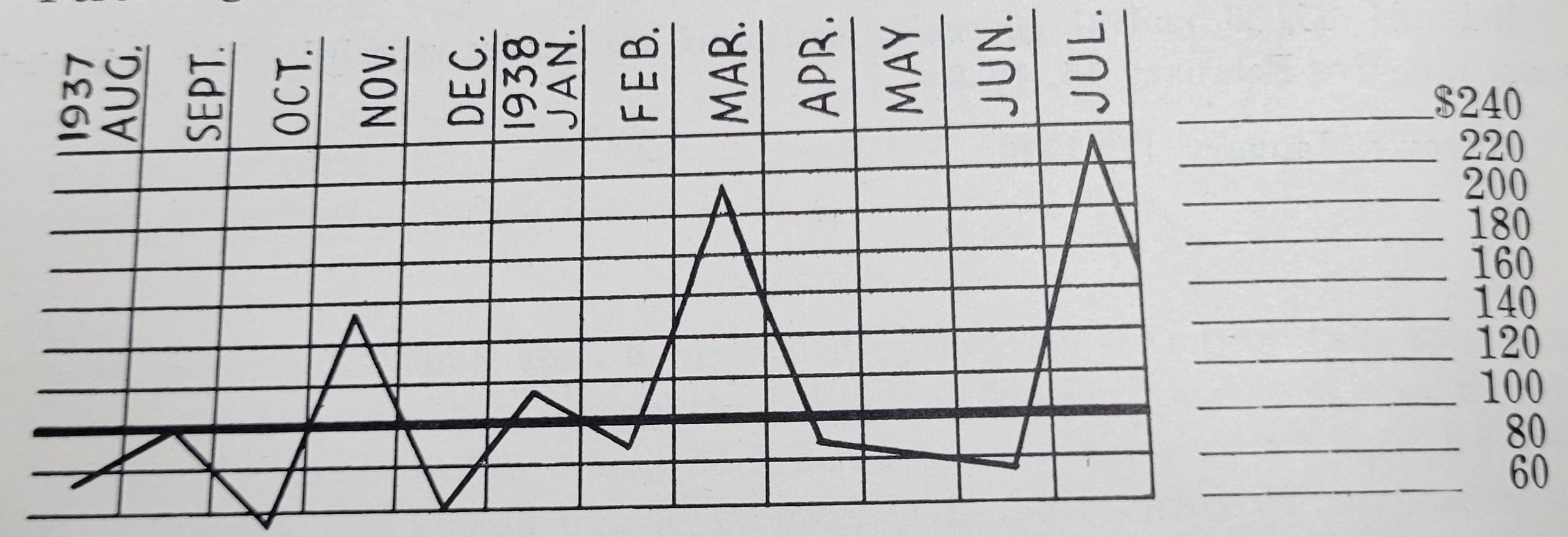
You can see from the above chart that August looked doubtful, October was a despair, December and January looked doubtful again, and that by the end of June another period of despair had arrived. You can also see what fun we’ve had stalling creditors at various periods in that cycle. And one must remember that we could not foresee a good month ahead; we often thought there wouldn’t be a good month and that we would have to close the office.
But our experience has been only typical in a small way, and on its own scale, of the most of the members of the Bar. Jacksonville has approximately 400 attorneys. Of these numbers, about one in twenty, or five per cent of our local bar, are relatively well off and make most of the income now derived from the practice of law here. This of itself should not be, and is not, the object of complaint. The trouble is that even our five percent, as well as the balance of us, are feeling unnecessary economic hardship.
I make no discussion of the very small percentage of attorneys who might be considered unqualified.
Last year we saw the Bar attempting to meet this problem by the obvious expedient of arbitrarily limiting the number of persons admitted to the Bar. At that time I pointed out the malicious effect of such a program (Florida Law Journal, July, 1937). Happily the Supreme Court, in an honest and truthful opinion by Justice Terrell, concurred in by an unanimous Court, settled for at least the present the contention that formal college education, with its financial requirements in disregard of other more important qualifications, should be the criterion for admission to the Bar.
This year we have seen the Bar attempting to meet the economic problem by the second most obvious expedient of forcing all members to operate by a Code of Ethics which prohibits the solicitation of business. The adoption of this expedient would seem to indicate that the Bar is in a truly desperate situation economically, and that the individual members of the Bar are unwilling to allow their associates to make an income by methods which tradition and the Common Law forbids. It is hardly necessary to point out that the tradition and the Common Law were established under conditions vastly different from those existing here today. Every informed attorney knows that the field for the practice of law has been reduced by half in the past fifteen years. We have seen the real estate business taken over by title insurance corporations who are permitted to advertise. We have seen the wills and administration of estates taken over by banking and trust companies who are permitted to solicit business. We have seen the defense of damage and personal injury cases taken over by insurance corporations who are permitted to solicit business. We have seen the prosecution of damage and personal injury eases taken over by these same insurance corporations, who are permitted to solicit the settlement of claims from the injured parties. We have seen many of the Court’s functions taken over by administrative commissions who have little, if any, consideration for the practice of law. If these conditions, and others similar to them, existed when the traditions and Common Law were established which forbid the solicitation of business, then I submit that the judgment of those who established them was faulty.
How does it serve the public to have a corporation, instead of a lawyer, present an injured man’s claim to itself? How does it serve the public, from a legal point of view, to have a corporation defend a damage suit claim, instead of having the defendant defend his own claim in accordance with the defense he really has or wishes to assume and by his own attorney? How does it serve the public, from a legal point of view, to have a person who wishes to own real estate represented by a corporation rather than by his own attorney in examining the title? How does it serve the public from a legal point of view, to have a person who wishes to provide for his loved ones after his death represented by a corporation, rather than by his own attorney who has spent years in personal study and practice in order to be better able to serve him? How does it serve the public to have the public keep locked tight in its bosom, through fear or ignorance, its legal problems, rather than come to us who have spent years in study and practice in order to be able to solve these very same legal problems?
As you see, I brush aside all consideration for the more acceptable forms by which these evils are known. A bad odor smells bad no matter by what name it is known. The fact that lawyers no longer serve the general public is known to the general public better than it is to the lawyers themselves, who are paying the price for their lack of service by suffering their present economic travail.
The reason why lawyers fail to serve the general public is, in my opinion, because, through confused thinking and the mockery of false idealism, the lawyers fail to solicit business. In other words, we fail to acquaint our potential cash customers with the services which we have to offer. We fail to find out from John Q. Public what his individual legal problems are and inform him what we can do for him.
Solicitation of business is an integral part of every business. Every businessman knows that production can only go forward as fast as salesmanship goes forward. Whether this be a good thing or a bad thing, it is what the public demands. If we are to survive as a profession, we must survive as a business, or become a government-controlled subsidy. If we are to survive as a business, then we must go about our economic-social problem in a business-like way. We must, in my opinion, solicit business.
TAKES ISSUE ON SOLICITATION BY LAWYERS
I read with timely interest the article of Edgar Waybright, Jr., Esquire of The Jacksonville Bar, published in the Bar Journal for January 1939 in, advocating that lawyers be authorized to solicit business. Inasmuch as I too am a junior member of the Florida bar, having been admitted to practice on March 10, 1934, I feel that many factual statements hy Mr. Waybright, Jr., as to his earnings derived from practicing law are somewhat analogous to my experiences, yet, I am not in accord with his views.
There are many reasons, in my humble opinion, why lawyers should not be permitted to do what is so assiduously advocated by Mr. Waybright, Jr., and I shall enumerate a few of them briefly, as follows:
The attorney who espouses solicitation might lose some of the few clients he now has.
The practice of bidding for legal business would he widely indulged in and prospective clients would endeavor to get the cheapest lawyer, thus reducing to a minimum reasonable attorney’s fees.
Animosities between members of the bar would be created, and time would never heal such wounds; a resentful feeling; between brother lawyers would result.
Jurors and judges in the trial of a cause, knowing that solicitation was practiced, would lose faith in what lawyers argued before them, and would become suspicious of witnesses and parties introduced by each lawyer.
Clients would be urged to litigate matters which they had decided to amicably adjust between themselves, thus seriously affecting the administration of justice by stirring up strife and fomenting litigation.
The soliciting lawyer would be entitled to at least one runner, thereby bringing about wide-spread ambulance chasing.
The dishonest and sharp practices by unscrupulous lawyers would be expanded.
The respect which the public has for the legal profession and its members would be greatly lowered.
It would bring about a most cruel exploitation of lawyers of average means but with great integrity and ability. They would bear the economic disadvantage and inequity of attempting to compete for the solicitation of business against a few with unlimited financial power and resources.
There is no more reason to permit lawyers to solicit clients than there is for physicians and surgeons to solicit patients. Would any lawyer trust his family to the physician or surgeon who solicited a delicate operation upon the lawyer or a member of his family?
The usefulness of the legal profession would cease.
Could any lawyer who has considered the question seriously abandon the wisdom of the ages, which has been our heritage?
It is my feeling that anyone who has practiced law for a period of at least five years and who has become dissatisfied with the pecuniary rewards for his efforts, although not as great as anticipated, had better give up the profession and engage in some commercial enterprise where practices of crass commercialism prevail and where he can compete and solicit as his own desires and ingenuity may prompt, rather than attempt to alter and reduce the standards which have long characterized our profession.
I am fully cognizant of the fact that there are many functions being performed daily by certain classes of corporations and insurance companies and lay agencies which encroach in some manner upon the legal profession, and which also may be detrimental to the public welfare. I do not believe that these practices and conditions can be remedied by conferring upon lawyers the right to solicit business.
I have in mind a means by which these practices and conditions might be eliminated, without reducing the legal profession to the level of “pawn-shop” standards that would inevitably result from the solicitation of business. It is highly probable that the passage of a law, broad in scope, defining the practice of law in this State, would not only be of great benefit to the general public, but to the legal profession as well. With such a law in force in this State, I submit that those legal duties which by “tradition and the Common Law” should be performed by lawyers, and which are now being performed by corporations and insurance companies and lay agencies would in a large measure be returned to those most capable and better equipped to handle them, without lowering the standards of the legal profession by permitting its members to solicit business.
Respectfully,
FRED T. SAUSSY, Jr., Tampa
(Editor’s Note: As The Florida Bar continues to celebrate its 75th year, we are reflecting on the milestones, people, and progress that have shaped the profession since the historic integration of the Bar in 1950. Throughout the celebration, The Florida Bar News is featuring stories that highlight key moments in our shared history — and we want to hear from you.
If you have memories, reflections, or personal stories about the practice of law in Florida, we invite you to share them. Selected submissions may be featured in upcoming editions of The Florida Bar News. Please email your recollections to [email protected].)