
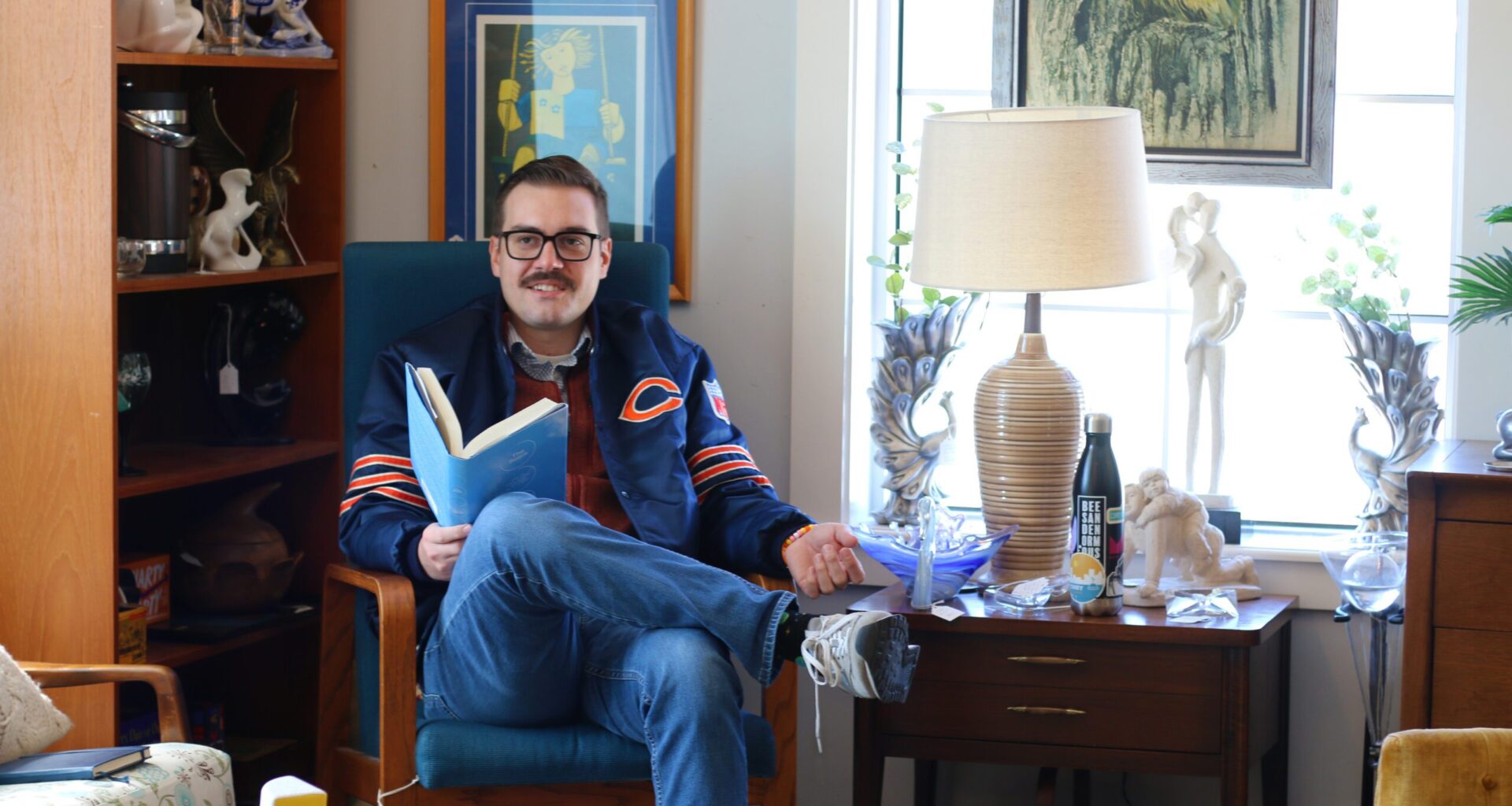
Retro music, eclectic furniture and antiques galore. By the front door, a stocked bar with both well-known brands and local brews. Whether you’re looking for unique home decor during the day or hoping to sit back, sip and converse with others at night, The Vintage Chair offers the best of both worlds. Established in 2022 in the heart of Curry Ford West, the multipurpose shop serves as a social hub, bringing people from all walks of life together under one roof.
One of its regulars, Stephen Holzman, first discovered The Vintage Chair through “Curious Conversations,” a monthly event hosted at the store for a stimulating discussion of a selected topic. At these meetups, he befriended co-owner Susan Kelly, a retired University of Central Florida professor-in-residence and licensed therapist. The two hit it off right away, thanks to their overlapping interest in education. Holzman, himself an education researcher by trade, often comes to her with questions for his projects. For two years now, Holzman has popped in at least once a week.
Growing up in Conway, Holzman attended Boone High School — a playful point of contention during our conversation, considering Kelly’s granddaughter is an Edgewater High School student, and I am also an Eagle alum. As a young adult, Holzman studied at Florida State University, which led him to a demography master’s program and job at University of Virginia’s Weldon Cooper Center for Public Service. Now, he finds himself back in Orlando, researching the very schools he grew up in and around.
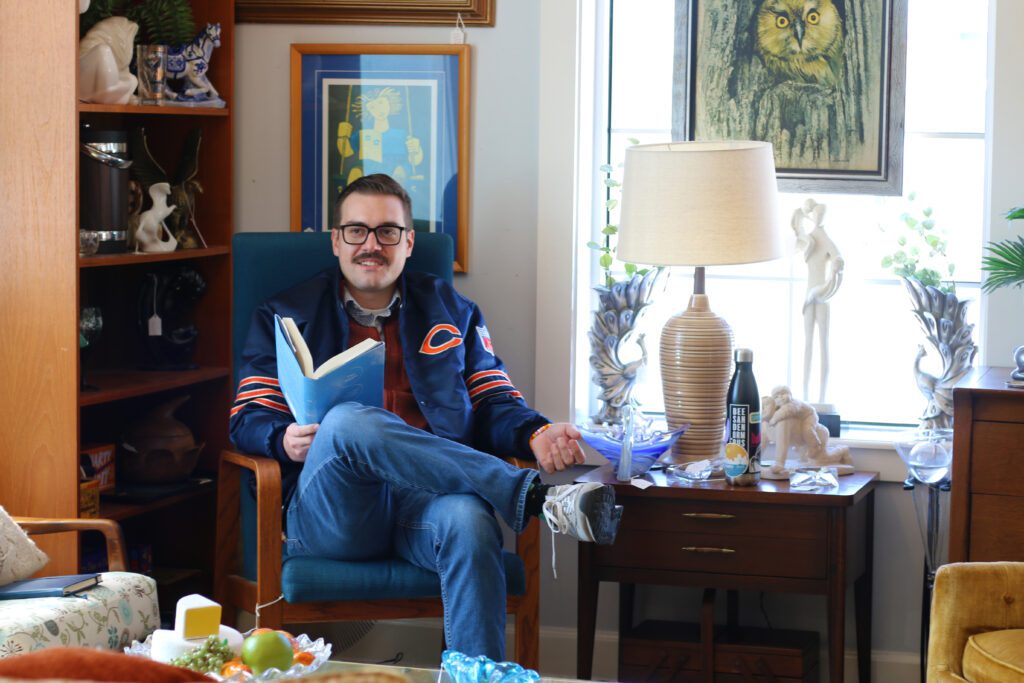
On a Thursday evening, the day of the week he typically comes to The Vintage Chair, we sat and chatted on some of the armchairs for sale. He told me about his life as an education researcher, how it connects to his habits as a regular, and a new hobby he’s picked up: birding.
(BARBARA IVINS)
When we first chatted, you mentioned you went out of your way to find a third space. Why?
Stephen Holzman: We have a book club, the Orlando YIMBY [“yes in my backyard”], an urbanist group here. We go to county meetings and advocate for more interesting shops like this, or policies that would facilitate shops like this … In that book club, we were talking about third spaces, and the political necessity of these spaces for making democracy work. There was an intentional thing, of like, “Oh, if we want to be good participants in our community and democracy, we should know our community.” We should get to know people we didn’t plan to get to know, and see what happens — to discover their humanity, and what their stories are.
In your mind, what makes The Vintage Chair stand out?
Holzman: It’s quirky. It’s filled with lots of interesting objects. But, the real draw is the interesting characters that walk through the door.
The Vintage Chair co-owner Susan Kelly, who also joined in our conversation, feels similarly. For her, the regulars are not just the highlight of her day but also a pivotal part of how she runs the shop.
Susan Kelly: What I really love about all you regulars, is that when an “irregular” person comes in, everybody’s the same way with them. Like, “Oh, hi! Who are you? What’s your name? Have you been here before?” That kind of thing. I don’t have to do anything. They do it all. And that’s — to me — that’s what you want to create, that atmosphere. … You know what it’s kind of like? Stephen, it’s like when you have a classroom, and when there’s a substitute, the kids can run the room. Not that you guys are kids, but do you know what I mean?
Holzman: You, as a teacher, you almost deputize somebody.
Kelly: Yeah!
Holzman: If you have a kid like that, you’re like, “Yeah, can you keep everybody in line?”
Kelly: Yeah. If I know if I’m busy helping somebody get some furniture out, and somebody was waiting up [at the front], somebody here who’s a regular could just like, probably stand in for me.
Holzman: Half of us have covered shifts when you need to run an errand or whatever.
Kelly: Yeah, no, Stephen’s working tomorrow. So, people who have covered for us are all — almost all, except for my family once in a while — are all visitors to the shop, and have been for a while. And I trust them.
Stephen, you’re an education researcher. Tell me more about that.
Holzman: I am working on a book right now. I’m independent, so I have no direction other than making sense of what I see going to school board meetings. … I think coming to places like [The Vintage Chair] — one, I have an expert that I can consult with, and a direct witness to some of the history of policy decisions — but also, you pick other people’s education experiences: “What was it like for you?” We have retired school principals that come through here, or colleagues of my teachers … Maintaining those connections, and getting the real story, the one that you don’t get from the PR folks at the district or whatever, is part of why I like being out in the community.
Why do you think your work, and education as a whole, matters?
Holzman: I mean, at least in Orange County, it’s the day-to-day life of, literally, a couple hundred thousand kids, 14,000 teachers, more staff on top of that. And their day-to-day life, their joys and anxieties and all that, are facilitated by this political mess — where they chase different projects, or they have different understandings of what’s actually happening in classrooms. It’s a hot mess, and I care about those people.
And, again, coming into these [third spaces], you run into your teachers, and you’re on equal footing. In the larger third space theory, it’s like running into politicians — or maybe even city or county staff — in a third space; you’re on equal footing, and you don’t have to play the games that happen in a big bureaucracy. It’s tough to work out. But when things are broken, you almost depend on a space where everybody can lay their cards on the table. … There are fundamental problems that we’re trying to outrun, and sometimes you gotta slow down and grab a coffee or beer and see where the conversation goes.
Outside of your research, what else do you do?
Holzman: I’ve really gotten into birding. … I like picking places that make sense to read the book that I’m reading. Donna Haraway is a historian of science and a feminist theorist, but she had a lot of books on how we interact with animals in spaces, and she’s coming from primatology. And so, watching the birds, and reading some of her work on what we can learn from birds, … it helps you really immerse yourself in it.
What do you love about birding?
Holzman: It’s almost like a ballet. I guess, “Swan Lake” came, and I heard one of the houses by Lake Davis playing that music, probably in April or May, and it kind of clicked. … You can never look at everything all at once, but you pick the little bit that you can focus on, and everything else happens in the background. And it is a ballet: The ducks come in, but then, another group of birds and moorhens are marching around and they react to each other, and the geese are always p—– off. It’s like a musical thing.