
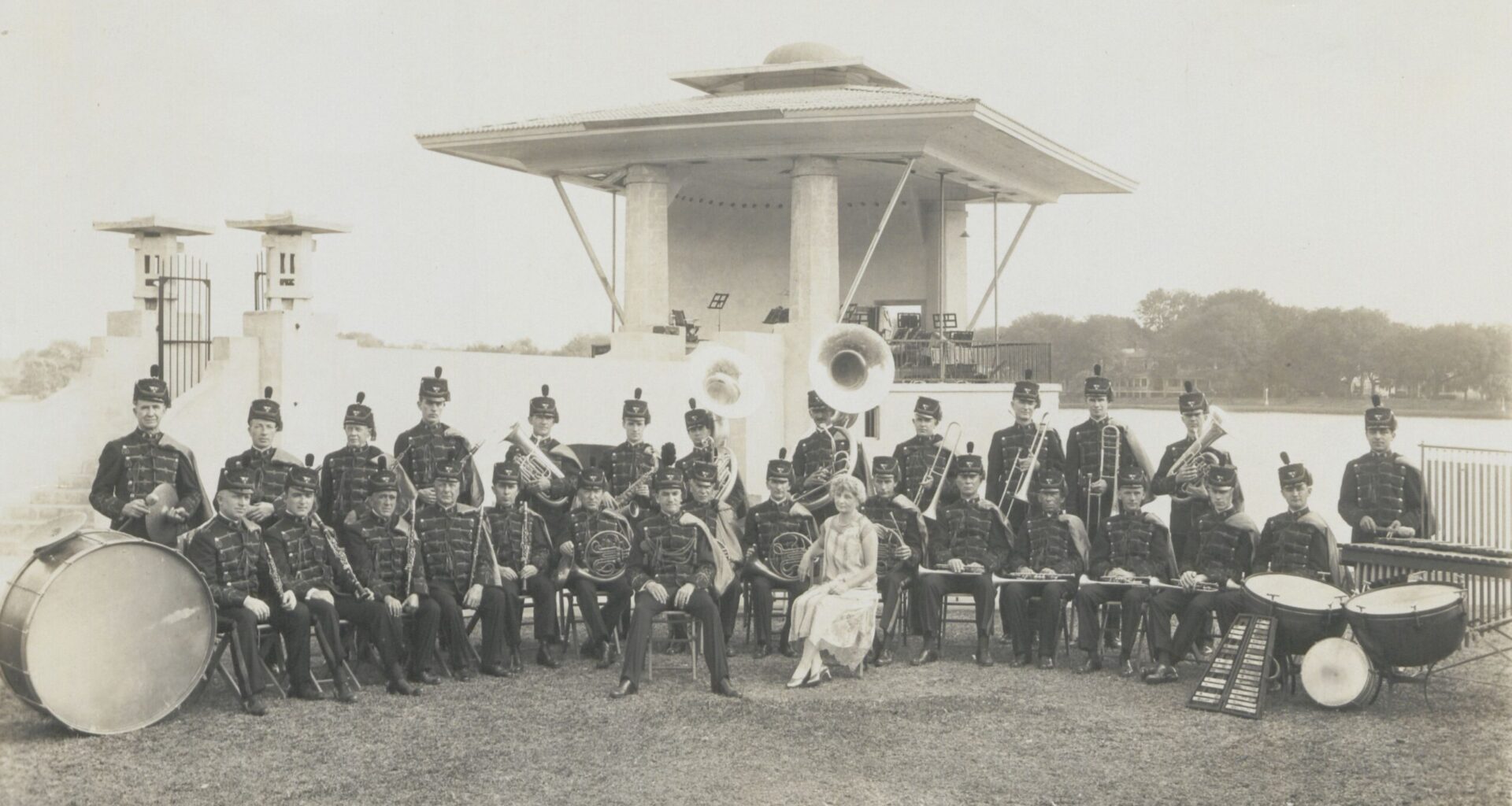
Known for its swans and iconic fountain, Lake Eola is one of Orlando’s most popular, recognizable and picturesque landmarks. For residents and visitors alike, walking the circular path around the lake is a familiar downtown activity that connects them to Orlando’s cultural identity. Along this route is also the Walt Disney Amphitheater, an open-air bandshell with a rainbow design on the outer facade. Although this version is the one we’re most familiar with today, the present incarnation represents the most recent face of an evolving structure. Before the amphitheater, an earlier bandstand served as a focal point for music, gatherings and public life in the city. Behind it was none other than Ryan and Roberts, Orlando’s first-established women-led architectural firm.
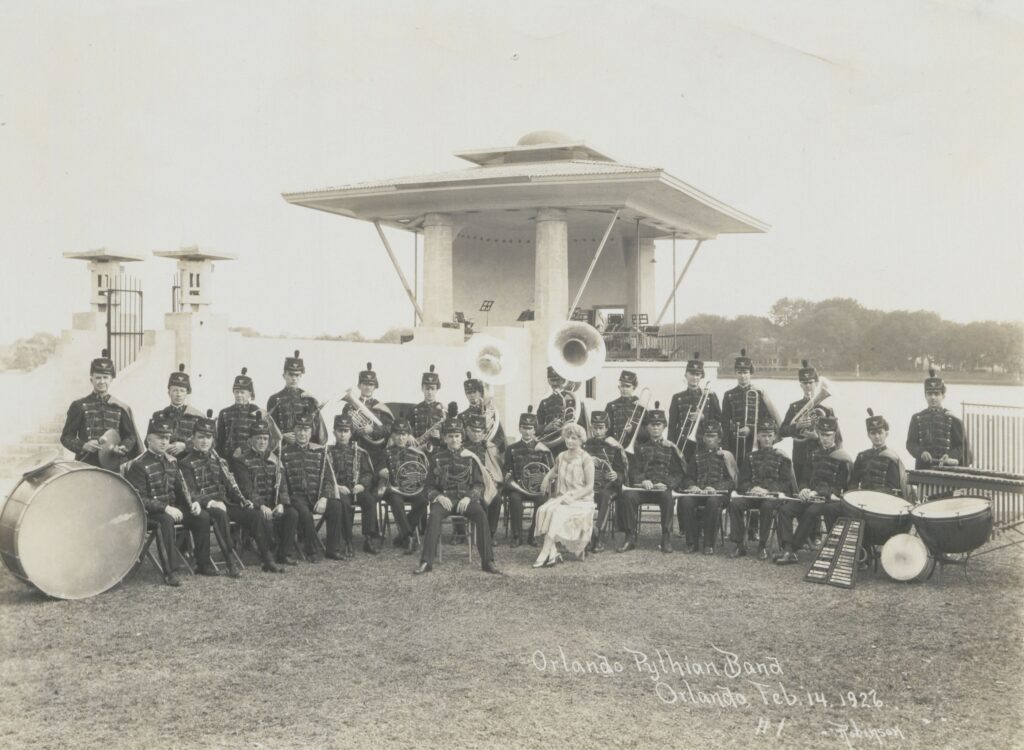
Photograph of the Orlando Pythian Band taken in front of the Lake Eola bandstand in 1926. (COURTESY OF ORANGE COUNTY REGIONAL HISTORY CENTER)
Isabel Roberts, born in 1871, was an architect and a practitioner of the Prairie School style. Born in Mexico, Missouri, she trained in New York before becoming one of only two women to join Frank Lloyd Wright’s studio in Oak Park, Illinois. There, she contributed to design efforts while refining her own architectural style in one of the most influential environments of the era.
In the late 1910s, Roberts relocated to Florida, where she eventually settled in Orlando. She formed a professional partnership with Ida Annah Ryan, a Massachusetts-born architect and the first woman in the United States to earn a master’s degree in architecture. Together, they established Ryan and Roberts, one of the earliest women-led architecture firms in the nation and the first of its kind in Orlando. Their firm stood out among the city’s active architectural practices in the 1920s.
The work of Ryan and Roberts was known for the breadth of its portfolio. Operating from a downtown Orlando office and their shared home and studio, the firm designed a wide range of civic, residential and commercial projects throughout Central Florida. Their portfolio included apartment buildings, churches, schools, banks, libraries and private homes in Orlando and nearby St. Cloud.
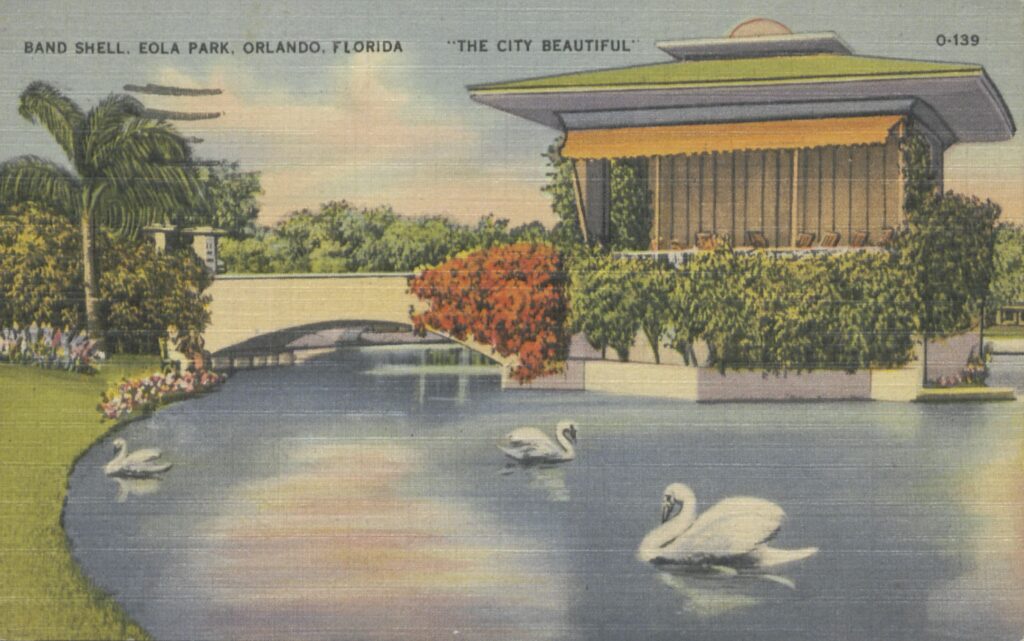
Postcard illustration of the Lake Eola bandstand and bridge featuring swans and a cloudy sky. (COURTESY OF ORANGE COUNTY REGIONAL HISTORY CENTER)
Among their most celebrated projects was the original Lake Eola bandstand, completed in 1924. Designed by Isabel Roberts, with Ida Annah Ryan as her partner, the structure was commissioned after their firm won a city-sponsored design competition. The bandstand’s aesthetic paid homage to the Prairie School principles of design, with strong horizontal lines, a cantilevered roof, geometric elements and ornamental lamps. Japanese influences appeared in its layered roof forms and lanterns, which were frequently featured in Prairie-style designs.
With the success of community events at Lake Eola, Ryan and Roberts’s city-commissioned bandstand quickly became more than a performance venue. It functioned as a backdrop for concerts and community gatherings and became a familiar image on postcards and promotional materials during a period of rapid growth and increased tourism in Orlando.
By the late 1950s, however, the structure was in poor condition and was ultimately demolished. Over the years, the Lake Eola bandstand evolved into the present-day amphitheater we know and love. Although the original bandstand is gone, many contributions made by Ryan and Roberts still stand in Orlando and St. Cloud today.
___
Liss Castillo is a museum technician at the Orange County Regional History Center.