
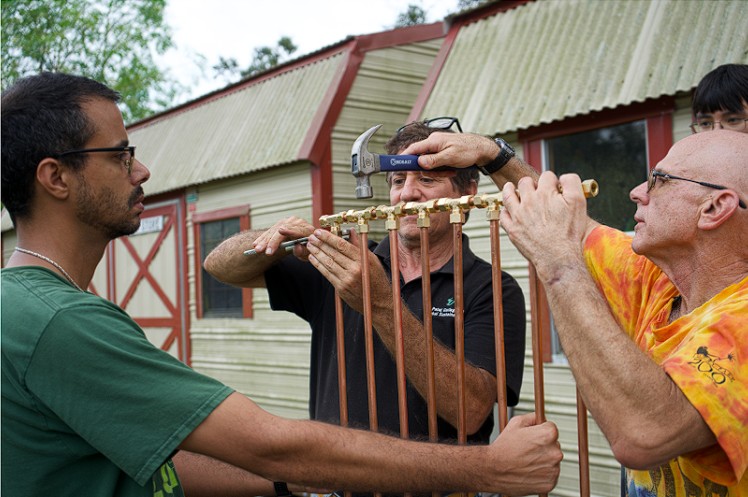
 Zaid Alkhairi, on the left, and Thomas Culhane, in the middle, assemble the solar water heater prototype at Rosebud Continuum. SPECIAL TO THE ORACLE/LOGAN RANCE
Hot water is inaccessible to millions of displaced people worldwide — but two USF graduate students are working to change that.
Chelsea Mandrigues and Zaid Alkhairi are both master’s students in the USF Patel College of Global Sustainability.
Last semester, Mandrigues and Alkhairi spent their weekends constructing a solar water heater specially designed to bring hot water to people living in refugee camps.
Solar water heaters use the sun’s energy to generate heat without relying on external power, and can be installed on rooftops and other sunlit outdoor spaces.
Many solar water heaters rely on welds or custom parts, making them difficult to repair, replace or construct — especially in conflict zones.
However, Mandrigues and Alkhairi’s design reflects a much larger ambition.
In fall 2025, Mandrigues and Alkhairi engineered a system and completed their first prototype using accessible materials — such as copper pipes and Plexiglas.
“With what we’re building, we want to be able to ship something ready to assemble, that can be put together with just a wrench and a hammer,” Alkhairi said.
Related: USF rocket team takes flight in NASA competition despite challenges
Alkhairi, who grew up in Jordan, said he is no stranger to water security issues. He said he understood from a young age how limited access to water can make life difficult.
“This is something that I care passionately about, and I’m here to provide ideas,” he said.
Mandrigues carries her own memories of water insecurity.
As a child living through Michigan’s harsh winters, she said she sometimes lacked hot running water and remembers heating pots on the stove to take a warm bath.
“From my own experience, I know that having [hot water] is about dignity,” Mandrigues said.
Mandrigues and Alkhairi said those experiences instilled a desire to help others — especially people in crisis.
When they saw families struggling to access essentials such as clean water in places like hurricane-stricken Jamaica and war-torn Gaza, the project’s purpose became clear — to help restore this basic human necessity.
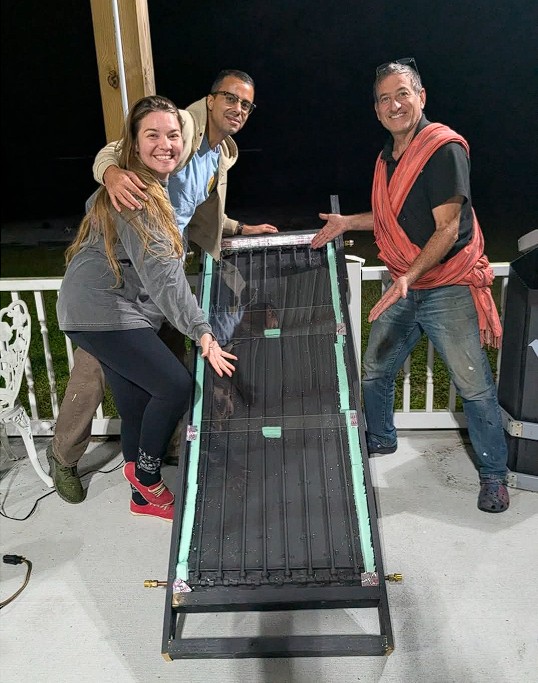 Chelsea Mandrigues, on the left, Zaid Alkhairi, in the middle, and Thomas Culhane, on the right, display their newly constructed solar water heater. SPECIAL TO THE ORACLE/CHELSEA MANDRIGUES
Although Mandrigues and Alkhairi met at USF, much of the project’s hands-on work took place at Rosebud Continuum, a sustainability education center in Land O’ Lakes.
Many specialists helped guide the project, including Thomas Culhane, an assistant professor at USF’s Patel College of Global Sustainability.
Culhane said the project’s design is inspired in part by his own work building solar water heaters in Cairo and Palestine during the mid-2000s — when he was a graduate student studying urban planning.
According to him, blockades often prevent metal tools and welding equipment from entering Gaza.
Therefore, a solar water heater that can be assembled without welding or fuel-powered torches is critical in areas with similar restrictions.
“With these embargos, you can’t even get in medicine or food,” Culhane said. “So you’re certainly not going to get acetylene torches and gas cylinders needed for welding. But you could, feasibly, get in copper pipes and Plexiglas.”
Related: USF seniors launch Bulls Give Back to fight food insecurity in Tampa Bay
Hot water is necessary to support disease prevention, sanitation and personal hygiene — but refugee camps often have limited access to the resource, according to the United Nations High Commissioner for Refugees.
But Mandrigues said the issue goes beyond physical health.
“In human rights work, one of the main tactics of genocide or oppression is to strip people of their dignity,” she said. “Sometimes something as small as warm water helps restore that.”
Alkhairi added that water is essential for every human being.
“If we can’t provide at least hot water to people who need it, then what are we really doing?” he said.
And though the team said the project has required persistence and dedication, Mandrigues and Alkahairi said it feels like they’re hitting their stride.
“Now that we’ve finished this first panel, the next one will come together quickly,” Mandrigues said.
Culhane said he envisions publishing videos, schematics and step-by-step guides after the prototype is up and running at Rosebud Continuum this semester — so anyone can replicate the system even if construction materials can’t cross borders.
Mandrigues and Alkhairi said they believe their solar water heater can serve as a model for communities around the world, and are hopeful other students will join them.
“If you can see a child smile because they took a warm bath, I feel like I’d be happy for the rest of my life,” Mandrigues said.