
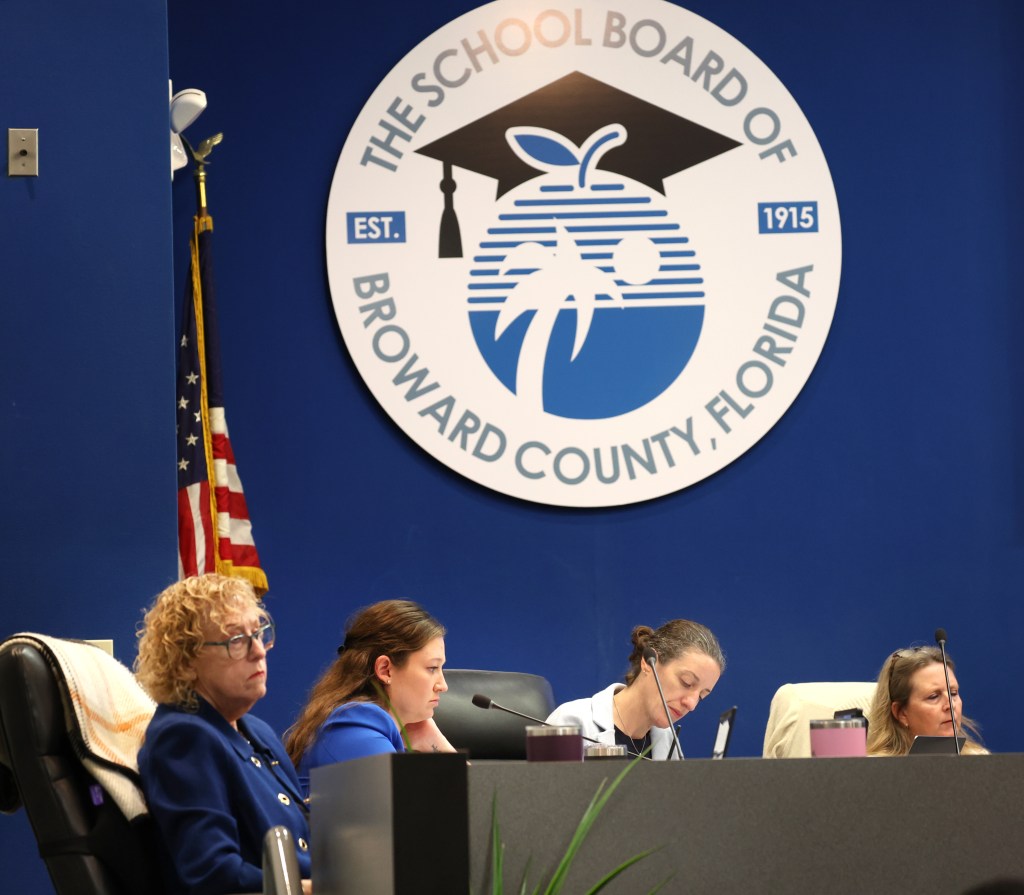
Broward school administrators failed to adequately inform the School Board or the public of a controversial plan to give high-paid administrators bonuses of up to $14,000, a school district audit has concluded.
The report, completed by the office of Chief Auditor Dave Rhodes, provides new details but doesn’t fully explain how administrators making up to $265,000 a year collected large supplements from a 2022 referendum that was pitched to voters as a way to boost teacher pay.
Several board members have argued they were misled into approving the bonuses because an agenda item for a July 2024 meeting omitted key information.
“Staff did not exercise the level of diligence, internal control or transparency required when administering voter-approved funding, undermining the board’s ability to make informed decisions and to ensure the integrity of referendum-funded supplement allocations,” the auditors wrote.
The audit states that David Azzarito, a human resources administrator, placed the item on the July 30, 2024, School Board agenda. Azzarito told auditors he discussed the idea with Superintendent Howard Hepburn, but Hepburn said he didn’t recall discussing it with Azzarito or approving it, the audit said.
Azzarito told auditors that Judith Marte, who retired as deputy superintendent of operations in July 2024, was initially not supportive of the idea, but she “started to change her thinking” in May or June 2024, the report said. Marte told the South Florida Sun Sentinel that’s untrue.
“I was never supportive of downtown administrators getting any referendum since I believed the language intended to give funds to school-based and front-line staff,” Marte said in an email. “I never changed my thinking, and had I not retired, I would have refused the money.”
Records show that Hepburn was the only employee to decline the money. The School Board voted Jan. 6 to stop payments for about three dozen others in senior leadership positions but did not claw the money back.
But that could change. School Board member Allen Zeman said he plans to bring a request to the School Board in March to seek reimbursement from any administrator still working for the district who received referendum payments that the School Board never intended to approve.
The referendums only last for four years, and the School Board plans to ask voters to renew it. The money, which is used for safety and mental health as well as employee supplements, will go away if voters fail to approve it in November.
Zeman said the district needs to assure voters that the problems with the referendum funds have been fixed. He said he hopes Hepburn will first ask staff members to voluntarily repay the referendum money.
“We don’t want voters to say, ‘that’s the money they gave away to high-paid people,’” Zeman told the Sun Sentinel.
Board member Adam Cervera said he plans to ask the School Board on Tuesday to direct Superintendent Howard Hepburn to implement a series of recommendations identified in the report, which include setting clear eligibility requirements for referendum money and making changes only if discussed in a workshop and approved by the School Board. Chairwoman Sarah Leonardi has agreed to co-sponsor the item.
“What the audit says very clearly is that there were failures in process, documentation and governance, and that transparency was insufficient at a systemic level,” Leonardi told the Sun Sentinel.
Leonardi added that district officials have already taken steps for improvements, such as requiring more detailed executive summaries on board items, and ensuring that staff fully brief board members about agenda items.
Zeman said he also expects Hepburn “to hold individuals accountable for their roles in this debacle.”
The audit traces some of the issues back to 2022, when the referendum was placed on the ballot. The district was seeking a renewal of one passed in 2018, and the earlier one had language that restricted referendum money to teacher pay, safety and security and mental health. The 2018 tax was $50 per $100,000 in assessed property, while the 2022 tax increased to $100. With the extra money, School Board members agreed to expand the money to groups beyond teachers.
Instead of limiting supplements to teachers, the new referendum said the money would go to teachers and staff. But the district didn’t define which non-teaching staff would benefit, the audit found.
School district staff did not provide auditors “with tangible records or testimony documenting details of the decision-making process,” nor did they identify anyone who initiated the discussions in the superintendent’s leadership team, also known as the Cabinet.
Azzarito and district administrator Valerie Wanza told auditors “that the Cabinet discussed concerns about the ‘optics’ of including executive directors and Cabinet-level administrators,” the report said.
In August 2023, Azzarito met with School Board members individually to discuss allocations for each employee group. The School Board agreed that month to give most employees referendum supplements of 5.5% of their base pay. The agenda item specifically stated that the money would only go to district-level administrators with the position of director or below, meaning executive directors, associate and deputy superintendents and chief executives would be excluded.
After the 2023 allocation was approved, Azzarito and other administrators were told of situations in which certain executive directors were earning less than directors, since directors collected referendum dollars, the audit states.
“At that point, further discussions arose that giving increases to executive directors would create the same problem with the chief executives,” the audit stated, attributing the information to unnamed district officials.
Marte told the Sun Sentinel, “I was not supportive of directors getting any of the funds since some executive directors were lower paid. I was vocal but this predates Dr. Hepburn, and I was vocal at Cabinet.”
On July 1, 2024, Azzarito emailed a compensation manager to provide him with financial data related to the inclusion of all employee groups, saying he needed it for a closed-door session scheduled for July 23, 2024, the audit states. Neither Azzarito nor Hepburn said they recalled whether the issue ever got discussed during a closed-door session, the report states.
The 2024-25 referendum allocations, submitted by Azzarito, were placed on the School Board agenda on July 30, 2024, but it made no mention of adding higher-paid employees, the audit said. The item said that all eligible employees represented by the management employee group Educational Support & Management Association of Broward, or ESMAB, would qualify for the referendum money.
Azzarito could not explain why the language about the money going to only certain groups was removed without explanation, the audit said.
“He characterized the error as an ‘oversight,’” auditors wrote.
While there was no discussion about high-paid employees being added, the School Board did vote unanimously to commit the money for three years.
Auditors interviewed three former School Board members, Torey Alston, Daniel Foganholi and Brenda Fam, asking them whether they recalled who the 2024-25 referendum money was intended for. Fam said she thought it was only intended for lower-paid employees, while Alston and Foganholi said they thought it was intended for all, the audit said.
Several current board members, contacted by the Sun Sentinel, also had different recollections. Leonardi and Zeman said they don’t remember ever being told the money would go to the highest-paid administrators. Debbi Hixon said she believes it was discussed, and she opposed it.
Auditors “did not find the staff’s efforts to inform the board members were fully transparent or effective, but the assertion that staff acted in contradiction to the board’s direction was not substantiated during the investigation,” the report said.
“Transparency and accountability are priorities for the Superintendent, and he appreciates the recommendations outlined in the report,” district spokesman John Sullivan told the Sun Sentinel. “The Superintendent remains committed to continuous improvement and to working collaboratively with the School Board to strengthen governance and public trust.”