
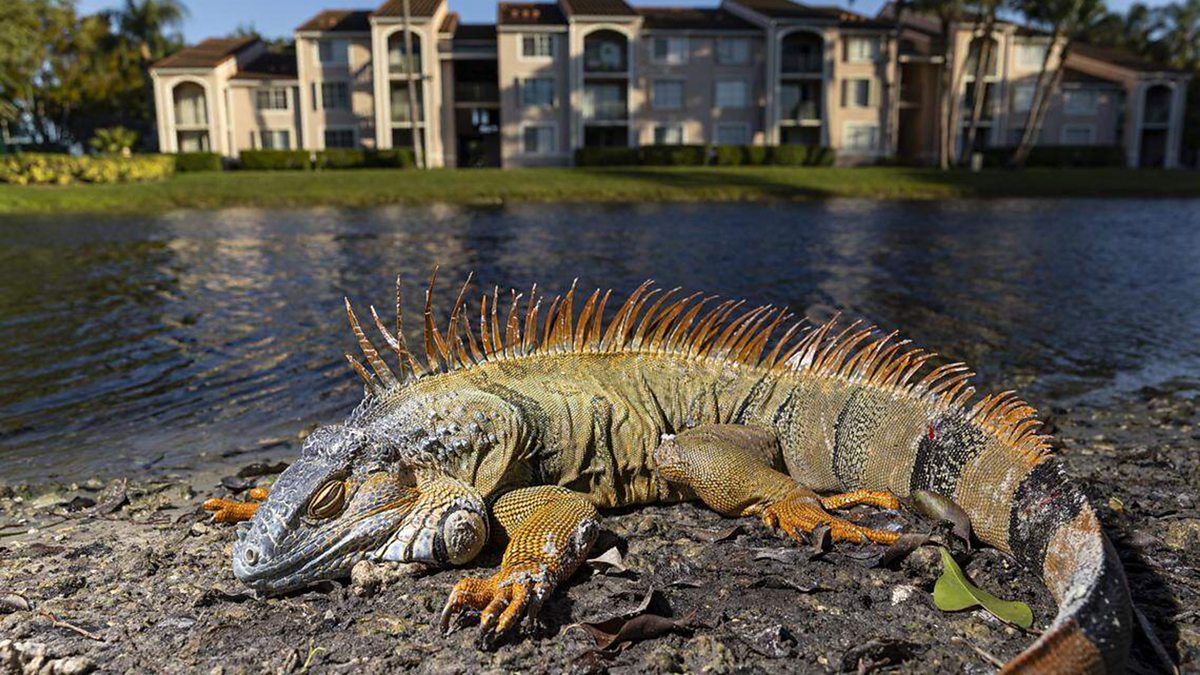
Iguanas are cold-blooded reptiles – meaning they rely on the sun and higher temperatures in order to stay warm.
But once temperatures drop below 4C (39F), the lizards go into a form of survival mode.
Drop it like it’s cold
In these colder conditions, an iguana’s metabolism will slow dramatically and their heart rate and breathing decreases. They enter a state known as torpor – which can look as if they are in a sort of coma.
In this state, their nerve signals slow down to a point where they cannot move, or grip onto branches.
Combine that with the record low temperatures – some parts of Florida reached -5C (23F) in early February – and it appears as if the iguanas have frozen solid.
Typically, iguanas won’t suffer any long-lasting effects from entering torpor – unless they were particularly high up in a tree before falling.
As the temperatures rise, the iguanas start to ‘thaw’ out, coming out of their cold-stunned state and recovering. Despite the freezing overnight temperatures seen across Florida, in some parts of the state temperatures still reached between 7C (45F) and 12C (54F) during the day.