
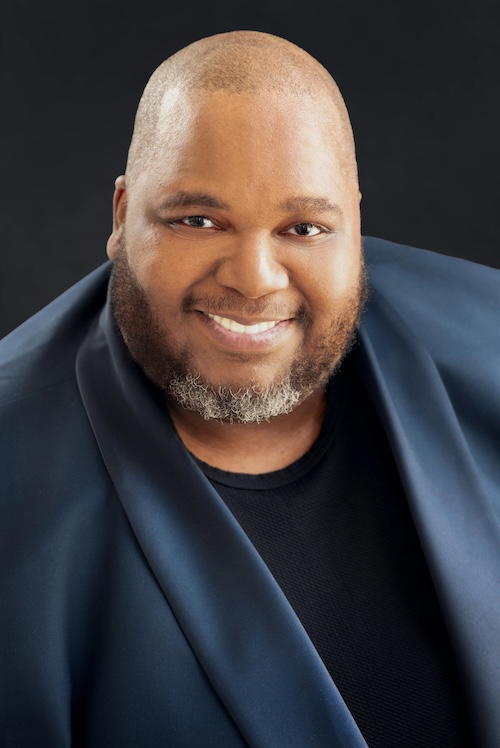
Limmie Pulliam performed with the Jacksonville Symphony Friday night at the Kravis Center.
The Jacksonville Symphony blew some dust off the traditional orchestral concert format Friday night, building an entire performance at the Kravis Center around the formidable American tenor Limmie Pulliam.
Pulliam, a Missouri native, has spoken frankly about his decision to abandon music after college due to rejections over his severe weight problem. For years he worked as a bill collector, then ran a security guard company before making another attempt at a musical career.
“He Quit Singing Because of Body Shaming,” read The New York Times headline on his 2023 Carnegie Hall debut. “Now He’s Making a Comeback.”
Pulliam’s comeback has included performances with the Metropolitan Opera, the New World Symphony, Cleveland Orchestra and other leading organizations. He performed the role of Canio in Leoncavallo’s Pagliacci with Florida Grand Opera in 2024.
At the West Palm Beach concert, he gave a performance in two parts: A series of love songs by Richard Strauss and a succession of operatic greatest hits.
Lieder performances are rare in South Florida, so the orchestrated Strauss songs were the most interesting part of the program. Pulliam’s dark burnished tenor voice and crisp German articulation suited the songs well, his vocal power apparent not only in fortissimo climaxes but in soft passages in which he filled the hall with an effortless, lustrous legato.
The orchestra, conducted by music director Courtney Lewis, gave transparent, brilliantly colored accompaniments, although occasionally edging a little too loud for the singing.
In “Allerseelen,” Pulliam deployed his deep, plush sound in a wistful love song, singing the words “Gib mir die Hand” (Give me your hand) in tones of pensive romantic intimacy and bringing shining high notes to the climactic phrase in which the poet asks his love to return.
He brought urgency and headlong passion to “Cäcilie.” The orchestra played quite loud and at times threatened to overpower the singer. But Pulliam’s voice was so big that the extra power he drew on to stand up to the orchestra gave the performance that much more force.
In “Morgen!” his restless performance sounded as if he were improvising a poem on the spot, in a delicate expression of the joy of romantic love. His vocal power soared through the hall in the brassy, celebratory “Ich liebe dich.” He brought urgency and passion to the darker, minor-key broodings of “Zueignung,” a more ambiguous song about the joys and tribulations of love.
Concert performances of arias can come off as superficial, as a succession of famous tunes ripped from their dramatic contexts. But Pulliam’s performances were so committed, so fully characterized and theatrically sung, in a voice so powerful, that they came off with much of the force they might have had in a first-rate operatic performance.
It may be impossible to restore any freshness to “Vesti la giubba” from Pagliacci. But Pulliam brought out its raw emotion, movingly expressing the grief of a comic actor preparing to perform after learning that the love of his life had betrayed him. In luxuriant if tragic tones, he sang expressively of Harlequin taking away his Colombina and clapped his hands in bitter self-mocking applause. His voice soared into a heartrending account of the aria’s climactic passage, “Ridi, Pagliacco,” bringing a sob into his voice as he quietly repeated the words.
In “E lucevan le stelle” from Puccini’s Tosca, he expressed the desperation of a man facing execution, bringing anguish into his voice while maintaining all of his vocal luster. He gave effective performances of “Recondita armonia” from the same opera, pantomiming a painter gazing at his own work, and “Nessun dorma” from Puccini’s Turandot, with stupendous vocal power in its climax. But he was at his most moving and effective in the tragic arias that gave scope to his powerful voice and expressive intensity.
Although the orchestra appeared to lack the string player dimensions of most orchestras, its sound was full and balanced and the performance virtually immaculate, with precise playing through all sections.
The concert opened with the Prelude and Liebestod from Wagner’s Tristan und Isolde. Lewis led a performance that at first felt brisk and restrained, if technically polished. But the playing bloomed in a great crescendo to the overture’s climax, with a fine sense of dynamics and balance in the long series of ascending notes of the climax of the Liebestod.
In Tchaikovsky’s Romeo and Juliet Fantasy Overture, the well-known melodies came off with glowing sensuality. But the best part was the musical portrayal of a sword fight —particularly bracing amid all the vocal lyricism in the rest of the concert—with strings racing with strongly articulated precision at high speed in passages punctuated by precise crashes of brass and percussion.
Limmie Pulliam performs again at the Kravis Center in West Palm Beach at 2 p.m. Sunday in a program called “Witness: An Afternoon of Spirituals,” with pianist Mark Markham. kravis.org
Posted in Performances
Leave a Comment