
Chip and Kasinee Tolman begin each day by lifting their two adult children out of bed and into their wheelchairs. They place them on the toilet and, after helping them use it, carry them back to their chairs. While one parent feeds them, the other washes their sheets.
“It’s a twenty-four seven situation. You have to do everything for them. Their cognitive skills are like babies,” said Chip Tolman, whose children, ages 24 and 28, have cerebral palsy and mental delays.
The 71-year-old Orlando father has bad knees and continual back pain from the effort. But his biggest concern is who will care for his kids after he and his wife die.
Tim and Marie Kuck, founders of the Orlando nonprofit Nathaniel’s Hope, which offers respite care to families with disabled children, hope to offer him a solution.
The Kucks have purchased close to 400 acres in east Orlando that they plan to transform into a home for about 200 adults with disabilities. The goal is to provide those adults with a place to live and work and give families the peace of mind that their loved ones will be well cared for.
The plans for Hopetown include independent and group homes, a skilled nursing facility, a cafeteria, a town center with event space, recreational land and businesses where residents can work.
“It’s a community like Baldwin Park and not anything remotely close to an institution,” Tim Kuck said. “It’s a place that will have residents but also be for the Orlando community. We hope to make it very inviting.”
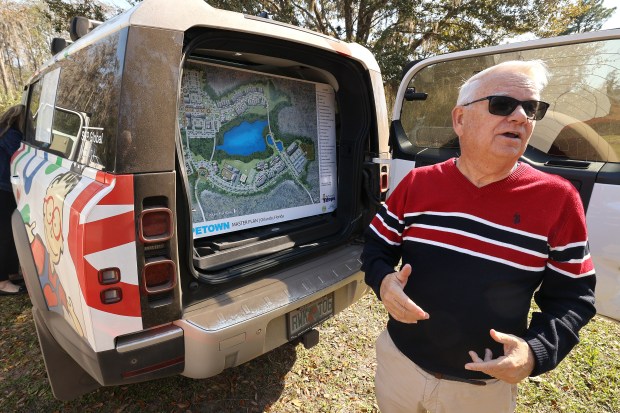 Tim Kuck discusses a plan to build a community on 400 acres of land for disabled people. He is pictured on Thursday, January 29, 2026. (Stephen M. Dowell/Orlando Sentinel)
The Kucks added 200 acres of land earlier this year to the 171 acres of adjoining land they acquired in 2022. The couple paid a total of $7 million for the land and expect to spend $100 million developing Hopetown, which they are modeling after a development near Austin, Texas.
That Texas community, founded in 1953, aimed to create a place where adults with cognitive disabilities could live, work and learn in a development that charted a “dramatically different course compared to the institutions of the day.”
The Kucks started their nonprofit more than 20 years ago after their son Nathaniel, who had an undiagnosed condition that left him disabled, died at the age of four.
“We were thrown into a community that we weren’t prepared to be a part of. But once we were there, we learned so much,” Marie Kuck said.
Their nonprofit, which has expanded to 38 states and three countries, rents space in local churches and brings in skilled caregivers to provide respite care, allowing parents to drop off their children for a few hours each week and get a break from caregiving.
“When you went there, you always knew that the people taking care of your kids were top notch, top notch all the way,” said Chip Tolman, who dropped his kids off at Calvary Orlando every Saturday for three hours when they were young.
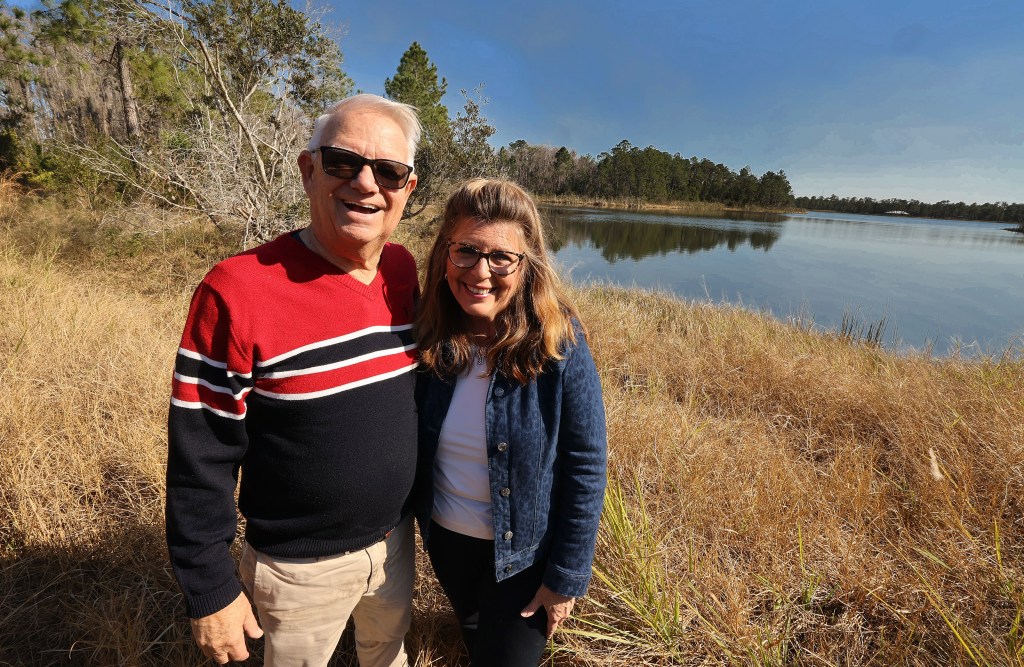
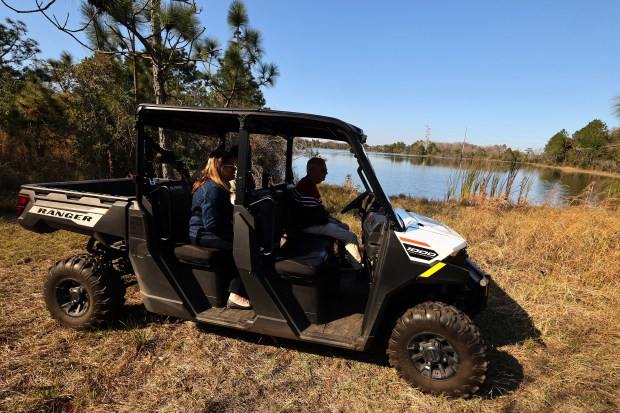 Tim and Marie Kuck are pictured on Thursday, January 29, 2026, on a 400 acre tract of land in Orlando where they plan to build a community for disabled people. (Stephen M. Dowell/Orlando Sentinel)
Now he hopes his children will be among the first residents of Hopetown. When there, caregivers can wheel them to the town center to check out the shops, take them to the cafeteria to have a meal with their peers or push them on the handicap accessible trail that the Kucks want to construct around a lake on the property.
“My kids have a good time looking around and seeing stuff. They don’t want to sit at home and look at the big screen TV, watch Disney videos. I can tell they get real bored with that.”
The Kucks own Regal Boats, an internationally known luxury boat manufacturer. They will own all the properties at Hopetown and rent them out to businesses and residents.
They also plan to open up about 200 acres of conservation land on the property to the community for hiking, fishing and birdwatching.
Ideally, donations from the community will help build the development and keep residents’ rents low.
“We don’t want this to be a community just for the wealthy,” Marie Kuck said. “Everybody should be welcome here.”
At Marbridge, the Texas development that is home to 265 disabled residents, the monthly fee is $4,475. That includes rent, utilities, food, access to caregivers, job training and other amenities. About half the residents receive financial support through Marbridge’s fundraising efforts to reduce their rent.
“Our goal, though, is to make our endowment much larger, to be able to get anyone a scholarship, so that anyone can live here,” said Steven McAvoy, CEO of Marbridge.
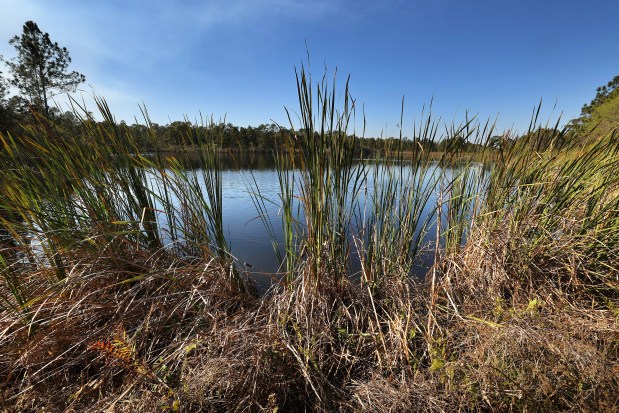 Tim and Marie Kuck plan to build a community for disabled people on this 400-acre tract of land in Orlando that is pictured on Thursday, January 29, 2026. (Stephen M. Dowell/Orlando Sentinel)
The Kucks want to partner with local hospitals and other agencies to bring services to Hopetown.
They’d love for local hospitals to set up medical facilities in the neighborhood where people with disabilities, both residents and nonresidents, can come for care.
They’d like to have an athletics complex with recreational activities.
“With a gymnasium, maybe a splash pad, a pool that would also be available to the Central Florida community,” Tim Kuck said.
There will be a work center that will train residents on job skills, a petting zoo and shops and restaurants for residents and the greater community, he added.
“We’re hoping to have an ice cream shop. And wouldn’t it be great if the people in the community across the street brought their friends over for ice cream?” Marie Kuck said.
“Tim and Marie are amazing people,” Chip Tolman said while discussing the project over the phone. “And it’s such an ambitious project…” He got choked up and passed the phone to his wife.
“We’re doing the best we can right now,” Kasinee Tolman said, holding back her own tears. “And I hope a lot of people, like us, can look forward to Hopetown, like a candle that lights up.”