
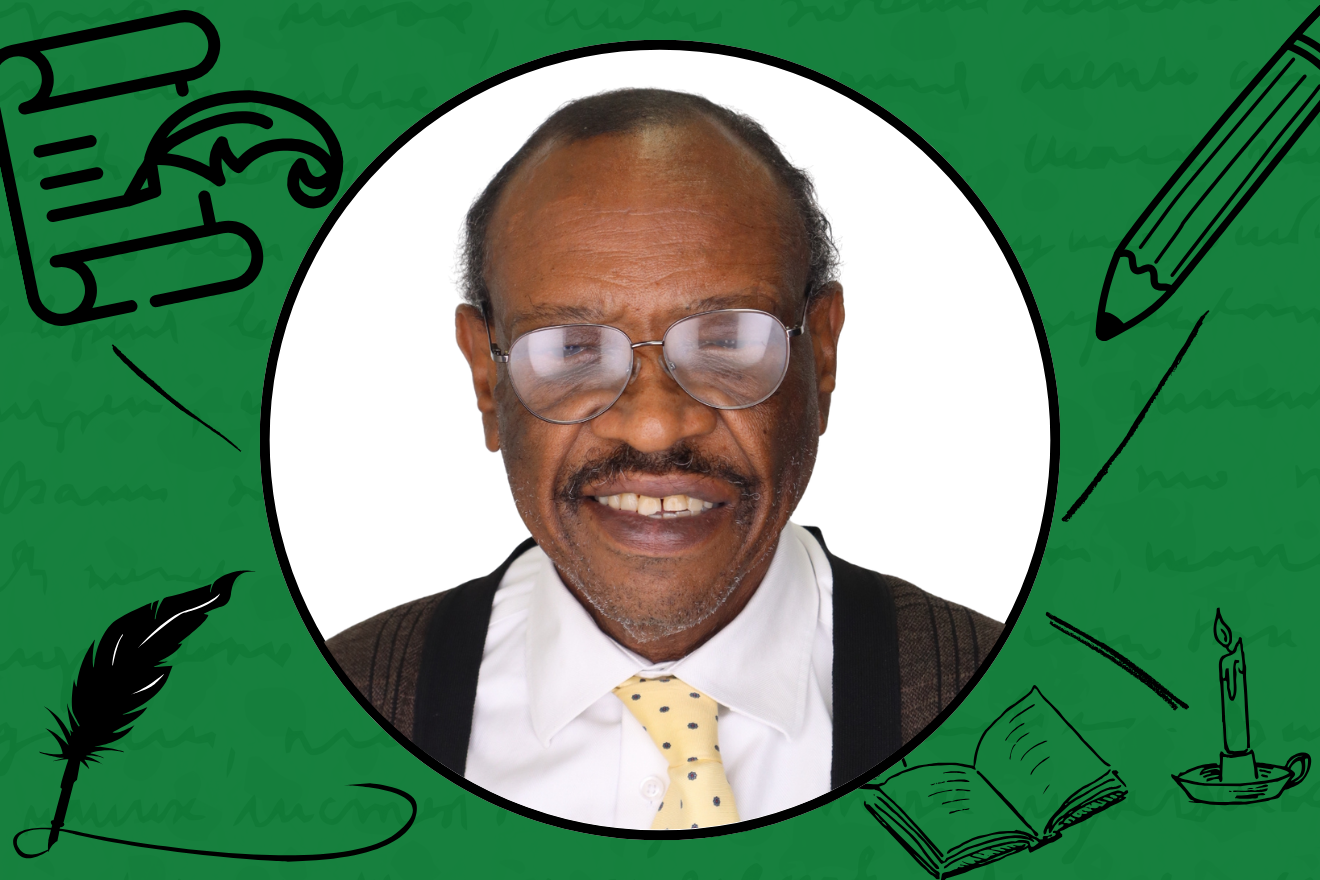
 Reginald Condry, a Tampa native and minister, said Fredrick Douglass’ autobiography inspired his poem titled “We Shall Win the Race.” ORACLE GRAPHIC/NATHAN POULETTE
For Reginald Condry, writing has never just been about words on a page — it has been about survival, faith and the long, unfinished journey of Black history.
Condry, 60, said his connection to USF is based on “legacy,” as his daughter, sister and son-in-law are USF graduates, and he is now attending alongside his nephew.
Condry, a Tampa native, became an English major at USF in fall 2025 as part of a personal journey to make more connections and to improve as a poet.
But Condry’s passion for poetry started much earlier in life.
Condry wrote the poem “We Shall Win the Race” in February 1982, at age 17, in honor of the struggles of Black people.
Condry said he did not fully understand the poem’s meaning when he first started writing it, but reading about Frederick Douglass and the realities of slavery helped inspire it.
Frederick Douglass was an American abolitionist and author who escaped slavery in Maryland and became a voice for human and civil rights, according to the National Museum of African American History and Culture.
And almost 45 years later, the poem has gained a new meaning — one rooted in history, spirituality and lived experience.
Condry now hopes his poem will resonate with readers during Black History Month.
“When I read that book, it made me think about families being broken up,” Condry said. “You could be married on a plantation, and someone could take your wife or your kids away, and you still had to stay.”
Related: USF alumnus, Navy veteran shares story of service and survival
 Reginald Condry wrote the poem “We Shall Win the Race” in February 1982, at age 17, in honor of the struggles of Black people. SPECIAL TO THE ORACLE/REGINALD CONDRY
Condry attended Hillsborough High School before joining the U.S. Army at age 20.
He entered the Army as an E-1, an entry-level rank, and served for eight years, including time overseas in Germany from 1990 to 1992.
“I had a good service time,” he said. “I really enjoyed being in the military.”
While the military shaped his discipline, Condry said faith shaped his life and writing.
He said he was “saved” at 17, became a minister at 20 and met his wife through the Church of Our Lord Jesus Christ, a Pentecostal faith.
The couple married in 1985 and traveled overseas together through their ministry while he continued to serve in the Army.
After returning from the military in the early 1990s, Condry attended Hillsborough Community College and earned an associate in science degree in 2012.
He briefly studied paralegal work at HCC, but said a professor there encouraged him to focus on expressive writing instead.
“She told me, ‘Maybe you’re built to have an opinion of your own,’” Condry said.
Related: OPINION: Our lives are too curated. It’s time to develop personal taste
Since then, Condry has written poems and preached personal testimonies, many of which have been shared through his church.
Condry said he is well-versed in the horrors of slavery, which inspired him when writing and preaching his poetry.
Despite the brutality of slavery, Condry said what stood out to him most was the perseverance of Black people.
“They still kept running the race,” he said. “They were forced to do things they didn’t want to do, but they didn’t give up on who they were.”
Condry said his poem “We Shall Win the Race” reflects both the literal and the symbolic race of Black people and their struggles.
“It’s a two-part thing,” he said. “It’s running a race and becoming a race. Through all that hardship, we still became a people.”
Condry said that for him, Black History Month is about recognizing strength alongside struggle.
“It was a hard time that people could have just said, ‘I give up,’” he said. “I just wanted someone to understand where I was coming from. Everybody has a struggle, everybody is running a race.”
While many of his recent pieces are devotional, Condry said “We Shall Win the Race” remains one of his most meaningful works — capturing the essence of how Black people push forward.
“If we continue in the race, we can make it,” Condry said. “Don’t give up.”