
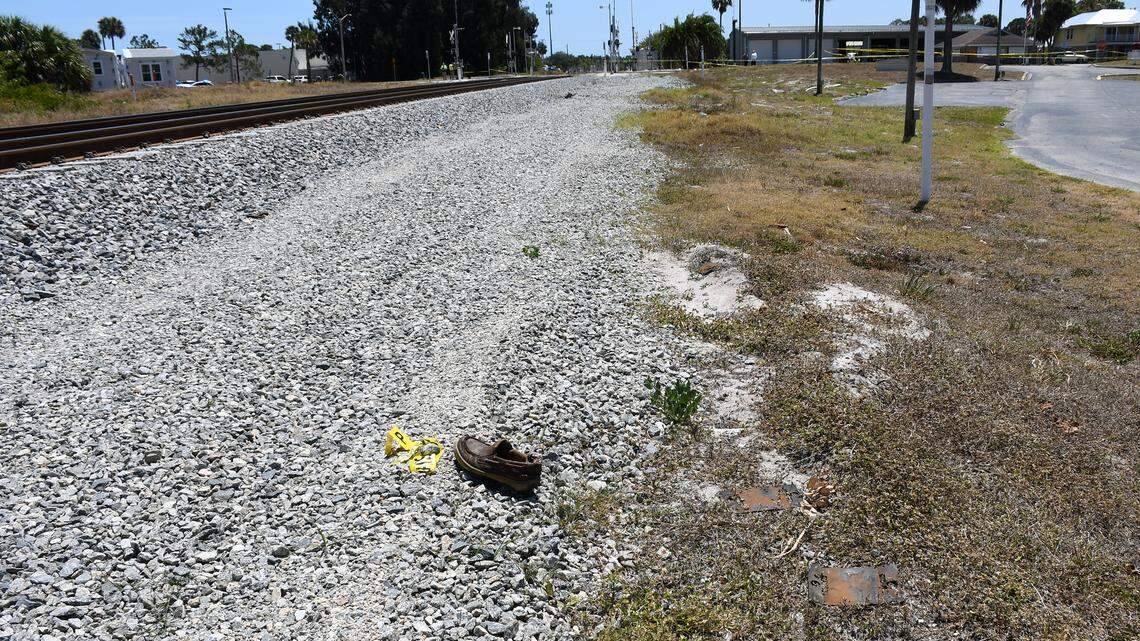
Investigators photographed a shoe at the scene of a fatal train collision in Micco, Fla., in April 2024, at the Barefoot Boulevard crossing. A Brightline train traveling at 102 miles an hour struck 62-year-old Randy Johanson, who was walking across the tracks.
Courtesy photo
Brevard County Sheriff’s Office
READ MORE
Killer Train
Brightline is the deadliest major passenger railroad in the United States. An investigation by the Miami Herald and WLRN reveals the shocking toll and the failures that led to it.
Expand All
As pedestrians in Florida regularly die on railroad tracks, two congressmen from the state are pushing a bill dubbed the “Safer Rail Crossing Act,” to help direct federal dollars toward reducing deaths.
The bill was filed in recent days by U.S. Rep. Maxwell Frost, a public transit advocate and Democrat based in Orlando. It was quickly co-sponsored by U.S. Rep. Brian Mast, a Republican from Fort Pierce.
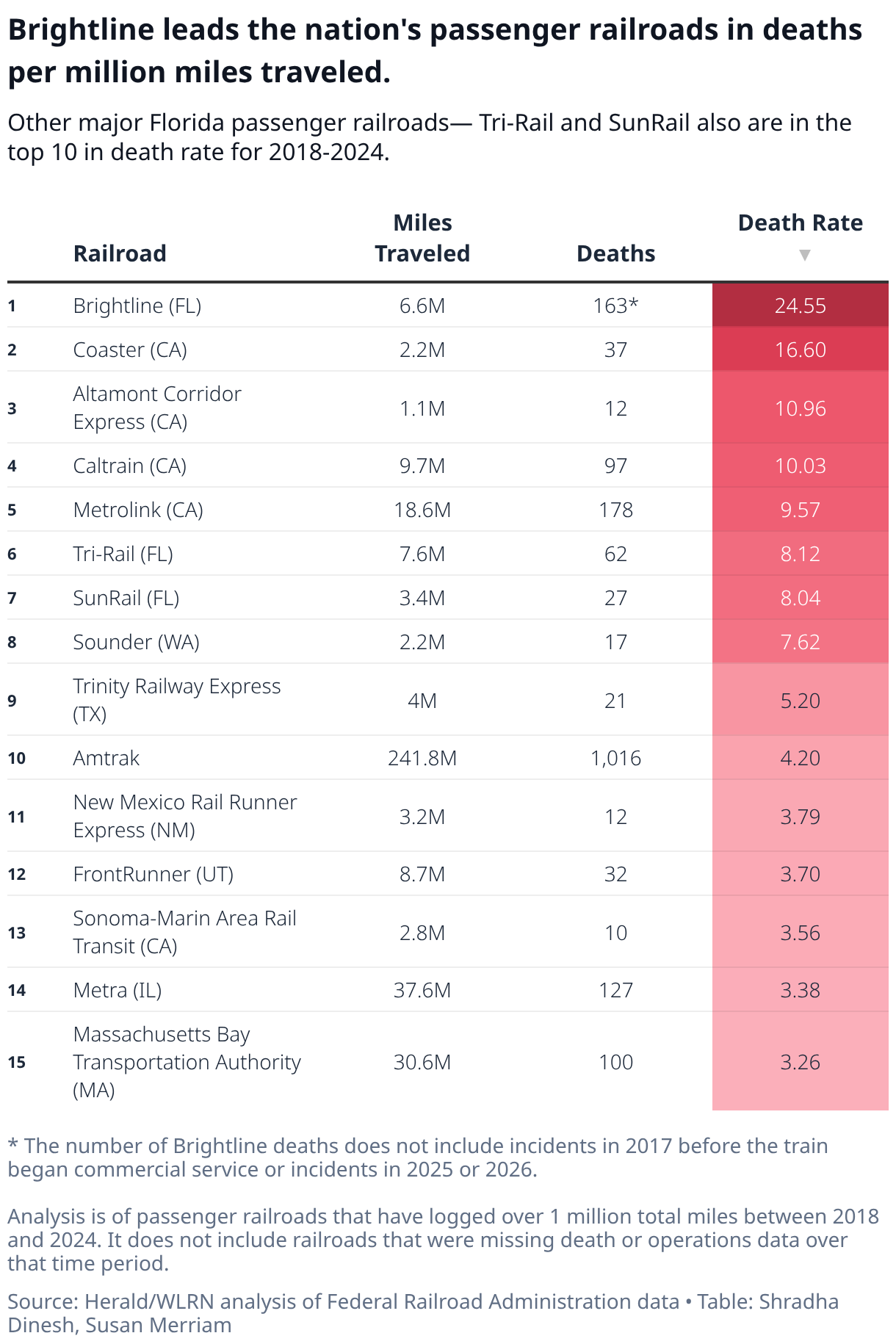
Neither congressman mentioned any rail company by name. But Florida has the dark distinction of hosting three of the nation’s top 10 deadliest passenger rail lines: Brightline, Tri-Rail and SunRail, according to a Miami Herald/WLRN analysis of Federal Railroad Administration data.
In a series published last year, The Miami Herald with WLRN public radio reported that Brightline trains had struck and killed almost 200 people since starting test runs in 2017, making it the nation’s deadliest major passenger rail system. The latest death occurred Feb. 2, when a man was struck while walking across the tracks at a crossing in Deerfield Beach. That brings the total confirmed by the Herald/WLRN team to 198. The Herald/WLRN found that the majority of those killed – 172 of them – were on foot or bicycle.
The proposed bill (HR 7358) is brief, just a paragraph that requires Secretary of Transportation Sean Duffy to “issue guidance” within a year about what types of state projects would be eligible for federal funding to reduce trespassing fatalities and injuries at highway-railroad crossings.
Frost said in a written statement that state and local governments need clearer guidance in order to use the federal funding for pedestrian safety improvements. He noted that Florida ranks among the highest for pedestrian rail injuries.
“These crossings don’t just pose safety risks, long and frequent stoppages delay emergency responders, disrupt freight movement, and create costly choke points in our supply chains,” his statement said.
The bill was referred to the House Committee on Transportation and Infrastructure. Frost sits on that committee, as does Rep. Frederica Wilson, D-Miami Gardens, a longtime advocate for safer rail corridors.
The issue of train related deaths has already captured attention from Secretary Duffy, who last July committed to reducing the number of Brightline-related deaths.
“We have to try to get that number to zero,” Duffy said at a subcommittee meeting. He subsequently released $42 million in grants for safety improvements on the Brightline corridor.
Duffy was responding to a plea that day from Rep. Wilson, who said the Herald/WLRN investigation highlighted the need for “stronger rail safety commitments in South Florida.”
Duffy, Mast and Wilson all have been touched personally by train tragedies. Eight years ago, Mast and Duffy were with a group of Republicans aboard an Amtrak train in Virginia headed to a GOP retreat when it crashed into a garbage truck, killing a 28-year-old man. Mast was with two of his children. Duffy and his wife had eight children on board.
At the time, Mast was one of Brightline’s most outspoken critics, and he said the experience strengthened his opposition.
Wilson was aboard a Brightline train test run in January 2018, just before the service officially launched. Later that day, a woman was struck and killed by a Brightline train. Wilson expressed deep sadness and called for a safety review.
Mast’s office declined to comment for this report. But in an email to constituents on Thursday, he announced support for the bill, alluding to Brightline and the Florida East Coast Railway, which share tracks in his district.
“We see high-speed rail lines and freight trains cutting through our communities every day. Far too often, unsafe crossings and outdated infrastructure put pedestrians, families, and commuters at risk, at times leading to fatal outcomes,” the email says.
“As rail systems grow, safety has to as well,” it continues. “Families shouldn’t lose loved ones because a crossing failed or because municipalities didn’t have access to the best practices for hazard correction.”
Frost’s district includes Orlando, the terminus city for the privately owned Brightline’s higher-speed route that starts in Miami. The final 35-mile stretch of track from Cocoa to Orlando runs along State Road 528 and is separated from roads, cars and people. There have been no Brightline-related deaths reported on that stretch, according to Federal Railroad Administration data.
The northernmost Brightline death reported to the Federal Railroad Administration occurred in Cocoa, where Brightline trains hit 110 miles an hour but are at street level.
Frost has been a supporter of the planned Sunshine Corridor project that would expand rail in Orlando and beyond, integrating SunRail commuter service with Brightline, and extending Brightline to Tampa.
At the state level, bills (SB 1301 / HB 1323) were filed in January that also were aimed at reducing collisions at Florida rail crossings.
The original bills required technology to be installed at rail crossings that would immediately alert train crews of a person, animal or car blocking the train’s path. Amended versions of both bills reduce the requirement to a study of the technology by the Florida Department of Transportation.
Related Stories from Miami Herald
Miami Herald
Brittany Wallman joined the Miami Herald in 2023 as an investigative journalist. She has been a reporter in South Florida for 25 years, and shared in the South Florida Sun Sentinel’s 2019 Pulitzer Prize for Public Service, for coverage of the Parkland school shooting. She grew up in Iowa and Oklahoma. Brittany is a graduate of the University of Florida.
The Kansas City Star
Susan Merriam is a data and visual journalist at McClatchy, where she has published work with the Miami Herald, The Kansas City Star and The Sacramento Bee among others. She has been part of teams honored by the National Press Foundation, Investigative Reporters & Editors and the Society for News Design for their investigative and local accountability reporting.