
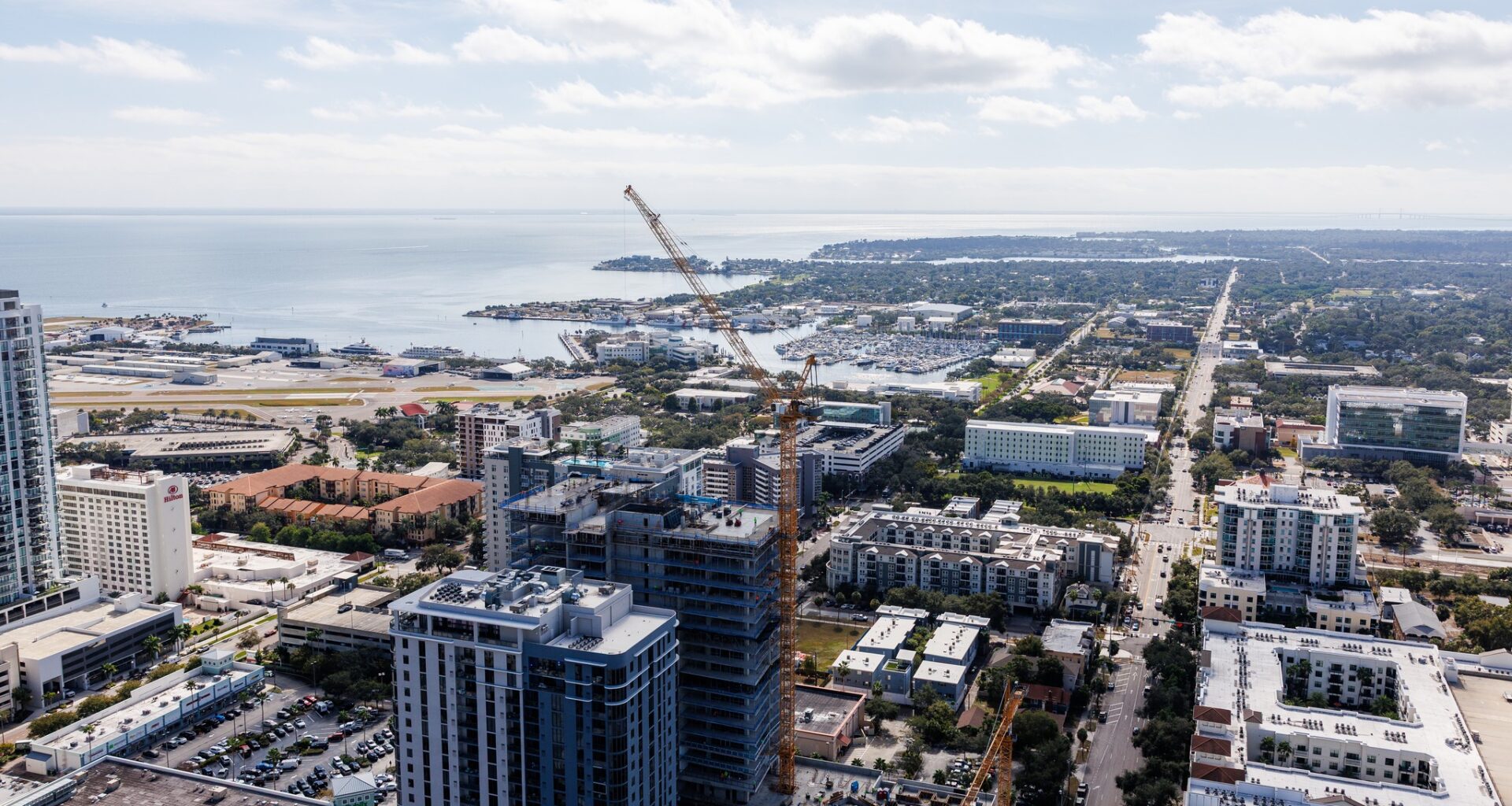
Tampa Bay’s development machine is still moving; it’s just not expected to print through 2026.
Architects tend to feel those shifts early. They’re hired long before ribbon cuttings, sometimes years before a project finishes. By the time the public sees a building, the costs behind it have already been (re)negotiated, trimmed and occasionally abandoned.
The Tampa Bay chapter of the American Institute of Architects’ latest Voice of Architecture survey suggests 2026 will bring continued growth in real estate development – but at a slower pace than the last two years.
Fifty-five percent of the 92 architects surveyed expect demand for architectural services to increase this year. That figure was 66% in 2025 and 64% in 2024. Seventy percent rated the region’s development-related economy as “excellent” or “good” compared to 80% the previous two years.
The majority is still optimistic. It just isn’t emphatic.
“While the overall outlook is positive, there was a decline in positive responses to three key economy-related questions,” said Chris Kirschner, president of BDG Architects in Tampa, in a prepared statement that accompanied the survey release. “This reflects how architects feel that the area’s development-related economy likely will grow more modestly in 2026.”
Larry Silvestri, a local real estate attorney who works on contracts, leasing, title matters and entitlements, told the Catalyst:
“The expectation is that we all still be in business. There will be opportunity, but just fewer as the year progresses. Deals will still get done. Some deals will just die.”
Interest rates remain part of the adjustment. In the American Institute of Architects survey, 40% of architects said the higher interest rate environment has negatively impacted their business, down sharply from 79% last year.
Silvestri described the shift: “In this interest rate environment – we’ve gone from 4% or 5% to 7% or 8%. Now we’re experiencing a ‘reversion to the mean’ and the percentage is rolling back to 6%. It would be nice to be down into the 5% range.”
Even as rates stabilize, projects are being reshaped. In the American Institute of Architects survey, 64% of architects said they have cut costs to compensate for higher interest rates, up from 40% last year.
“The biggest trade-off is between development cost and land use cost,” Silvestri said. “In ‘value-added development’ – maybe you don’t get to put in the high-end Kohler system, but a cheaper one.”
That pressure is not coming from financing alone. Sixty-nine percent of architects expect higher overall project costs due to tariffs.
“Higher costs are a fact of life for owners and developers these days,” said Matt Fetterhoff, a vice president with Phillips Heavy, Inc., in the survey release. “It’s more important than ever for architects, planners, engineers and construction professionals to collaboratively plan projects, so everyone has clear expectations on costs.”
In Pinellas County, much of the opportunity lies in redevelopment, because “Pinellas is challenged environmentally,” Fetterhoff wrote. Meaning, the dirt might be poor and cheap, but that helps keep the value of development up – “It’s like a balloon. You push in somewhere, and it comes out somewhere else.”