
By Matthew Cimitile, University Communications and Marketing
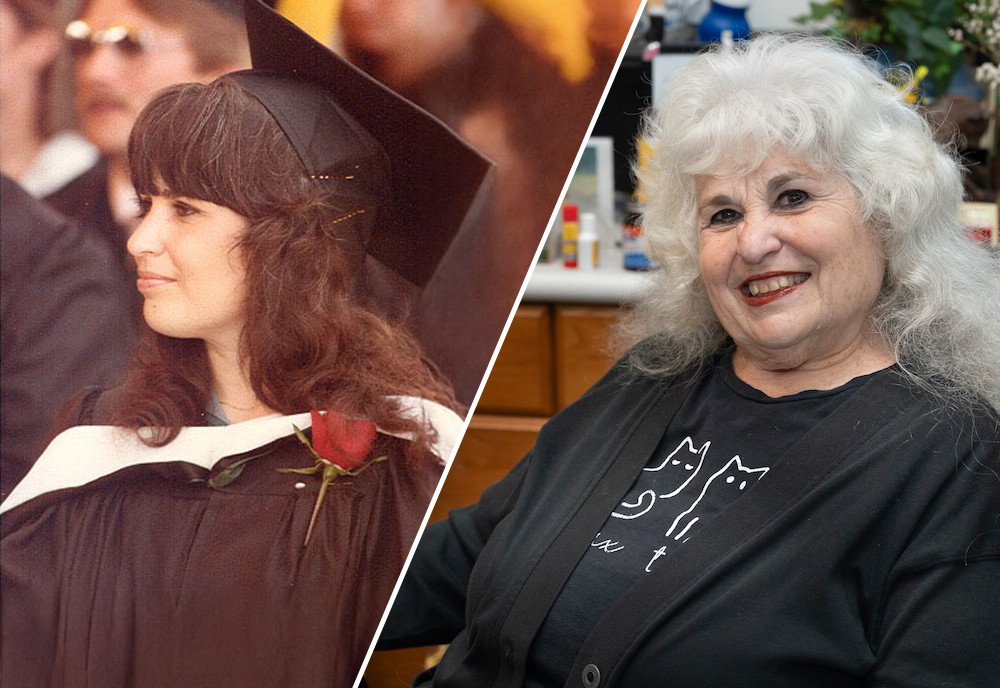
In 1969, Joan “Sudsy” Tschiderer stumbled upon USF St. Petersburg while on a shopping
trip with her friend.
At the time, the campus, which opened in 1965, was located at the end of Bayboro peninsula.
It consisted of buildings and barracks that were previously used to train and house
merchant marines for World War II.
Tschiderer picked up a brochure and decided she would attend the small commuter campus
for a semester and then transfer to another university.
Instead, she stayed and has been a part of almost every major initiative, development
and milestone that has taken place at the USF Bay campus – the original name of USF
St. Petersburg. As a student, Tschiderer helped form student government and initiated
the student publication The Crow’s Nest. As a staff member, she was the first to develop and run student activities, organizations
and recreation. She would go on to coordinate special events, from the opening of
the Campus Activities Center, now the Judy Genshaft Student Life Center, to lecture
series, festivals, concerts and more.
Over the years, she became the unofficial ambassador for the campus as it grew from
military barracks to the vibrant community of today.
“I love being around the creative spirit that is found on this campus,” said Tschiderer,
who earned her bachelor’s degree in English in 1971, a master’s in English in 1983
and continues to work on special projects for University Advancement. “The university
experience at its best allows students to be challenged and learn who they are at
their core. It is that great testing ground where magic and passion are nurtured.”
As part of USF’s 70th anniversary celebration, we asked Tschiderer to reminisce about the campus community during its early days,
what has remained the same throughout the years and why USF St. Petersburg has become
a second home she never left.
Can you describe the campus when you first arrived?
When I came to campus in 1969 and we drove down the peninsula, there you saw a military
fortress that was the former U.S. Maritime Service Training Station that was built
in 1939-40 in anticipation of World War II. It trained servicemen in shipping operations
and as electricians, mechanics and bakers to provide support for military troops.
By 1969, USF had taken it over and used it to house virtually everything – offices,
the library and bookstore, classrooms and an auditorium. With all these services in
the same place, you always bumped into everybody.
The second part of campus were the barracks, which were the wooden housing facilities
for the servicemen. USF converted them to even more classrooms and study lounges,
and it would eventually contain a coffeehouse and game room. We also had a swimming
pool. It was a really homey place.
What were your fellow classmates and professors like back then?
As I recall, it was in the vicinity of 400 students and probably 35 faculty and staff.
When the campus started, it was designed for upper division juniors, seniors and graduate
students. So, we were mostly older students and had a really eclectic mix. What encouraged
me to stay and not transfer was the variety you encountered. There was a range of
ages, from 19 all the way to 80. And such distinct backgrounds. I remember classes
in American history where you would have Vietnam veterans, conscientious objectors,
soldiers and nurses from World War II and the Korean War, and young people who were
anti-war. It was an amazing mix to bring to the classroom and helped us open our minds
to the issues we were studying.
What comes to mind when you look back at your history here, both as a student and
staff member?
My plan was to be a journalist. During those days, we started student government and
The Crow’s Nest. The first edition was primitively produced with hand-drawn pictures.
But I’m so proud that we started a publication that has lasted more than 55 years
and had students who wrote for it go on to become editors at newspapers and win Pulitzer
Prizes. And I’m proud of the university for supporting a paper that has allowed students
to test and hone their skills in journalism.
When I graduated, I was hired on to help develop the student affairs program, being
the person responsible for student activities, organizations and recreation. I remember
when we wanted to advertise our events, we would do so over a loudspeaker that was
piped into the student lounges. I would go on and use my radio voice and make such
announcements throughout the day.
I also recall the decades of water volleyball, where we played nearly every day from
noon to 2 p.m. The pool was always open and free. Students brought their families,
faculty brought their families, so we all got to know each other because it was one
big gathering. I remember, too, that the harbor was quite active with ships from all
over the world, particularly the British Navy, the Dutch Navy, humanitarian ships
and even Jacques Cousteau’s ship, the Calypso, was in port for several months. You
would meet people from all over the globe.
A lot has changed over the time you have been here, but what, if anything, has stayed
the same?
Probably the heart. I have rarely encountered a faculty or staff member who does not
want students to succeed and have a positive experience. By positive, I mean to be
challenged, to think critically, to be curious and to be kind. Every day, it is such
a joy to see how our people really, truthfully want success for our students. I really
do believe that we care about giving the next generation the best tools they need
for running our world.
Most people go to college and then start a career somewhere else, or work at a number
of different places. You have remained here. What is it about this campus and community
that has become a second home for you?
That is a tough one. I have had offers to work in other places and institutions. But
I’m a homegirl. I’m a lifelong Floridian. I love to travel, but I like to come home.
Every year, I would have a chat with myself and ask what would I do for the next year,
try something else or stay here. And at the end of that chat, I would always make
a commitment for another year. So, I guess you can say I made a lot of commitments
to this place.
For me, the sense of community is really strong on campus and in this city. It has
allowed me to form communities of my own, such as the USF St. Pete Singers, which
began in 1974 and still performs today, and being part of the first St. Petersburg
women’s soccer team in 1975, the USF St. Pete Sandspurs. Our slogan was “a pain in
the grass.”
I also kept returning to USF St. Pete because I loved being around the scholarship
and creative spirit that is found on our campus. I am endlessly grateful for the enduring
friendships I have made and am still inspired in so many ways by the younger students
who continue to come here to learn, to be challenged and to grow.