
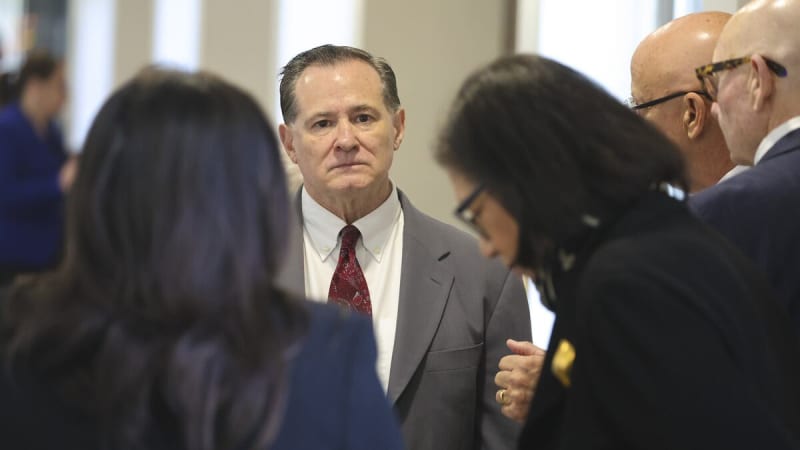
The trial of a Tampa neurosurgeon accused of causing a traffic crash that killed a bicyclist was postponed Tuesday after his attorneys alleged the judge showed bias against him.
Defense attorneys for Philip Henkin filed a written request for Hillsborough Circuit Judge Robin Fuson to recuse himself, citing numerous statements the judge made in a hearing that occurred Monday before the trial was expected to begin.
They included a determination that the fatal collision was not based on “speed alone,” according to court records.
The defense, led by attorney Richard Escobar, argued that the judge’s statements showed he’d prejudged the facts of the case.
“Based on these statements as alleged, Dr. Henkin reasonably fears he will not receive a fair trial,” the defense request stated.
Assistant State Attorney Dawn Hart disputed the defense’s request, writing in a response that Fuson’s comments were merely his own “mental impressions and observations” of various case-related matters. His comments, Hart wrote, were “reasonable and appropriate” under the law.
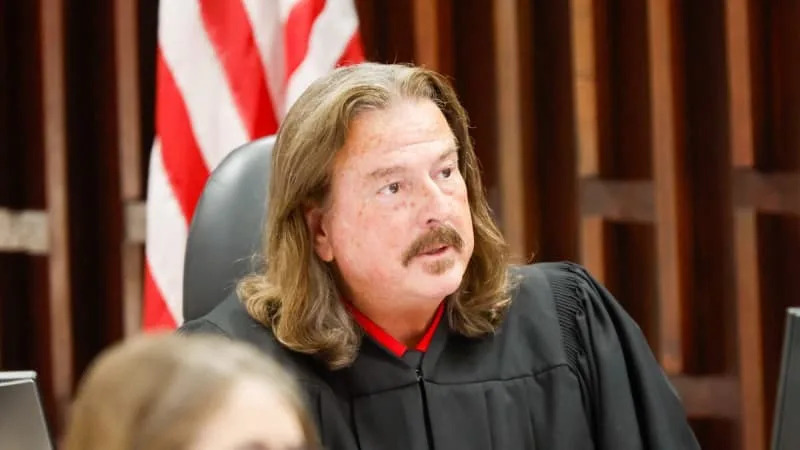
Fuson nevertheless recused himself from the case in a brief order issued Tuesday morning. He wrote that the defense’s request for him to step aside was legally sufficient, but he did not comment on the truth of their allegations of bias.
Judge Elizabeth Rice, who handled several of Henkin’s pretrial matters, also filed an order recusing herself from presiding further, though her order did not specify a reason.
The vehicular homicide case was reassigned to Judge Lindsey Alvarez. No new trial date has been set.
Henkin, 63, is accused of causing the death of Adam Hasebroock, a banker and triathlete who was struck by a Tesla while riding a bicycle early the morning of Nov. 4, 2021. If convicted, he faces up to 15 years in prison.
The collision happened shortly before sunrise on Lizards Tail Road, a tree-lined, lightly traveled two-lane north of Bruce B. Downs Boulevard in New Tampa.
Henkin was on his way to workat his nearby surgery center when the collision occurred. He told police he believed he was driving the speed limit, which he thought was between 35 and 40 mph, according to court records.
Police said the speed limit on the roadway was actually 20 mph. They identified data from the Tesla, which they said showed the car was moving at more than 80 mph just before the crash.
Surveillance footage from a nearby USAA building showed Hasebroock was struck as he rode near the middle of the road, according to court records. The defense noted in court that he was traveling south in the northbound lanes, arguing that he was violating traffic laws.
Prosecutors said Henkin was driving north and had entered the southbound lane when he hit the bicyclist.
Leading up to his trial, Henkin’s attorneys filed numerous court papers asking to toss some of the state’s evidence and to dismiss the charges. Their arguments included assertions that the roadway was dark and too poorly maintained by the city of Tampa to be considered safe. They asserted there was insufficient signage and roadway marks.
Judge Rice denied the defense’s request to dismiss the case and suppress evidence last week.
The defense request for Fuson to step aside came on what was to be the first day of Henkin’s trial. They quoted 17 snippets from a court transcript in which Fuson made comments they said showed he’d prejudged the case.
“You can’t do 80 mph on Lizard Tail Road maybe. I don’t know,” he said at one point.
“It’s not just speed alone in this case,” he said later.
Those comments get to the heart of a key legal issue: To convict Henkin, prosecutors must prove he was driving recklessly, which can involve factors besides speed — like whether Henkin was weaving, whether there were other people or cars on the road, and whether his conduct before the collision could be seen as dangerous.
The defense also cited remarks the judge made that they said represent disputed facts about the circumstances of the collision.
“Maybe he should have slowed down and figured it out,” the judge said.
“Isolated dark road with a bicyclist on it,” he said at another point. “You don’t have a right to go 100 miles an hour.”
The defense noted there is no evidence Henkin was going 100 mph.
In their response, the state noted case law that says judges should not try to defend their honor or reputation when ruling on requests for their disqualification, even if the allegations against them are false.
Fuson was elected to the Hillsborough circuit court in 2018. As one of three trial division judges, he presides over many high-profile criminal cases involving allegations of serious crimes. Prior to taking the bench, he was a longtime criminal defense attorney and prosecutor.
Before his legal career, Fuson was a professional baseball player in the minor leagues.