
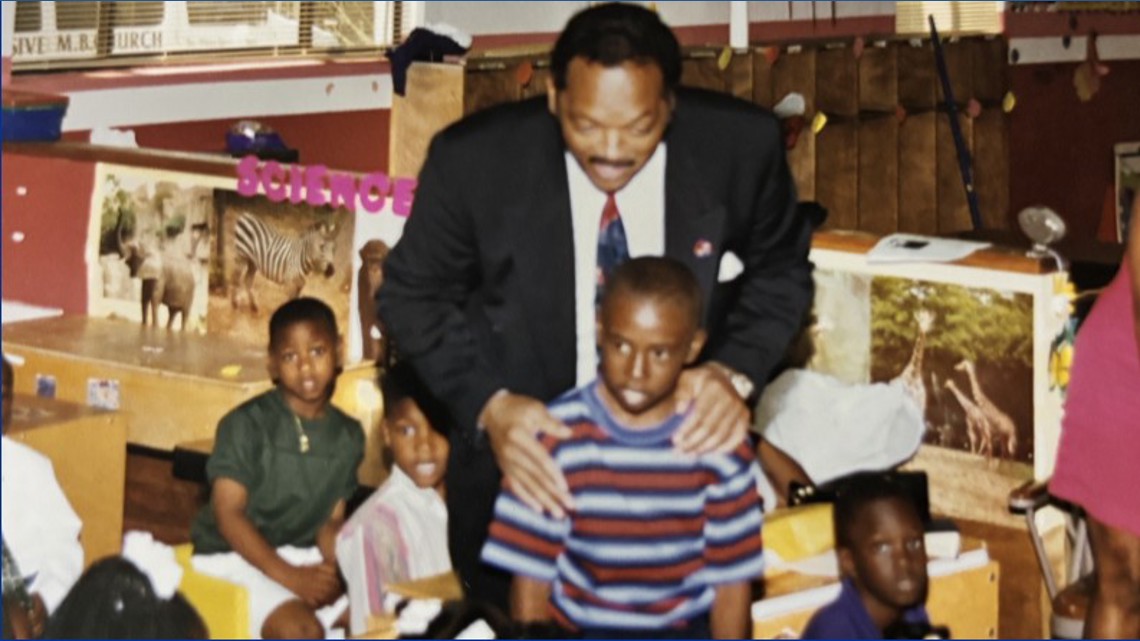
Rev. Jesse L. Jackson, the longtime civil rights leader and Black icon, died Tuesday at 84 years old.
ST. PETERSBURG, Fla. — For decades, the Rev. Jesse Jackson was a national voice for justice — marching, preaching and pressing America to confront inequality. But leaders in the Tampa Bay area say his impact here went far beyond speeches.
Pastor Louis Murphy, who now leads Mt. Zion Progressive Missionary Baptist Church in St. Petersburg, says Jackson’s presence in the city during a moment of crisis helped shape his own life and calling.
“Things were bad,” Murphy said. “But they thought, and they marched, they protested, they ran for political office, they did things the right way for the right reason. And we really are a better nation today because of the sacrifices that people like the Reverend Jesse Jackson made.”
In April 1994, as St. Petersburg struggled with rising crime, drugs and youth violence, Jackson came to the city at the invitation of Mt. Zion’s pastor at the time. He led a march of nearly 400 people through the community and delivered back-to-back sermons at Mt. Zion and nearby Bethel Metropolitan Baptist Church, urging residents to reclaim their children and their streets.
“We were in a time where there was a lot of violence in the city. Drugs, and things of that sort,” Murphy said. “And he came, and he spoke, and he marched to try to combat some of the violence and drugs that we were dealing with.”
Murphy described that moment as one of renewal and hope.
“It was certainly a period of restoration,” he said. “To try to encourage people that drugs is not the answer. There’s a much better way.”
For Murphy, the impact was also deeply personal.
“I recall having a little sidebar conversation with him that changed my life,” he said. “To have a personal conversation with him really just turned my life around.”
St. Petersburg Mayor Ken Welch, in a statement, said Jackson “reminded us that progress is strongest when it is inclusive — when people of every race, background, and neighborhood come together around shared opportunity and shared responsibility.”
Jackson would continue to return to Florida during moments of crisis and reflection, including after the 2012 killing of Trayvon Martin. Two years later, he returned to the Tampa Bay area for a 2014 event connected to Delta Sigma Theta Sorority, continuing the same message he preached for decades — accountability, opportunity and hope.
Today, Murphy says Jackson’s work lives on through the daily efforts of churches and community leaders.
“All of the issues that he stood for — we’re doing that every day,” Murphy said. “We’re in the trenches every day.”
Jackson is being remembered in Tampa Bay not just as a national icon, but as a leader who showed up and left a lasting mark when the community needed him most.