
Written by Michael Lewis on February 18, 2026

Advertisement
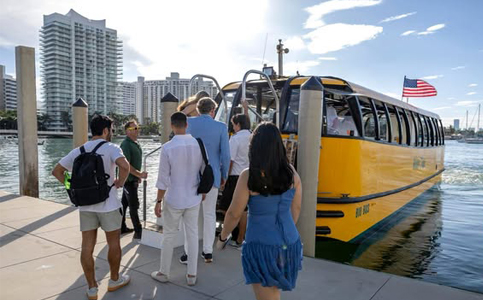
Could the newly floated water taxi linking Miami Beach and downtown Miami become The Little Engine That Could of transit across Biscayne Bay?
For decades, some have sought ferries or taxis on the bay and rivers to move better and more calmly as road traffic has multiplied and mass transit failed to keep pace.
Now, as Miami Today reported last week, a free water taxi launched by Miami Beach is ferrying almost 900 people daily between the Beach and downtown Miami, proving that water transit can work here. Bravo!
Imagine relaxing aboard a boat instead of battling traffic and then finding costly parking. It can be a dream instead of nightmare. And who knows how long it will be, if ever, until we get the Baylink transit that our 10-year-old Smart Plan promised us? A water taxi could help us go with the flow.
But is this a one-off success, a novelty? It plies the bay only between two points with few vessels and has already had too many people awaiting too few boats to become on its own a permanent transit solution.
That’s not to say bay transit can’t surge. Water taxis last year were a $21 billion global business that’s expected to hit $25 billion by 2030. It’s far bigger abroad than in the U.S., but water taxis and ferries do work here.
I know – I once commuted by ferry and water taxi multiple times a week on my job for three summers, with three separate lines competing for my fares. Combined, they carried 600,000 passengers in a two-month span in sparsely populated Northern Michigan. Imagine how such services could do in this metro area, where residents could commute while visitors boarded water taxis as novelties.
While I applaud the early success of today’s service for which Miami Beach and the Florida Department of Transportation split costs, they alone won’t fund the network of watercraft we need to turn this into permanent and reliable transit. Beach Mayor Steven Meiner has already called on other cities to pitch in to make the service a fixture.
But beyond broader funding is a stark reality: any long-term water transit success will require fares. Otherwise, it’s a free and fun boat ride. Users are going to have to pay a share of the costs.
In fact, unlike most mass transit, water transportation actually can pay own way. The owner of the newspaper for which I worked long ago on Mackinac Island, MI, in fact, has bought some of those ferry lines I used to ride and operates them as a business. Why not here?
When you think about it, water transit has unique financial advantages that highly subsidized Metrorail and Metromover and bus rapid transit and highways lack.
Ferries and water taxis need not buy rights-of-way and then pave them or lay rails or guideways. Nothing must be elevated. No curbing or lighting is needed. Construction is condensed to modifying or creating dock space – the equivalent of a rail or bus station.
That doesn’t mean a water taxi line is a breeze. It will face a raft of environmental rules, as does all transit. It will need multiple docks near transit on shore. Vessels aren’t cheap.
Expanded water transit could in fact require government incentives. In the right structure, they would pay off for us all.
Beyond profit to operators, expanded water transit will serve this community. It can get some of us off jammed roadways. It can ease and speed commutes. It can serve as an amenity for visitors. It could be a lifeline for Key Biscayne, which lives in fear of a loss of its mainland link over bridges that have outlived their lifespan.
No studies would be vital, for a simple reason: Miami-Dade has already studied water transit to death. You can find piles of reports, the latest less than two years old. That 2024 report by a county committee called for a network with 10 specific stops. “More than one single facility is necessary to provide comprehensive and sustainable operation,” the report said. True.
Commissioners have those reports and studies. They should now tell the mayor that they want the county’s transportation team to get to work on the project to make it a reality. Miami Beach has proven it can be done. The test case works.
Mayor Daniella Levine Cava and the commissioners can be heroes by getting behind water transit. No heavy investment is needed. This is a case where a call to private enterprise is totally appropriate – where, after all, are those ferries and water taxis of the northern U.S. working in winter, which is our peak season?
This has been studied to death. Take the studies off the shelves and offer government aid to private enterprise. Look to funding from the sales tax we levy upon ourselves for new mass transportation.
Is early success in Miami Beach scalable? Will economics permit a ferry and taxi fleet? Can water taxis and ferries exceed the 2,500 added users a day that the South Dade bus rapid transit service brought us for a $360 million investment? Daunting questions. Be positive and give it a try.
What we’d like to hear from county government is “I think I can! I think I can!”