
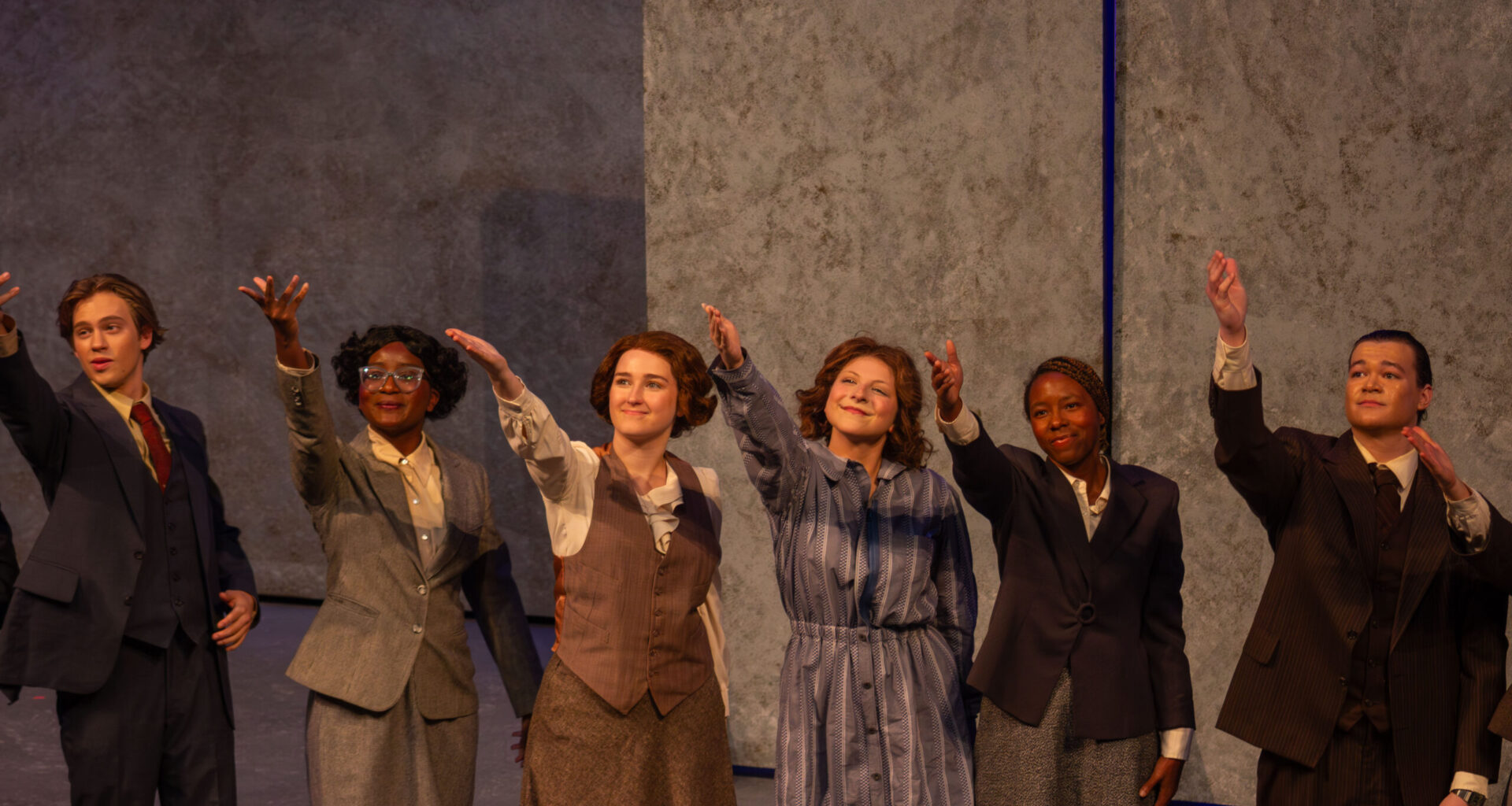
 USF’s Theatre department did the century-old play justice this weekend. ORACLE PHOTO/VIOLET VASQUEZ
So many people were excited for USF Theatre and Dance’s new production of Machinal that I had to change my plans in order to see it.
I initially planned to attend the premiere — Thursday at 7:30 p.m. — but every seat had already been reserved.
Friday’s showing was also sold out, so I had to settle for Saturday. I was okay with this, though, because the play sounded promising.
Machinal, written by American playwright and journalist Sophie Treadwell, premiered in 1928, according to Playbill.
This play received unanimous critical acclaim and is recognized as one of the greatest plays of all time by outlets including Entertainment Weekly, The Independent and BroadwayWorld.
The plot follows a young woman named Helen in 1920s America whose life ends in tragedy after she listens to society’s rules for success, according to a blurb on USF Theatre’s Current Season page.
Suffice to say, the main question on my mind as I shuffled into the Theatre 2 building on Saturday night was if USF Theatre could successfully honor the play’s almost legendary legacy.
After watching the play — and being so impressed I had to return on Sunday — I can say with confidence that USF honored Machinal’s legacy.
Related: OPINION: Why you should support the arts at USF
My first thought upon leaving Machinal was how relevant the play feels to our current decade, despite it being almost a century old.
The main conflict stems from Helen feeling trapped by the hostile and misogynistic society she’s a part of.
She’s pressured into a loveless marriage with her oafish and abusive boss and desperately longs to be, in her own words, “free.”
These are feelings I’m sure many young viewers of the play can resonate with.
Dora Arreola, the director of Machinal and a theatre professor at USF, said she agrees the play speaks to the current moment.
“I think it has a very powerful message for young people — to [attain] self-determination, identity, to be who they want to be and to be with who they want to be with,” Arreola said.
At the heart of Machinal is senior theater performance major Katelyn Pingor, who stars as Helen.
Pingor brings a heightened sense of emotional intensity to her character that contrasts perfectly with the cold and mechanical environment that surrounds her.
“The clear expression of [Helen’s] emotions was really interesting to me,” Pingor said.
Pingor reveals those emotions through a series of frantic, stream-of-consciousness monologues in which she maneuvers, almost rhythmically, between catharsis, hopelessness and anger.
Pingor said that memorizing these monologues proved challenging.
“I would give someone else the script and they would sit with me in the lobby for sometimes hours at a time [as I rehearsed].”
But she added that the process became much more natural as rehearsals continued.
Related: OPINION: USF’s music scene is the lifeblood of the campus
And that definitely comes through in the final performance — Pingor is utterly transfixing and it becomes impossible to imagine that this is an actress reading memorized lines.
Something that surprised me was the prevalence of dance throughout the play, as several scenes are entirely based around an ensemble cast wordlessly performing choreography.
These numbers were incredibly entertaining to watch and some of my favorite moments from the play.
And the numbers were actually choreographed by the cast themselves, in a process that Arreola described as very collaborative.
“Everybody was adding stuff and bringing ideas and it was very dynamic,” Arreola said. “I really love the process and all the students that I have here.”
But just as important to the play as the acting is the stage design.
Machinal is an expressionist play, which means it uses “lights to convey emotion in the theatre,” according to its playbill.
Lighting is manipulated for dramatic effect several times, but I found the climax the most effective.
Helen reaches a breaking point as a result of the abuse she’s suffered and impulsively murders her husband late at night.
As if reacting to her turmoil, the stage lights rapidly flash through iridescent neon colors, an effect that almost made me feel like I was at a modern rave or concert.
The lighting works despite clashing with the period and makes the scene the play’s most visually striking moment.
Ultimately, the “tragic ending” promised on USF’s website comes to fruition and Helen is caught and executed for her crime.
It’s an intentionally frustrating, unsatisfying conclusion that leaves much room for viewer interpretation.
I left Theatre 2 with a deep pit in my stomach and countless unresolved thoughts circling my mind.
But I don’t mean this as a criticism — these feelings are what all good art should inspire.
“I like that it doesn’t have a great ending,” Pingor said. “I just hope it kind of sits with audience members as they leave and gives them a new perspective or provides something to think about.”
Although Machinal has finished its run, USF Theatre has several more shows planned for the semester — including a production of The Lightning Thief: The Percy Jackson Musical, according to the department’s webpage.
Related: USF to host theater festival in honor of female empowerment
So if you couldn’t make it to Machinal, support USF’s theatre scene by adding one of the upcoming shows to your calendar.
“The opportunity to see a transformation [of a character] on stage is an inspiration to transform ourselves, to be a better community, to be a better world,” Arreola said.
And Pingor said she agrees that supporting theatre at USF is important.
“[USF Theatre] is such a good space with people who care so much about what they’re doing, and I think that’s what makes it so important to me,” she said. “Everyone is always really excited for whatever they’re working on.”
Theatre — and the arts — are alive and well at USF, and I couldn’t be more glad.