
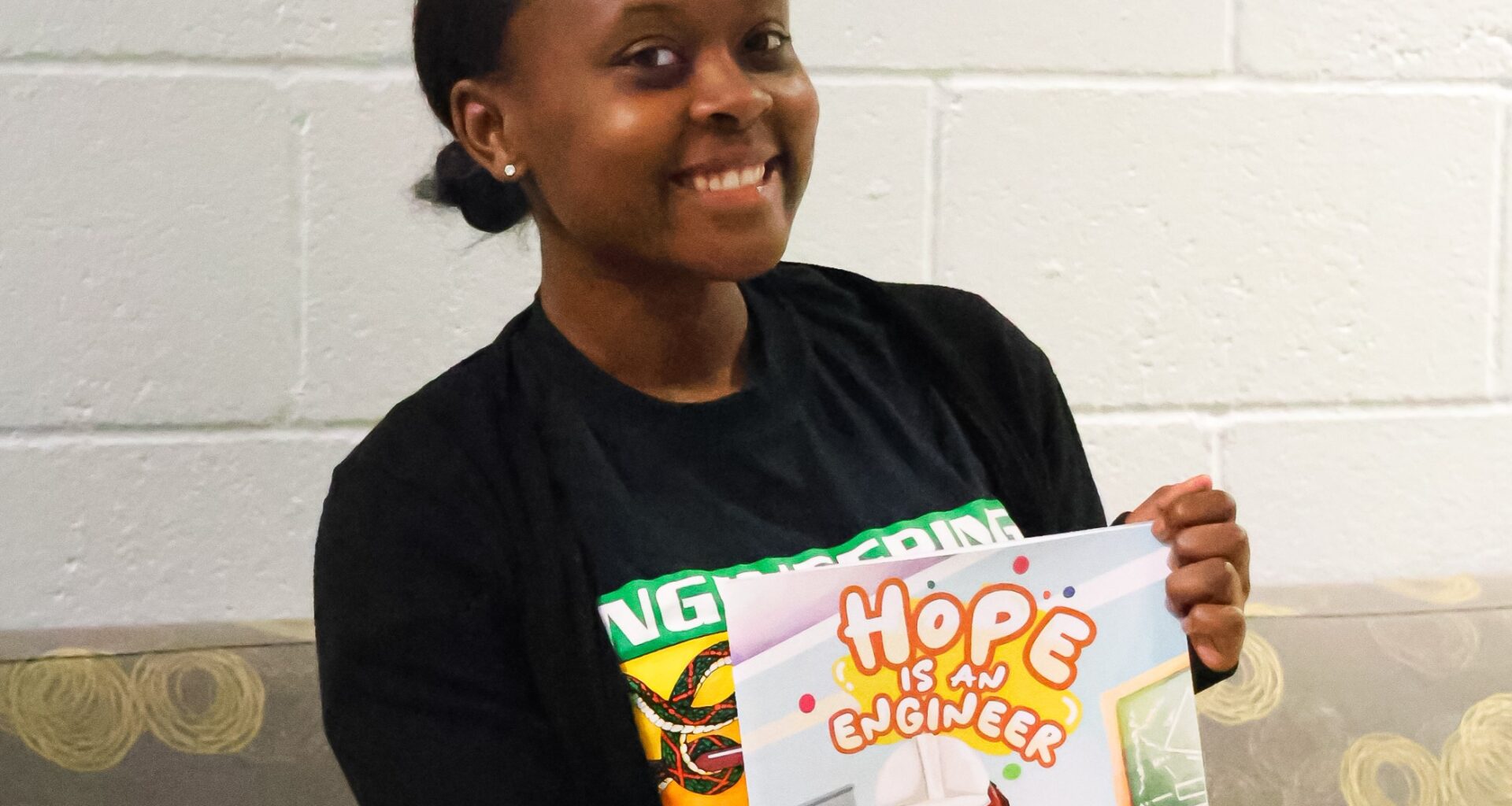
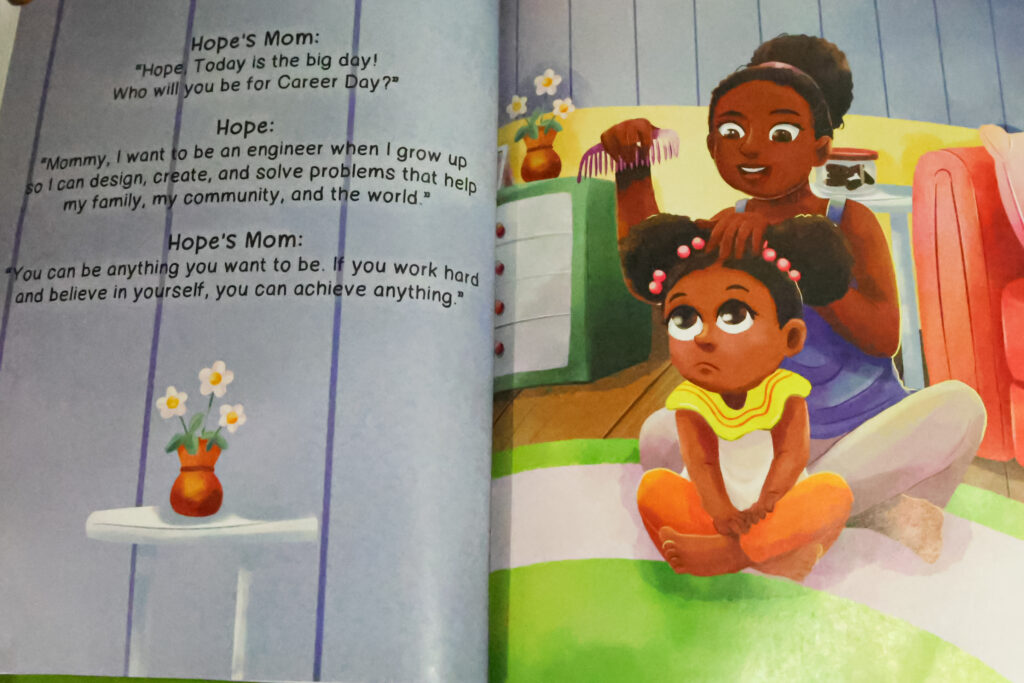
 An illustration of Hope and her mother highlighting her childhood experiences.
(Ashley Bigbee/FAMUAN)
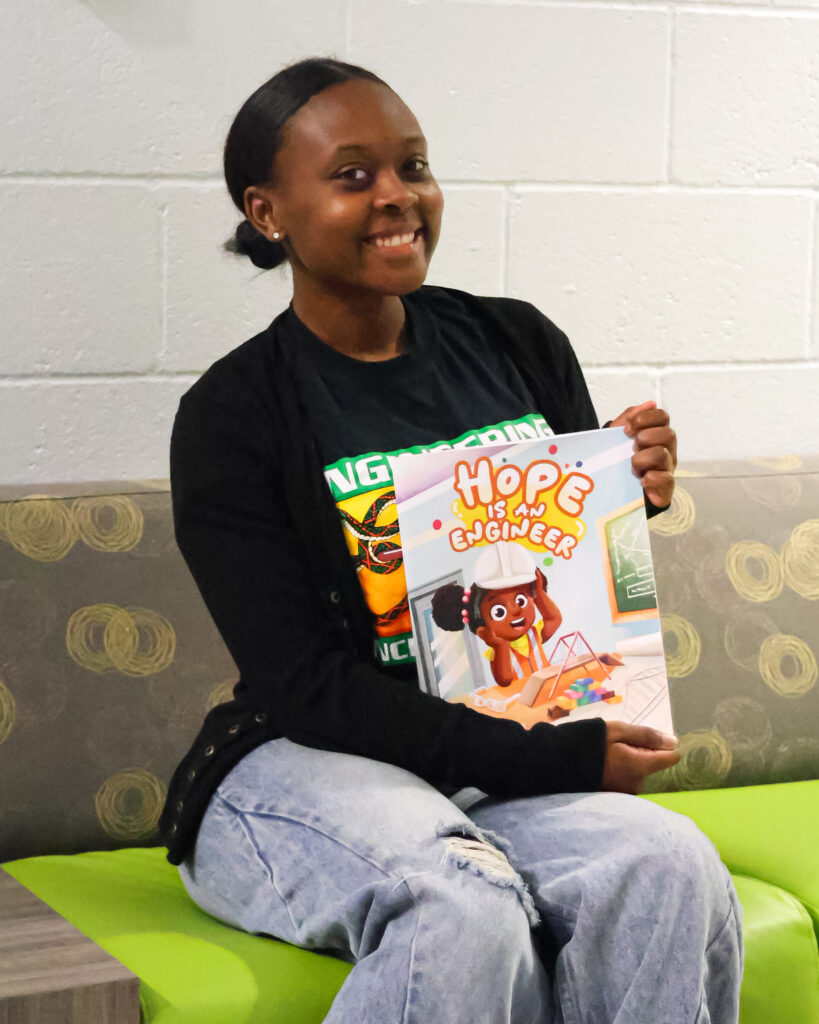 FAMU-FSU College of Engineering student Madison Devoux showcasing her book
“Hope is an Engineer”. (Ashley Bigbee/FAMUAN)
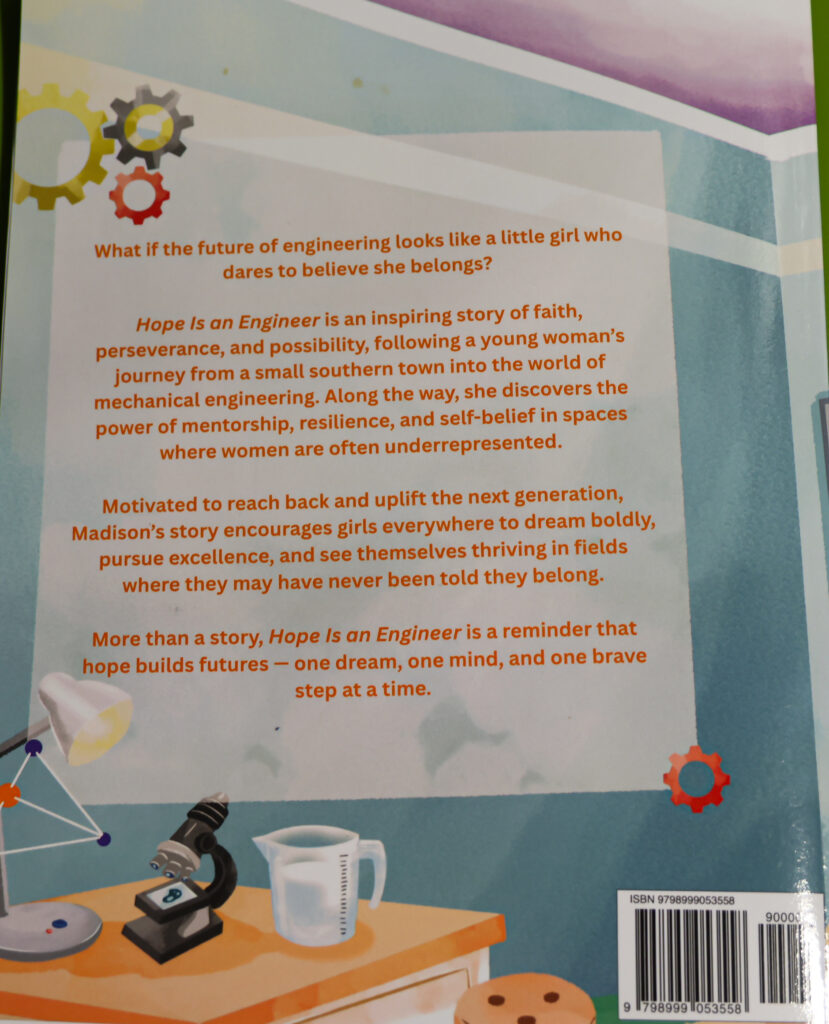 The back cover of Hope is An Engineer tells the readers the meaning of the book.
(Ashley Bigbee/FAMUAN)
In a world where representation for young Black girls is constantly evolving, a newly released book called “Hope Is An Engineer” is continuing to change the narrative on the Highest of Seven Hills.
For Madison Devoux, a fourth-year mechanical engineering student at Florida A&M University, her story started well before attending the College of Engineering. Raised in Cairo, Georgia, a small town 50 minutes away from Tallahassee, Decoux says her upbringings and curiosity deeply shaped her values. Devoux grew up loving problem-solving and building things, even though she didn’t see a lot of engineers who looked like her.
That’s when“Hope Is An Engineer” was brought to life.
“I created ‘Hope Is An Engineer’ because I wanted to fill a gap I experienced growing up,” Devoux said. “I rarely saw books where Black girls were shown as engineers or innovators. I saw movies like ‘Hidden Figures’ [and] TV shows, but I didn’t see the literature. I wanted kids, especially Black girls, to see themselves early and believe that STEM is a space where they belong.”
When you step into Hope’s world, the book is set in Devoux’s hometown with parts of the story taking place in Tallahassee, Florida. Throughout the book, readers are able to get a feel of her upbringing throughout her childhood home, school and even intimate moments like her mom doing her hair. Her goal for the book is intentionally grounded in familiarity and warmth.
“I wanted readers to feel like they were growing up with Hope and walking through each phase of her life alongside her,” Devoux said.
Before finding her publisher BFF Publishing and writer Toni Mutcherson, she tried to write the book on her own. However, it wasn’t something that came to her overnight.
“I quickly realized I was writing with an engineering brain instead of a storytelling brain. It was very technical, and that just doesn’t work when you’re writing for kids,” Devoux said.
While Hope reflects a young and eager Devoux pursuing a career in engineering, other Black women in her field of study inspired her to get to where she’s at in her collegiate career.
A lot of those women also happened to be FAMU alumna themselves.
“I have so many Black women in engineering who pour into me and truly support me,” Devoux said. “I also received a lot of love from the FAMUly, including FAMU alumna Ania Wilson, author of the coding book ‘C Plus Me.’ ”
Through storytelling told in realistic spaces and representation, Devoux hopes that the book serves both as mirror and window for girls with the help of the “Black Girl Magic” mindset with legacy in action. By doing that, this book makes space for the next generation.
“It is rooted in the history of Black women who led and survived in spaces they were never meant to be, especially in the South,” she said. “Black girl magic is resilience and using what you have to change the game, he book is my way of honoring the women who came before me while making space for the girls coming next.”