
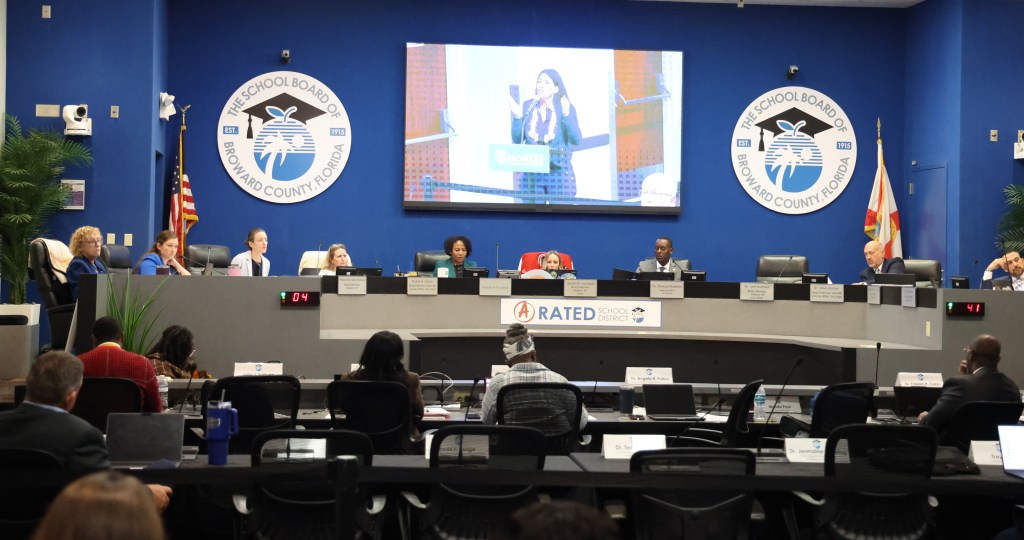
The Broward School Board agreed to stop paying for popular weight-loss medicines for its employees during a recent closed-door meeting — a move that legal experts and the teachers’ union say may have violated the state’s open-government law.
It’s the latest in a string of closed-door, secret meetings that have raised questions and concerns in recent years.
Some School Board members, as well as the district’s director of benefits and employment services, confirmed to the South Florida Sun Sentinel that a decision to end coverage of some GLP-1 medications, such as Wegovy and Zepbound, was the result of closed-door discussions.
A school district spokesman, while not saying whether the medications were discussed behind closed doors, said such discussions would be allowed under an exemption for collective bargaining strategies.
But the coverage change was not proposed during bargaining sessions, representatives of the district’s two largest unions, the Broward Teachers Union and the Federation of Public Employees, told the Sun Sentinel.
Instead, affected employees received a letter from the insurance company Aetna, which administers the program for the district. The letter said it’s the school district, not the insurance company, which makes coverage decisions.
The School Board’s action was confirmed by Dildra Martin-Ogburn, the district’s director of benefits and employment services, at a Feb. 11 meeting of the Superintendent’s Insurance and Wellness Advisory Committee. The committee consists of school district employees and representatives of employee groups and makes recommendations to the superintendent and School Board on matters affecting employees’ health.
“Yes, the board made a decision to remove the GLP-1 weight loss drug effective April 1. That is a fact,” Martin-Ogburn told the committee, adding that there were also external factors.
Martin-Ogburn told the committee that the district is self-insured, which means it pays for employee health care costs. The decision was made after Aetna dropped the GLP-1 weight-loss drugs from its formulary, or list of medications covered by Aetna insurance plans, Martin-Ogburn told the committee. The change will save the district about $12 million per year, she said at the meeting.
Martin-Ogburn confirmed to the Sun Sentinel after the meeting that the School Board reached consensus on the matter during a closed-door meeting. She said that discussions about wages and benefits are allowed in closed-door sessions.
However, the Sun Sentinel reached out to multiple lawyers and open-meetings experts who say that only applies if the proposed changes will later be collectively bargained in a public session.
Now, the Broward Teachers Union is filing a grievance, which in part challenges whether the meeting violated the state’s Sunshine Law that governs open meetings, President Anna Fusco told the Sun Sentinel.
“They did it all wrong,” Fusco said.
The grievance was initially filed on Feb. 10 to address a collective bargaining concern but is being amended to also address concerns over possible Sunshine Law violations, Fusco said. The grievance first goes to a district administrator for review but can end up going to an arbitrator if not resolved internally, she said.
Under state law, if a court rules a government agency violated the Sunshine Law, the “cure” would be to redo the meeting in public. The School Board did that voluntarily in 2023 when the legality of several meetings was challenged.
School Board member Adam Cervera told the Sun Sentinel he spoke with Fusco about her concerns.
“I know her position on all of this is that it should not have been part of closed door. If in fact, that’s the case and we did something wrong, we’re going to do what needs to be done to fix it,” Cervera said. “We’ll make sure it’s properly advertised or if it needs to be done at a board meeting or whatever. We’ll do that because we follow the law in Broward County.”
However, he said if it was a proper closed-door meeting, “which I think that’s the district’s position still, then I can’t really tell you what happened, who thought what, who said what or who voted what because it was closed door.”
Cervera said one possible way to resolve the issue is to request an opinion from the Florida Attorney General’s Office.
School Board Chairwoman Sarah Leonardi said the board takes steps to ensure compliance with the Sunshine Law.
“Our general counsel signs off on all closed-door topics and sits in on all closed-door sessions to ensure we stay within the confines of the law,” Leonardi told the Sun Sentinel.
District spokesman John Sullivan didn’t respond to multiple requests by the Sun Sentinel for the date of the closed-door meeting where the weight-loss drug decision was made. Several board members told the Sun Sentinel they don’t remember the exact date.
The School Board made the closed-door decision to stop covering GLP-1 weight loss drugs after being presented with a list of drug costs, Barbara Crowe, an executive with the district’s benefits consultants, Gallagher, told the superintendent’s insurance and wellness committee.
“We do not make recommendations. We do not vote on those items,” Crowe told the committee, referring to Gallagher. “We just bring them information, and then the board decides what they’re going to do.”
Sullivan told the Sun Sentinel that changes to the list of covered medications may be implemented through the district’s benefits administration process. However, he argued that they can be discussed during a closed-door session about collective bargaining strategies.
“To the extent any cost savings generated by such changes later result in compensation or other matters affecting bargaining units, those impacts would be addressed through the appropriate collective bargaining processes, as required by law. The District is currently within the collective bargaining period,” Sullivan said in an email. “The purpose of the statute allowing limited closed sessions in the collective bargaining context is to permit the Board and administration to discuss bargaining strategy and fiscal considerations in a manner that protects the District’s negotiating position.”
Michael Barfield, a public records expert who serves as executive director of the watchdog journalism group Florida Center for Government Accountability, said he has “grave concerns” about the district’s logic. He said it could be used to discuss any operational or policy change that has a financial impact behind closed doors.
He said the collective bargaining exemption “applies only in the context of actual or impending collective bargaining negotiations,” he said. The law “does not allow closing an entire meeting just because one exempt topic is discussed; nonexempt topics can’t ride along in secret,” Barfield said.
“Florida’s Constitution allows meeting exemptions only if they are justified by public necessity and ‘no broader than necessary’ to accomplish the purpose,” Barfield said. “Any doubts are resolved in favor of openness and disclosure; not closed-door meetings. The District’s construction of the exception is not consistent with transparency.”
Jennifer Mansfield, a Jacksonville partner with the Holland & Knight law firm who specializes in Sunshine Law issues, agreed, citing a 1985 opinion from the state attorney general that collective bargaining exemptions apply “only in the context of actual and impending collective bargaining negotiations and does not apply to other, nonexempt topics discussed during the course of the same meeting.”
“The Sunshine Law is construed to favor public access and to frustrate all evasive devices. The closure of a public meeting under the exemption cited also results in the public not being able to speak on a matter of public importance, which the Sunshine Law otherwise requires,” Mansfield told the Sun Sentinel.
“Under the limited facts disclosed to me, there appears to be cause to further investigate whether the closed meeting of the school board was lawful under the Sunshine Law,” Mansfield said.
The School Board’s use of closed-door meetings have raised concerns in the past. The district’s chief auditor’s office released an audit on Feb. 3 that concluded the school district was not transparent when it used money from a voter-approved referendum to give bonuses of up to $14,000 to some high-paid administrators.
The audit refers to a closed-door meeting from July 23, 2024, saying David Azzarito, who was the human resources chief at the time, asked an employee to prepare data about administrator supplements for that meeting. An agenda item for the closed-door session that day listed that as a topic for the School Board to consider, the audit said.
However, there are no statutory exemptions to discuss administrator pay in closed-door meetings, since it’s not collectively bargained, lawyer Barbara Petersen, an expert on Sunshine Law issues, told the Sun Sentinel in a recent interview. She said the statutory exemption for collective bargaining is there for a specific purpose.
“The idea is we don’t want union people sitting in on that meeting, hearing how far we’re willing to go. We want the bargaining to be on a level playing field and we don’t want to give them an advantage,” said Petersen, who is CEO of the Florida Center for Government Accountability and works with Barfield. “It does not apply in this situation.”
In a Feb. 5 email, Sullivan defended the general practice of discussing wage and benefit issues in private.
“With respect to closed sessions, discussions related to employment compensation are generally permitted under applicable law,” Sullivan said. “When issues uniformly affect all employees, such as benefits, those matters may be discussed in closed session.”
Sullivan told the Sun Sentinel on Feb. 5 that administrative bonuses were not discussed behind closed doors.
The Feb. 3 audit left it unclear whether the bonuses were discussed at that closed-door session. HR administrator Azzarito and Superintendent Howard Hepburn told auditors they don’t remember if administrator pay was discussed. Leonardi told the Sun Sentinel she doesn’t remember either, as the meeting was nearly two years ago.
“We aren’t allowed to keep our notes from closed-door sessions,” Leonardi said. “However, our general counsel was present for that closed-door session, and the Board relies on our legal counsel to alert us to discussions or topics we would not legally be allowed to have.”
Fusco blasted the School Board in November for another closed-door matter.
The School Board had initially agreed to save $35 million by eliminating traditional block periods and study halls, while limiting the ability of teachers to make extra money by teaching more classes than their normal load.
The district cited the collective bargaining exemption for holding the meeting behind closed doors. But, like the weight-loss drug, the issue was not bargained with unions.
“You should really consider exactly what goes in closed-door meetings and what really should be out in the public, considering your hostile takeover of our high school and middle school block scheduling and personalization courses,” Fusco told the School Board at a Nov. 18 meeting.
The School Board decided in a closed-door session that same day to drop the proposed schedule change.
The board also faced public challenges in 2023 when it cited a security exemption to hold closed-door meetings on issues such as clear backpacks, school uniforms and an employee discipline case. These are topics that many experts say don’t fall within the narrow security exemptions in the state’s Sunshine Law.
Sullivan initially denied at the time there were any violations.
“These claims on Sunshine Law violations are baseless and meritless. ALL School Board meetings, including closed-door sessions, follow board policies and state laws,” Sullivan said in an email to the Sun Sentinel on May 24, 2023.
However, in July 2023, Sullivan acknowledged at least one improper meeting after the Sun Sentinel discovered through public records that a concern over a software purchase was discussed behind closed doors. A new meeting on the purchase was held in public.
“We sincerely apologize to the public for discussing this finding during a closed-door session that should have been addressed during an open meeting,” Sullivan said in a July 14, 2023, email. “The District fully understands the importance of transparency and open dialogue. Enhanced protocols are being implemented to ensure more safeguards in the future.”
Marylin Batista, who was then general counsel, drafted new rules in 2023 to try to ensure closed-door meetings adhered to state law.
District staff who want to discuss a matter in a closed-door meeting were required to fill out a form ahead of time stating the reason, and it must be approved by the general counsel’s office, Batista wrote in a May 18, 2023, email to Leonardi.
“I will also reiterate in the memorandum that a closed-door session is not a substitute for bringing an item for consideration and vote by the Board,” Batista wrote to Leonardi.
In a Feb. 11 email to the Sun Sentinel, Sullivan said recent closed-door meetings have complied with the Sunshine Law.
“No, there were no Sunshine Law violations,” Sullivan wrote in that email to the Sun Sentinel. “Repeatedly suggesting otherwise is not supported by the facts.”