
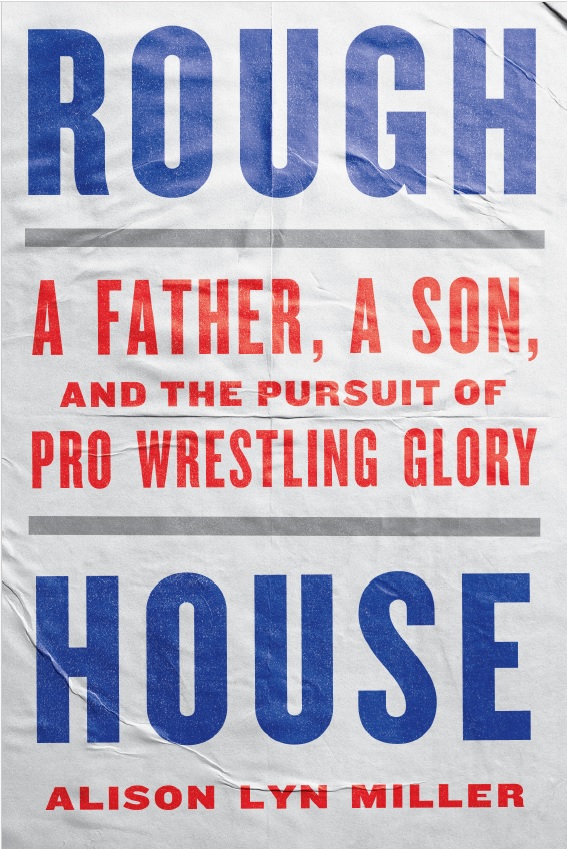
Alison Lyn Miller wasn’t raised on pro wrestling.
As a child of the late 1980s and early 1990s in Georgia, she knew the ubiquitous big names who made it into larger pop culture, but that was about it. It wasn’t until 2019 that she attended her first live show, and even that wasn’t the polished glitz of WWE or AEW, it was an independent show at an Athens brewery.
Which might make her the perfect candidate to write a certain kind of wrestling book in the 2020s — a peek at a small-town Southern wrestling subculture and the young pro who embraces it while also trying to escape it. In “Rough House,” Miller views the sport with an appreciative eye, but focuses less on the ring or the storylines and more on the relationships built around it.
“I could feel the connection between the fans and the performers” that first night in Athens, Miller told the Sentinel. “It all felt, at the same time, orchestrated and ad-libbed. I could sense that the crowd had some agency over what was happening, and I had so many questions about what brought them there — the guy next to me was like, ‘That’s my cousin. He’s a mailman.’ So my interest immediately was about ‘who are the people showing up, to perform and to watch?’”
MLW’s Killer Kross appeals to the smart wrestling fan
Within a few months, as a masters student at the University of Georgia, she found a subject for her narrative nonfiction study — Hunter James, a teenage superstar on the local circuits who is trying to do what his father couldn’t and make it big as a wrestler in a national promotion. His home base was the Landmark Arena in Cornelia, Ga., one of the first buildings where WWE’s AJ Styles got his start, but the book actually opens in a friend’s backyard, with James practicing on a ring surrounded by steel cable sheathed in garden hose.
“(James) was a few days shy of his 17th birthday in the opening scene of the book, which was the first time I ever met him,” Miller said. “Back when I had no idea this would become a book, I was there to see what backyard training looked like and he happened to be there.”

“For Hunter and his father especially, wrestling is the thing that both binds and breaks them; it defines their relationship,” Miller said. “Like so many people that I met, Hunter grew up watching it with his dad, and if you took wrestling out of their relationship, I don’t know that they’d have much of one.”
Miller purposely keeps the story focused on the independent scene — James is boosted by a 2023 match on AEW Dark at Universal Orlando and other near-misses at getting TV appearances. She admits that the big time can be out of her comfort zone.
“I’ve tried to watch wrestling on TV and it just doesn’t connect,” said Miller. “I took my daughter to an AEW show in Athens and it’s just so different because you feel so removed. When you’re at an indie show, if you’re in the front row, there’s a good chance you’re going to be taken out (by a flying wrestler). You’ve got to be on, and that’s what makes it fun. And you know you’ll see the guys hanging out before or after the matches. I’ve seen how meaningful that is to the fan who shows up every month or every two weeks.”
AEW’s brooding brawler Brody King has softer side
She said she did watch parts of the recent WWE Royal Rumble, since it was advertised as Styles’ retirement match. She felt the connection from the small time of Landmark Arena to the big time of a giant outdoor stadium, and she said it taught her something.
“For fans, it’s different from watching a movie star,” Miller said. “I’ve never met AJ, but I’ve been in these spaces where he was, and you feel connected to a wrestler in a deeper way after you’ve been with them on that level. So if Hunter James does ever make it, if I am sitting on my couch 10 years from now and watching him on TV, I’ll know what it feels like to be a wrestling fan.”