
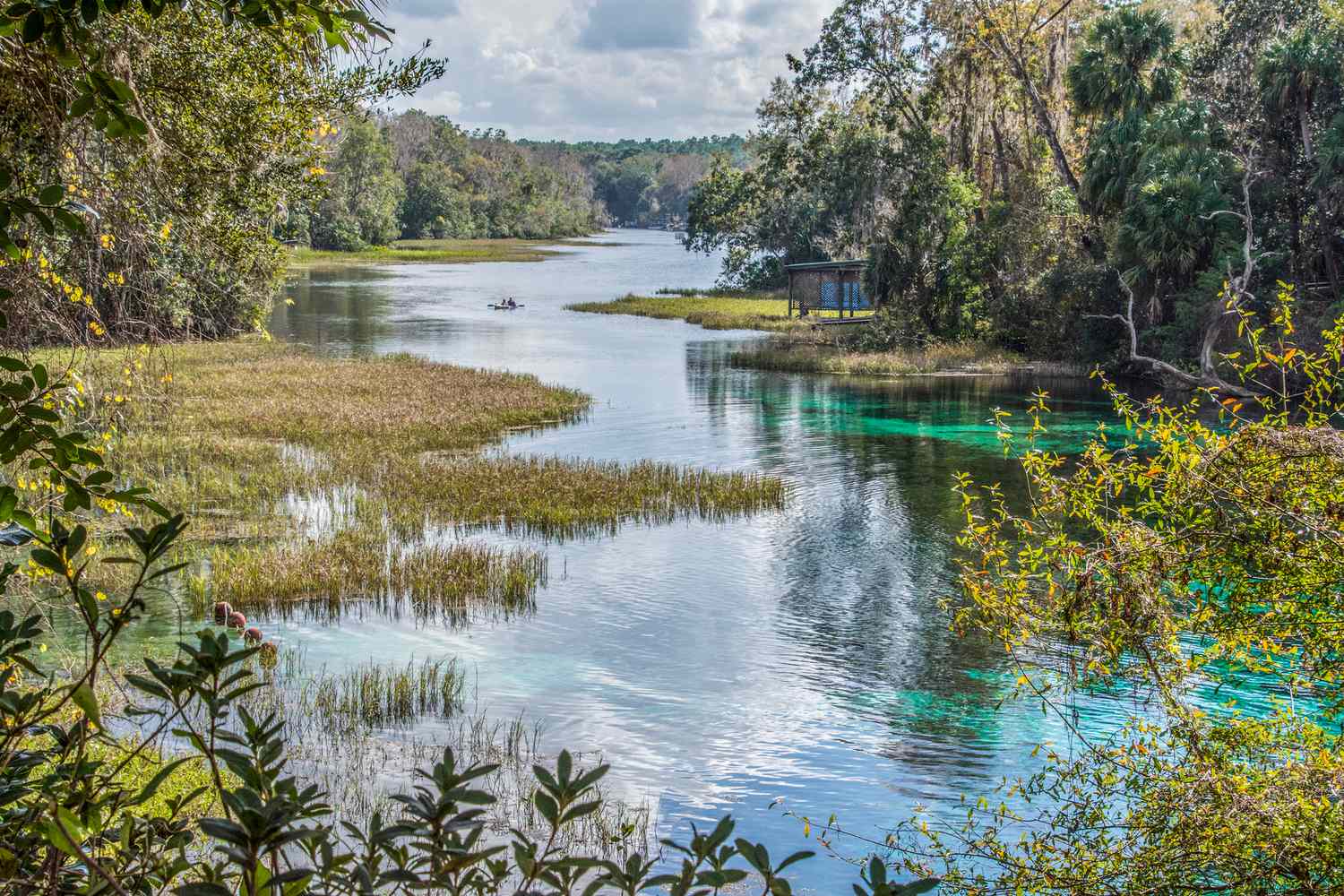
Rainbow Springs State Park’s sapphire-blue waters well up from the earth with startling clarity, a living force that has drawn people here for thousands of years—from the Timucua who once gathered along its banks to modern-day visitors floating quietly above the headsprings. “The river is unbelievably clear, the kind of clear that makes it look like a swimming pool, except it’s completely natural,” says Jessica Heller, marketing and communications supervisor for Ocala/Marion County. That glassy transparency comes courtesy of the Florida aquifer, which releases more than 400 million gallons of fresh water into the spring every day, flowing at a steady 72 degrees year-round.
Moss-draped hammocks and winding nature trails lead to ornamental gardens, constructed waterfalls, and gentle slopes, remnants of the early 20th century when this was a privately owned tourist attraction. Rich Lucy, area director with guest services at the park, likes to remind visitors that back in the ’30s, it was a destination. “People went there to go fishing and swimming. They had glass-bottom boats,” he says. “Luckily, it was sold to the state, and it became a state park where people can continue to enjoy it.”
One of Florida’s largest first-magnitude springs, Rainbow Springs anchors a 1,470-acre park that now hums with kayaks gliding over eelgrass, snorkelers drifting above schools of fish, and tubers laughing downstream on summer afternoons. Lucy notes that the river’s magic lies not just in the main spring but in what you can’t easily see. “Ours are made up of micro springs, hundreds of thousands of these little springs spread out through the entire river. That’s what makes it stay that crystal clear,” he says. Add in early-spring azalea blooms that wash the gardens in pinks, purples, and whites, and it’s easy to see why this place has captivated generations.
“A lot of people are hurrying,” Lucy says. “Slow down and enjoy this. Enjoy the nature, because there’s a lot to see if you just slow down and look.”
Planning Your Visit
Visitors walking around Rainbow Springs State Park.
Irina K./Adobe Stock
As one of Florida’s most popular spring parks, visitation spikes on weekends, holidays, and throughout the summer months. When the headsprings reach capacity, the park closes entirely, so timing matters.
“If you go on a summer day—or even a nice weekday—get there when they open at 8,” says Lucy. “You want to find that perfect spot, whether it’s on the grass knoll or under one of the big pavilions.” Arriving early gives you time to stake out shade, organize your gear, and settle in before the crowds arrive.
Park entry is standard: $5 per vehicle (2–8 people), $4 for a single-occupant vehicle, and $2 for pedestrians or cyclists. Because of high demand, Annual Entrance Passes are only sold on weekdays and non-holidays, though they can also be purchased online in advance at the Florida State Parks website.
Once inside, it’s easy to turn a visit into a full, unhurried day. “Tube or paddle in the morning, grab lunch at the concessions, take a walk on the trails, and end the day with a swim at the headspring,” says Heller. Outside the state park boundaries, additional outfitters along the Rainbow River offer clear-kayak tours, pontoon rentals, and guided dives—great options if the park reaches capacity or you want a different perspective on the water.
A few insider tips can make the day smoother. If you plan to tube from the state park, note that the tubing launch has a separate entrance with limited capacity. For longer floats, nearby KP Hole Park offers VIP parking on weekends, which can be a game-changer. Disposable containers aren’t allowed on the river, so pack food and drinks in reusable containers. And if you bring your own kayak, canoe, or paddleboard, self-launches are available at both the Rainbow Springs headsprings and KP Hole Park. From KP Hole, a short paddle upstream leads to Indian Creek, one of Heller’s favorite spots: a quiet, spring-fed side creek with a sandy bottom and a distinctly tropical feel.
The park’s campground sits about six miles from the headsprings, offering river access in a quieter setting. Check-in begins at 3 p.m., and early check-in isn’t available. Campsites include water, electric, and sewer hookups, with ADA-accessible restrooms, showers, laundry, and a camp store with a wide variety of food options. Canoes and kayaks are available for rent, and pets are welcome in the campground (though not in swimming areas).
Camping options are expanding, too. “We’ve got five camping sites designated for glamping tents,” Lucy says. “Big tents—with beds, dressers, split AC—so it’s camping, but with more comfort.”
How to Get There
A walking path through Rainbow Springs State Park.
CampPhoto/Getty Images
Rainbow Springs State Park is located in Central Florida near the town of Dunnellon, about 30 minutes southwest of Ocala, 90 minutes north of Tampa, and roughly two hours from Orlando. Visitors should note that the park has three separate entrances depending on activities. The main headsprings day-use area at 19158 S.W. 81st Place Road provides access to the spring itself, swimming, historic gardens, seasonal dining, and paddle rentals, though it often reaches capacity on summer weekends and holidays. The campground entrance, located at 18185 S.W. 94th Street, is reserved for registered campers with reservations and requires a gate code on arrival day. Seasonal tubing operates from a separate entrance at 10830 S.W. 180th Avenue Road, managed by the park’s concessionaire.
Best Time to Visit
Steps going into clear water at Rainbow Springs State Park.
CampPhoto/Getty Images
The best time to visit Rainbow Springs State Park depends on what you want to do. Summer is the most popular season, thanks to tubing and consistently warm weather. Heller notes that tubing runs on weekends from April to Memorial Day, daily from Memorial Day through Labor Day, and again on weekends through September. With that popularity comes crowds: during peak months, the park often reaches capacity by mid-morning. Spring and fall strike a quieter note, while winter offers the calmest experience for hiking, paddling, and wildlife viewing. Just plan ahead if camping, as sites fill far in advance year-round.
Best Things to Do
Canoes docked near a water entry point at Rainbow Springs State Park.
CampPhoto/Getty Images
Birding
A standout stop on the Great Florida Birding and Wildlife Trail, even casual visitors tend to notice the birdlife almost immediately. Wading birds stalk the shallows, woodpeckers tap through the hammocks, and osprey circle overhead along the river corridor. Slowing down pays off here—a theme echoed by park staff—especially in the quieter morning hours when songbirds and owls are most active.
Hiking and Waterfall Walks
The park’s trails range from gentle garden strolls to longer nature hikes through oaks and sandhill communities. Paved walkways wind past magnolias and three historic waterfalls, with benches placed for lingering. “The waterfalls were built in the mid-1900s, but they blend beautifully into the landscape and make for a fun discovery,” says Heller. Lucy encourages visitors to explore deeper: “See the waterfalls, but also check out the old zoo site, even remnants from the phosphate mining days. There’s a lot of history back there if you know where to look.” Uneven surfaces and steep grades mean sturdy shoes are a good idea.
Paddling the Rainbow River
Heller and Lucy cite kayaking or canoeing as one of the most immersive ways to experience the park. Moss-draped cypress trees frame the river, and wildlife sightings are common. Rentals are available inside the park, while private vessels can be launched with a short portage.
Snorkeling and Swimming
Snorkeling is allowed within the buoyed swimming area at the headsprings, where visibility is exceptional. “The headspring itself is a beautiful swimming spot,” says Heller. “It’s clear, calm, framed by lush greenery—it really does look like something out of a postcard.” The water stays a constant 72 degrees year-round, but depths exceed 10 feet, and there are no lifeguards, so caution is key.
Tubing
Tubing is the park’s most popular summertime activity. The steady spring flow does the work for you. The standard float takes about two hours, with longer options available from nearby KP Hole Park. First-timers should double-check directions—the tubing entrance is about nine miles from the headsprings—and arrive early during peak season.
Must-see Wildlife and Natural Features
A waterfall in the Rainbow Springs State Park.
Patrick Connolly/Orlando Sentinel/Tribune News Service via Getty Images
Wildlife viewing is woven into nearly every corner of Rainbow Springs State Park, from the river’s clear, slow-moving current to the shaded backcountry trails. Along the water, keep an eye out for wood ducks gliding past the banks, turtles basking on logs, and fish moving effortlessly through the spring run. On land, the park’s quieter trails offer chances to spot fox squirrels and gopher tortoises, while overhead, the calls of hawks, owls, swallow-tailed kites, eagles, pileated woodpeckers, and bright red cardinals provide a constant soundtrack.
The river itself is often the star. “One of my favorite things about spending time on the Rainbow River is the wildlife, especially the otters,” says Heller. “I honestly don’t think I’ve ever been on the river and not seen them. They’re playful, curious, and seem to pop up when you least expect it.”
Beyond wildlife, the park’s ornamental gardens and hand-built waterfalls are living reminders of its past as a private attraction. Renovated and thoughtfully replanted, they shine brightest in early spring before Florida’s summer heat sends them dormant.