
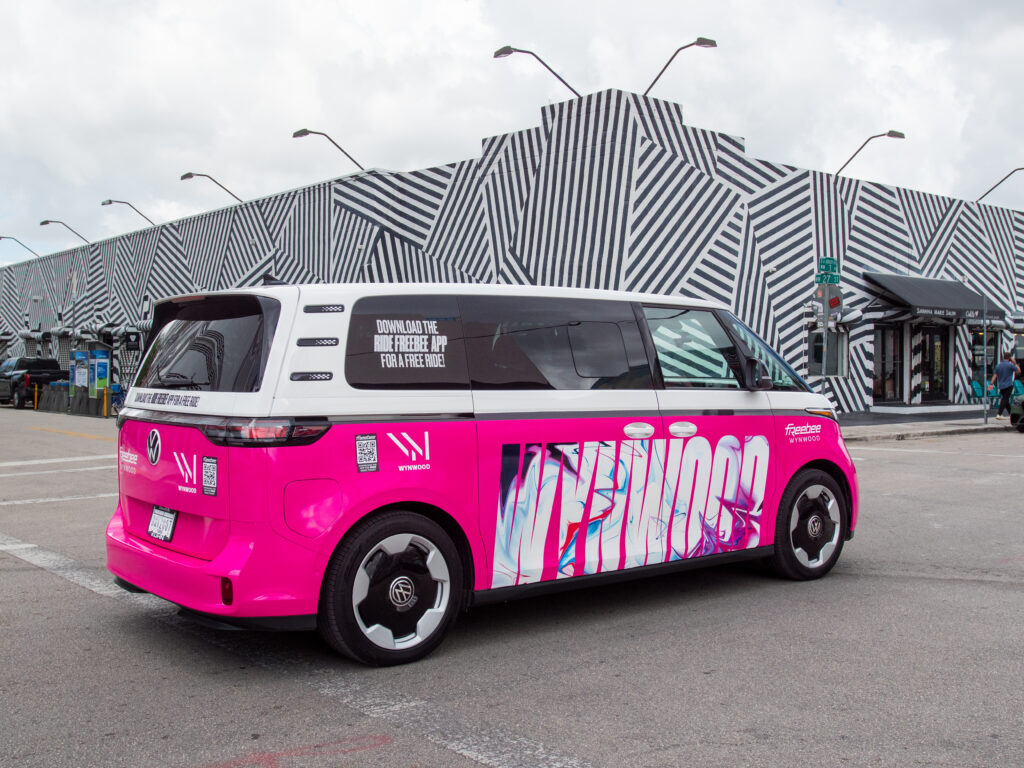
In sprawling, car-choked South Florida and beyond, a fleet of bright electric vehicles has been quietly rewriting the playbook for how cities move. What began 14 years ago as a scrappy marketing experiment on the streets of Miami Beach has blossomed into Freebee, the largest provider of microtransit in Florida.
Today, Freebee’s fleets of electric vehicles aren’t just for local convenience; they are a critical pillar of Florida’s public infrastructure, recently coming off a record-breaking year where Freebee served nearly 2 million passengers. Now, with a massive expansion underway from Downtown Miami to Central Florida and even beyond Florida, the company is proving that the future of transit isn’t just electric – it’s on-demand.
Managing Partner Jason Spiegel, who co-founded Freebee with Kris Kimball, recalls the startup’s beginning in 2012: “The business model in the beginning was totally different. We were more of a marketing and advertising company. We sold ads on the vehicles. That was the old days of Freebee.”
The total pivot to the business model Freebee uses today came in 2017, when Key Biscayne, facing mounting traffic and parking woes, took a chance on Freebee, offering the company its first shot at public transit through a pilot program back then. Now Freebee moves 12,000 passengers a month in that small community alone. And today, 93% of Freebee’s revenue comes from recurring government contracts, with advertising making up just a sliver of the pie.
In the last two years, “micro transit has become such an important and popular part of this and we’re reaping the benefits. It’s really timing and opportunity all kind of coming together,” says Spiegel says, in an interview with Refresh Miami. “We’re able to deliver at a lower cost, drive higher ridership and cover a much larger area than a typical fixed route.”
 Freebee co-founder and Managing Partner Jason Spiegel
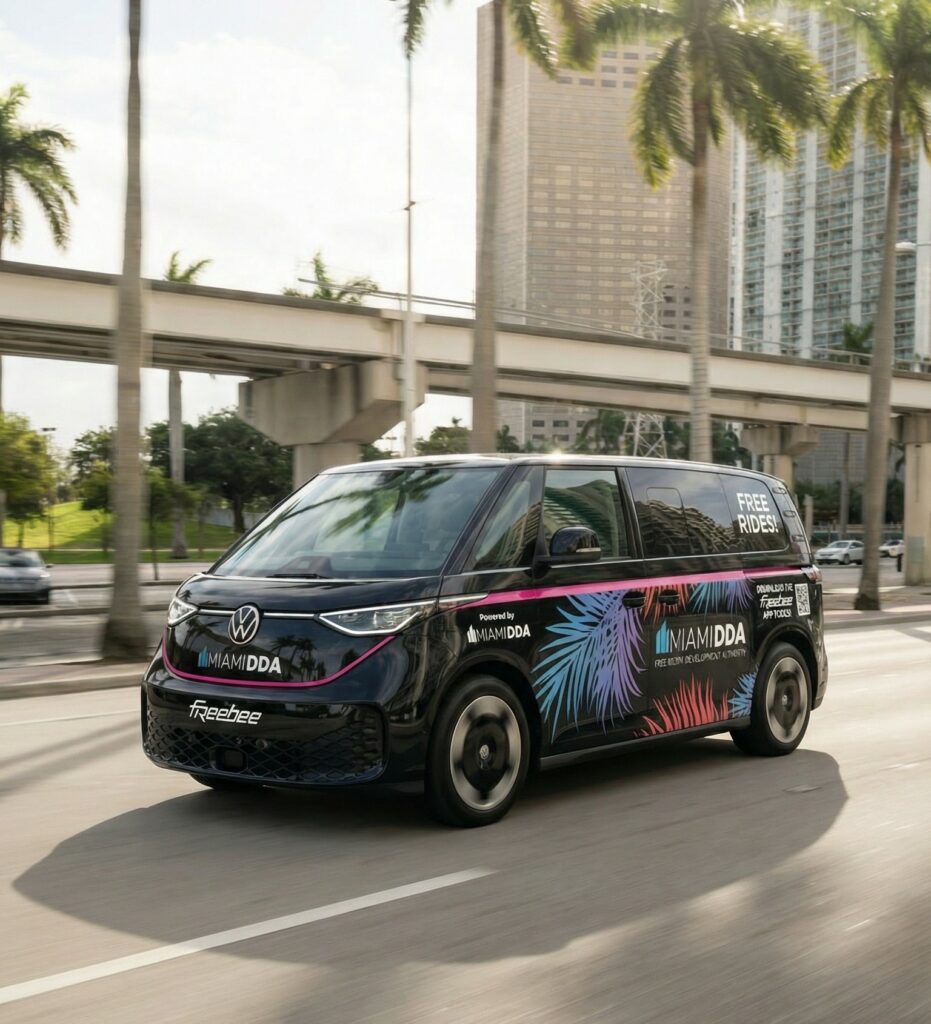
The result: Freebee’s network now spans 53 active destinations – from Key West to Central Florida and the Gulf Coast plus a few in North Carolina – and they are served by more than 300 vehicles, including 50-plus electric Volkswagen ID vans. Freebee has recently expanded into eight new zones, including its largest ever in Seminole County just north of Orlando, and grew 19 existing services. Locally Florida International University and University of Miami have networks too. The result: Freebee moving a lot of people. In 2026, Spiegel expects Freebee will cross 3 million annual passengers.
The rise of microtransit
The surge in demand is driven by a harsh reality for traditional transit: Many legacy fixed-route systems are struggling with rising costs and declining ridership. Spiegel notes that municipalities are often paying more for systems that serve fewer people.
Freebee solves these pain points by being more flexible and cost-effective, he says. By replacing underperforming fixed routes with on-demand electric vans, cities and counties are seeing dramatic results. Since launching in Seminole County in October 2025, Freebee is already moving nearly 30,000 passengers a month there.
“We look at public transit as moving the local economies,” Spiegel explains. “It’s driving more foot traffic to businesses, it’s getting workers to jobs more reliably, it’s’ reducing parking demand and it’s allowing people to spend more time in these commercial districts. It’s driving real economic impact.”
In South Florida and Central Florida over the next couple of months, expansion highlights include:
Downtown Miami & Brickell: Moving from a fixed-route circulator to a fully on-demand model. In partnership with the Miami DDA, Freebee is deploying nine vehicles (including new Volkswagen ID vans) to cover the urban core, Brickell, and the Arts & Entertainment District. “Circulators are great, but on-demand is the way to go. People want to be picked up where they are and dropped off exactly where they need to go,” Spiegel said.
Wynwood & Midtown: Doubling the fleet to strengthen the connection between the Arts District, Midtown, and Edgewater.
Palmetto Bay: Doubling the fleet to provide “first- and last-mile” connectivity to the new South Dade TransitWay BRT corridor.
Miami Gardens: Following strong demand since debuting in November 2025, Freebee will grow Miami Gardens’ fleet from six to 10 vehicles to better serve riders throughout the community.
Central Florida: Following a massive launch in Seminole County, Freebee is expanding into Lake Nona and other high-growth communities this spring.
The road ahead powered by national ambitions
While Miami remains Freebee’s “roots,” the company is no longer just a Florida story. After a few successful launches in parts of North Carolina, now Freebee – now with about 500 employees – is eyeing a national scale-up.
Within the next 12 to 18 months, Spiegel said he hopes to expand into five new states and intends to double or triple its current fleet of 300 vehicles within the next couple of years.
For Spiegel and COO Kimball, the two University of Miami grads who started this journey with a few “green” vehicles and a dream of cleaner air, the mission remains the same: making public transit so convenient that even the most “car-centric” Floridians choose to leave their keys at home. As Spiegel puts it, “There’s no looking back anymore.”’
READ MORE IN REFRESH MIAMI:
 I am a writer and editor with extensive media experience and a passion for journalism and serving the community. Most of my career has been spent with the Miami Herald in business news, and my expertise is writing about tech and entrepreneurs. I love hosting this blog for Refresh Miami and we aim to be the go-to site for South Florida startup and tech news, features and views. Have news? Contact me at [email protected]. Thanks for reading! Latest posts by Nancy Dahlberg (see all) Freebee accelerates growth across Florida, eyes major national expansion – February 23, 2026 After the exit: High-tech hustle meets Main Street for this former startup CTO – February 23, 2026 10+ things to know in #MiamiTech: A day-after Palantir HQ update, a local college wins $5M in quantum funding, and news from Elektron Energy, Endeavor Miami, Trubar, Avenue Z, Exowatt, eMerge, New World Angels, tech jobs & more – February 18, 2026