
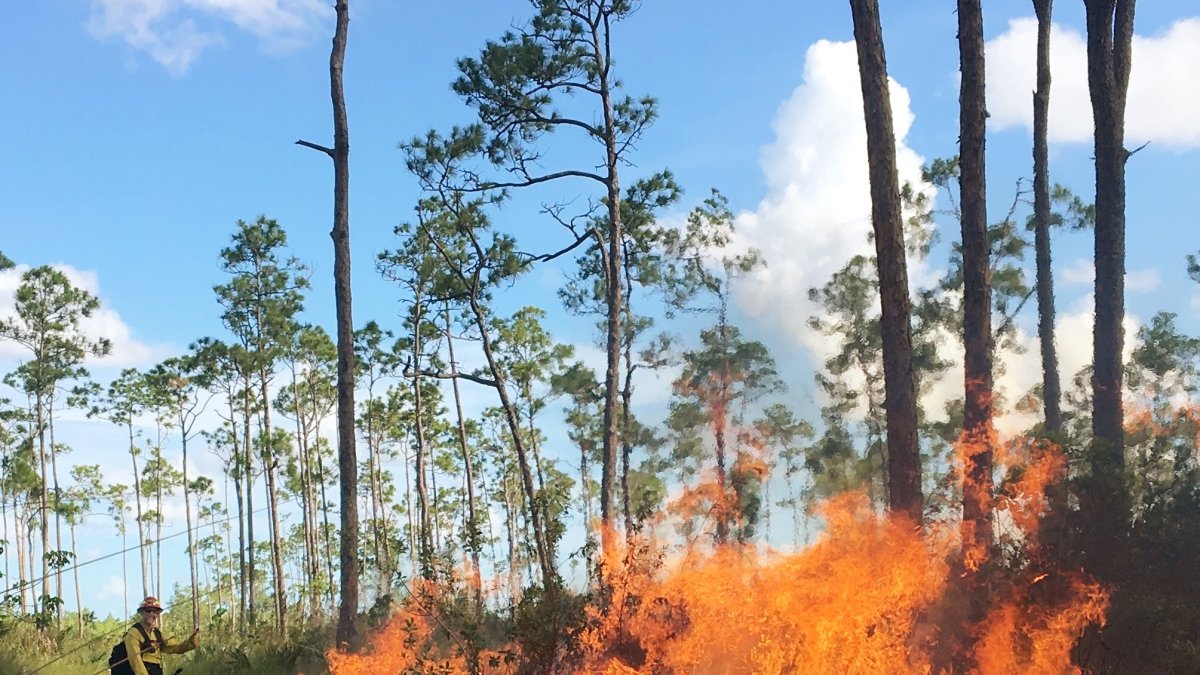
As crazy as it might sound, a South Florida ecosystem needs to be burned constantly in order to thrive.
The Pine Rocklands are an ecosystem found on the limestone rocks of Miami-Dade, where the native and keystone species of Florida slash pine occur.
Images depict a vast land with slash pines sprouting from the ground, standing tall in their lonesome as the dominating tree species of this ecosystem, accompanied by saw palmettos, cabbage palms, and the many grasses and shrubs of South Florida (FNAI, 2010).
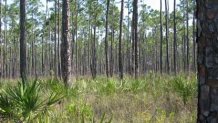
National Park ServiceNational Park Service
FIRE-DEPENDENT ECOSYSTEM
A unique quality of the Pine Rocklands is its dependency on periodic burns that help the land thrive.
Fires naturally would break out intermittently on these lands, helping with the germination of slash pine seedlings and getting rid of invasive plants.
However, as development and urbanization encroach on natural habitats, these lands are lost and must be protected and managed by people.
This ecosystem, which once covered approximately 126,500 acres of Miami-Dade County, has been reduced to only about 2% (2,273 acres) of its historical range, outside of Everglades National Park, according to the Florida Fish and Wildlife Conservation commission.
PRESCRIBED BURNS
With the responsibility to conserve the pine rocklands that are still present, many organizations in South Florida step up to the task and make sure natural fire procedures occur, under their control, through prescribed burns.
“Prescribed burns are safe, effective man-made fires controlled by fire experts that help restore health to fire-adapted environments. Unlike wildfires, prescribed burns are carefully planned to take place only under ideal conditions and are closely watched by experienced fire crews,” the Florida International University (FIU) Office of Sustainability describes.
Control burns tend to be prescribed every 3 to 7 years.
WILDLIFE – FAUNA
With much of the habitat loss, there also comes the endangerment of many species.
Pine Rocklands are home to some familiar Florida faces, such as the Florida panther, Miami tiger beetle, and the FWC-listed as threatened, gopher tortoise.