
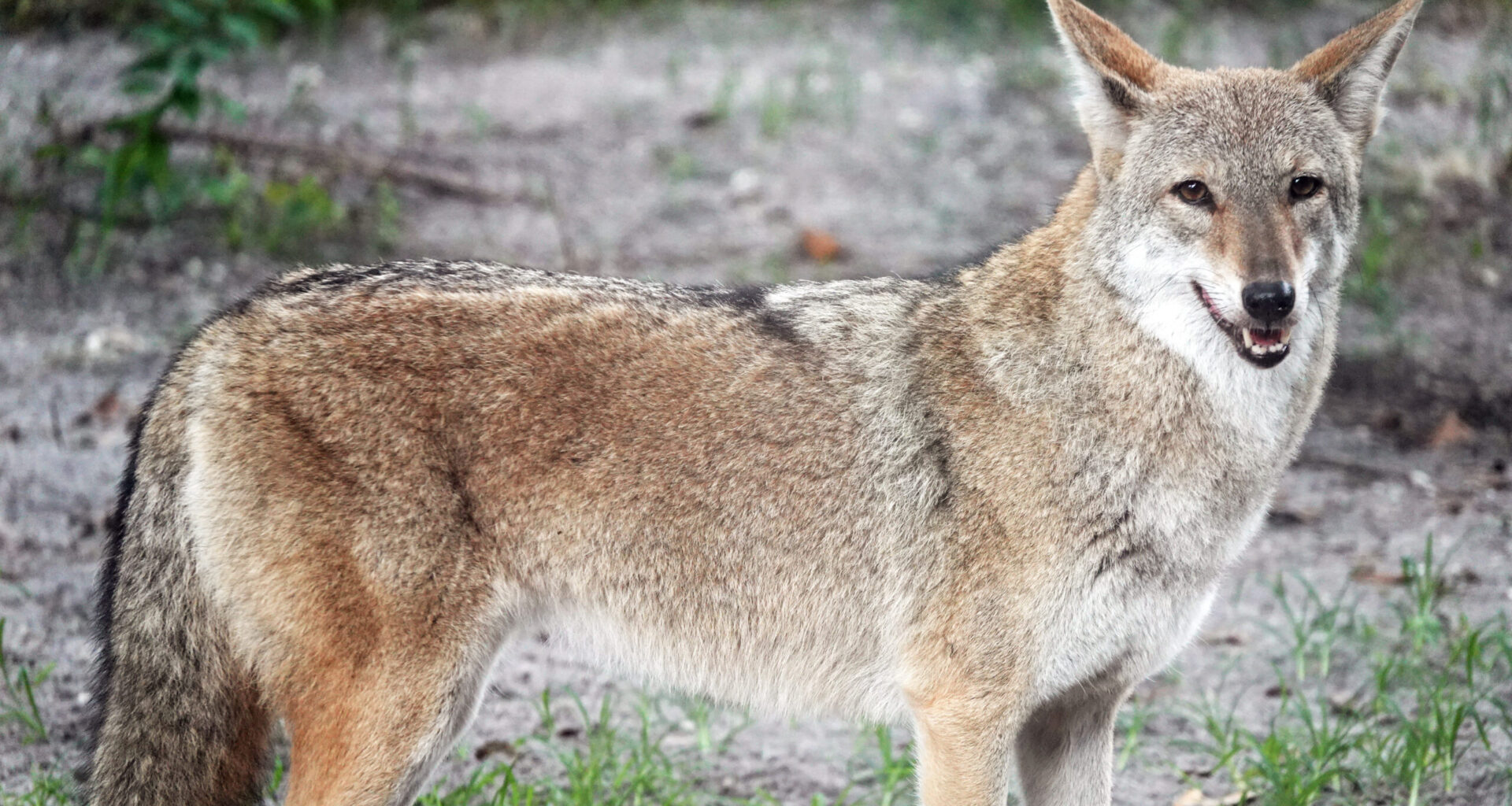
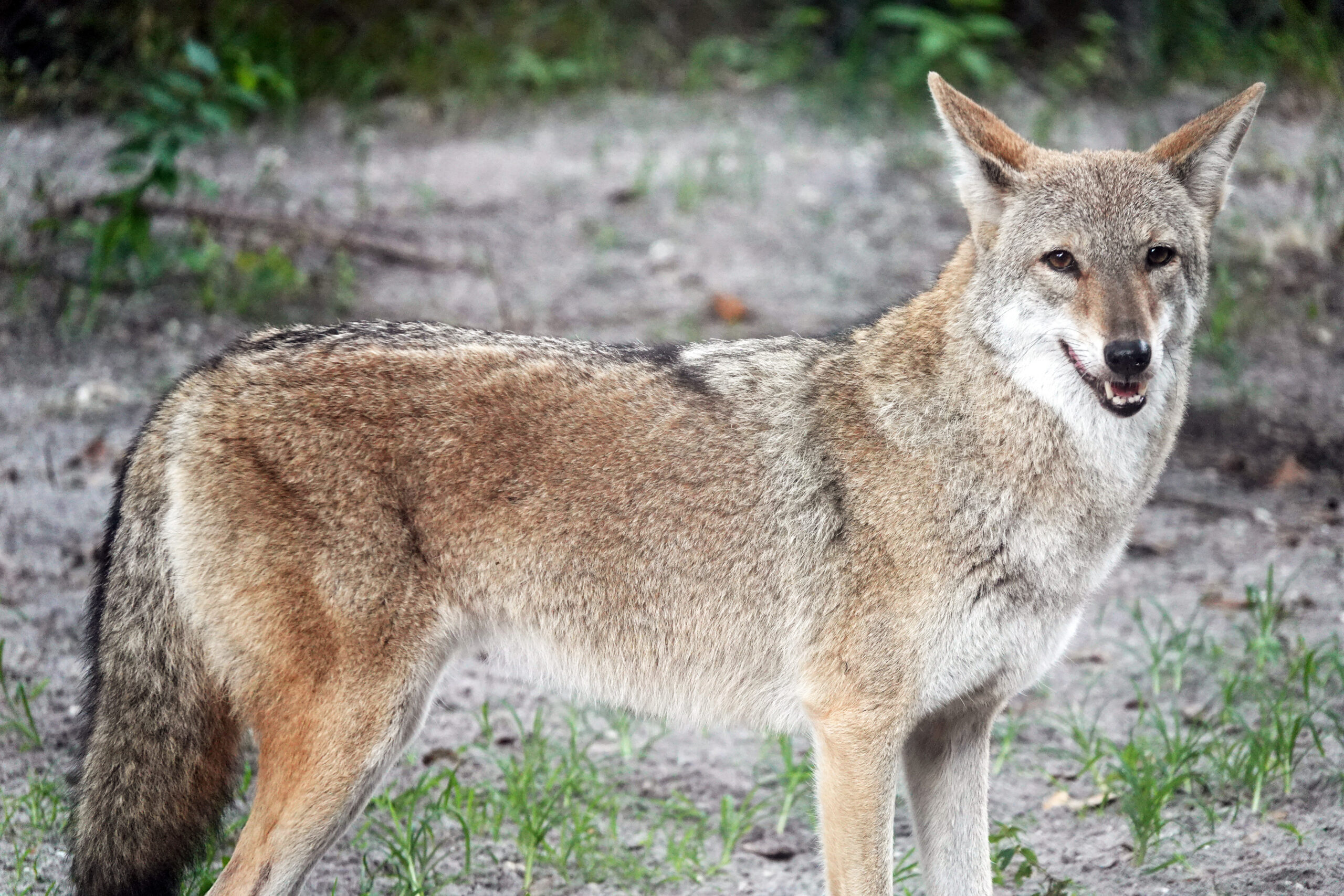
NAPLES ZOO / COURTESY PHOTO
They may look like dogs, but don’t be fooled! Coyotes are a different breed entirely.
Native to North America, the coyote has become a serious concern in South Florida, where sightings have increased in urban areas. This heightens fears about people’s safety when performing everyday activities, such as taking out the trash at night or walking their dogs.
Cape Coral Friends of Wildlife’s Janet Windisch explains that the more recent sightings in the city are related to the ongoing expansion. With the population steadily increasing in Cape Coral — 213,301 residents reported in 2024, according to the city’s website — house and building construction have followed suit.
“Coyotes have moved from their western habitat over the years. I don’t know whether the number is increasing — or whether the number of people is increasing,” Windisch said. “I can say that I think that people are more commonly seeing coyotes, because I know that they live in the city, they live in Rotary Park, they live in the old golf course, they live in some of the mangroves. And I think that people are starting to see them more, partly because we’re developing more of that land.”
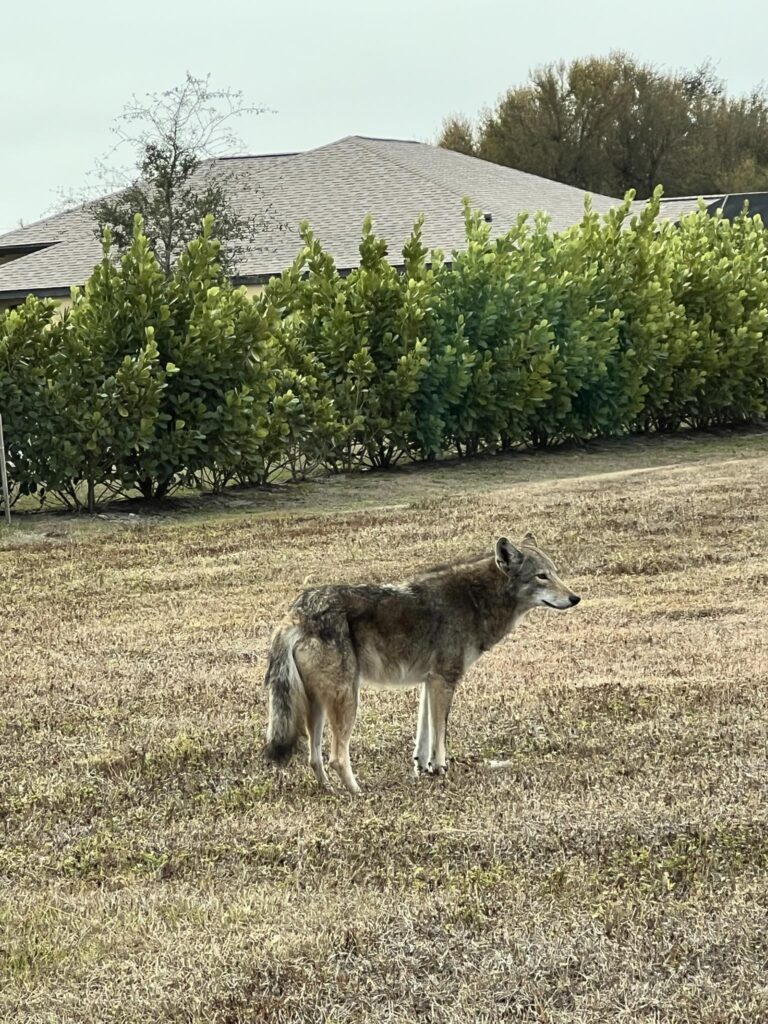
A coyote enters the backyard of a resident at Burnt Store Village. -JENNIFER BELTON / COURTESY PHOTO
Posts on Facebook, Instagram and Nextdoor have highlighted Floridians facing the issues of removing coyote habitats. The Luminary Hotel in downtown Fort Myers had a post trending across social media on Nov. 25 when a coyote became stuck on the ledge of the Denison Parking Garage. The coyote safely found its way out of the building, but the incident sparked the discussion of coyotes entering more urban areas.
Cape Coral Friends of Wildlife has been an advocate of protecting the Florida ecosystem and learning to live side by side with coyotes, despite concerns when residents spot them in their yards.
“I think what we would love to see is for people to get educated about coyotes and recognize that they’re in every county in Florida and their wildlife,” Windisch said. “They’ve been here for a long time, and we just need to coexist peacefully with them. They’re generally not aggressive to people, and if we take some simple steps, we can, like, reduce the potential hazard that they might present.”
Ranging from 20 to 30 pounds, coyotes are a naturalized species in all 67 Florida counties, according to the Florida Fish and Wildlife Conservation Commission (FWC). With their activity rate mostly during sunset and sunrise, these animals are territorial, and establish living and hunting grounds ranging from 1,500 to 12,000 acres.
They tend to stay around food sources — which, Windisch emphasizes, the Southwest Florida community can help prevent. Eliminating the animals’ access to trash decreases their appearances.
“Make sure that your trash is closed, so that there are no potential food sources,” Windisch said. “Remember that coyotes are typically afraid of people, and so if you see one and it seems to be getting a little close, you can yell, you can wave your arms, you can blow a whistle to scare them away, and that generally works.”
Even with taking precautions, living with coyotes still carries risks that Floridians must be aware of.
“They will attack small dogs, especially if the dogs are not leashed or left out alone,” Windisch said. “So, we have to do things, but we need to learn to live together, I think, for two reasons. One, it’s not effective to just get rid of them and No. 2, wildlife. They were here before us. They’re part of the ecosystem. So, let’s learn to live together and enjoy the beauty of all nature.”
The Cape Coral Friends of Wildlife have been working to keep the protected land that the coyotes roam in Cape Coral from the ongoing expansion of buildings. Some of these areas include Yellow Fever Creek Preserve and Redfish Point, according to Windisch.
Too close for comfort
Lisa Thompson, media contact for the Communications Division of Habitat and Species Conservation at the Florida Fish and Wildlife Conservation Commission, has provided information on what the community can do when interacting with coyotes.
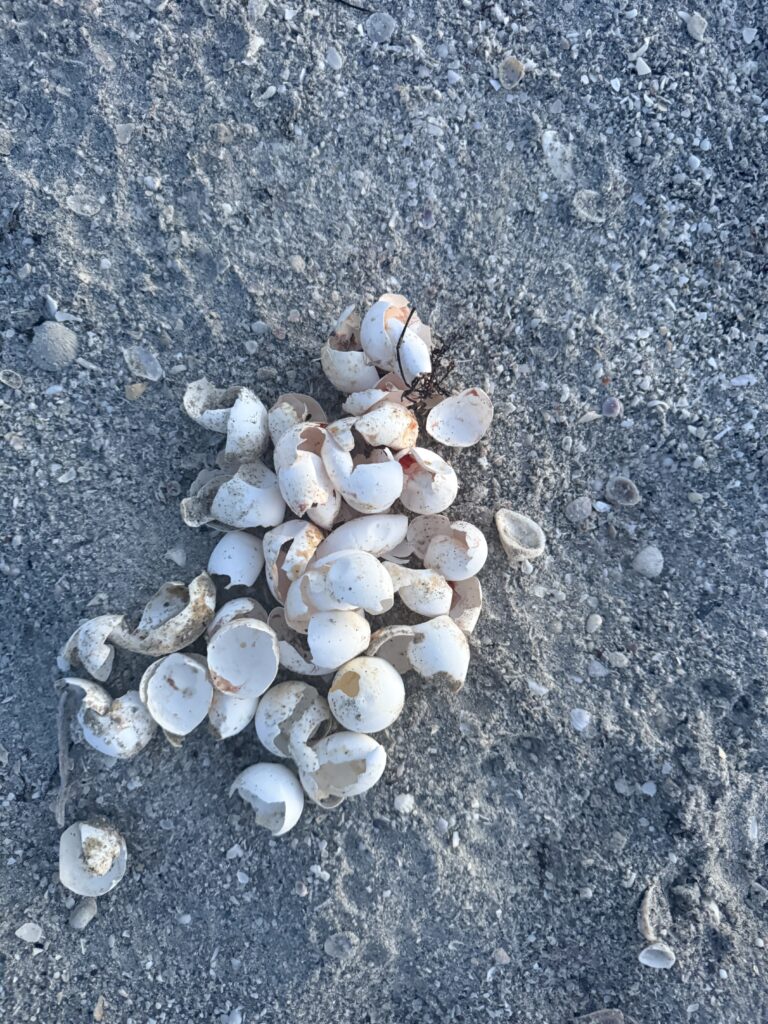
Turtle eggs destroyed by the coyotes on Sanibel. -SANIBEL-CAPTIVA CONSERVATION FOUNDATION / COURTESY PHOTOS
“The majority of urban wildlife often goes undetected by humans. Many people live alongside wildlife like coyotes, raccoons and opossums without even realizing it. However, conflict can occur when wildlife causes property damage or gets too close for comfort,” she said.
“It’s also important to note that coyotes and other wildlife that associate with places where people live — as an easy place to find food — may gradually lose their natural fear of humans.”
The organization receives more calls about sightings than about safety concerns, she added.
“Each year, typically, around half of the inquiries the agency receives about coyotes are simply sightings that are not associated with any specific conflict or concern. Most often, people are surprised to see a coyote in a suburban or urban area, and are unsure if they need to take any action or if they should be concerned for the safety of people or pets in the area.”
Most of the time, coyotes tend to avoid human conflicts — but they are opportunists, and will snatch smaller animals when given the chance.
“Coyotes help control rodents and other smaller predators, but they can also prey upon cats and small dogs, as well as small livestock, when the opportunity presents itself — another commonly cited concern,” Thompson said. “To protect pets, they should not be left outside unattended, even in a fenced-in yard. Walk dogs on a short, non-retractable leash that’s less than 6 feet to keep them close. Cats should be kept inside and not be allowed to free-roam.”
Sanibel Island leaders are also frustrated with the coyote population, especially as it has become a hazard to sea turtles. Coyotes have been known to kill the turtles and destroy their eggs.
Proposals to target the coyote population have been a topic of ongoing debate among Sanibel organizations and officials. With the potential for the predators to continue causing harm, the community is split on how to address the ongoing issues.
According to the Sanibel-Captiva Conservation Foundation, the coyote depredation rate on sea turtle nests has been steadily increasing since 2021 — and has exceeded 10% for the last four years.
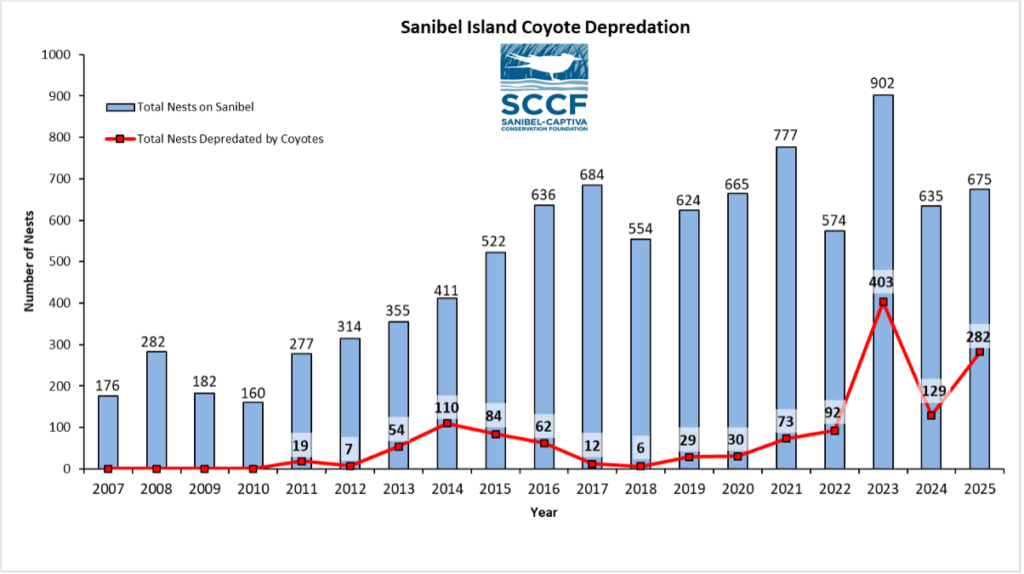
Coyote depredation by nest number. -COURTESY PHOTO
Wildlife under watch
Charlotte County has dealt with its fair share of coyote interactions, according to Charlotte County Animal Control Division Manager Brian Jones.
“They began arriving in Florida in the 1960s and have been migrating north since establishing themselves in all 67 counties,” he said. “Charlotte County Animal Control reported its first coyote carcass in 1997 in Rotonda West.”
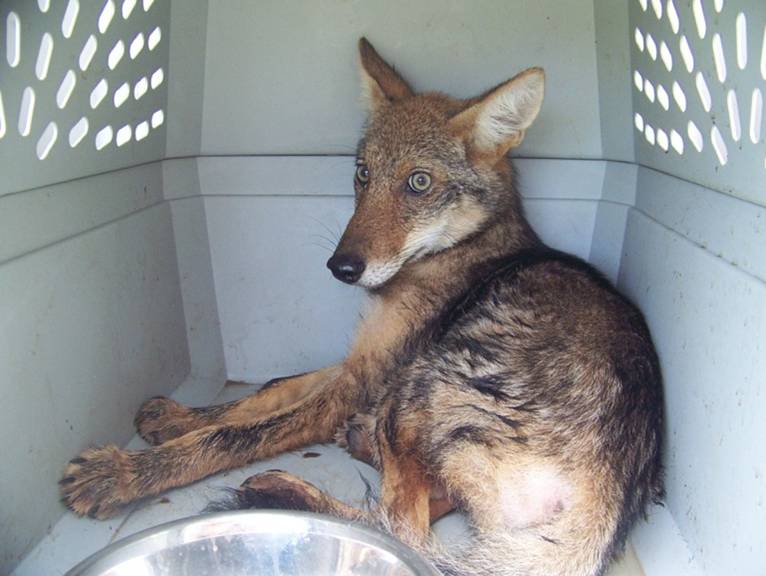
A coyote being transported by the Charlotte County Animal Control. -COURTESY PHOTO
Jones explained that, as counties in Florida continue to develop, the wooded areas and habitats of coyotes decrease. As a result, they begin to become more common in human neighborhoods.
“Reports have increased as development expands, and residents become more aware of wildlife in their neighborhoods,” Jones said. “Coyotes have been present in Florida for decades, but sightings are more common now due to habitat changes and human activity. In my 30 years with this department, I have seen reports of coyotes increase exponentially.”
While the increase can alarm residents, Jones has advice for anyone who comes face-to-face with a coyote:
“Stay calm and do not run. Employ hazing techniques, like making yourself appear large, waving your arms and making loud noises to scare the coyote away. Keep pets leashed and close to you. Never feed coyotes or leave food outside, as this encourages them to return.”
Jones noted that there are preventative methods to keep wildlife from prowling around your property.
“Secure fencing — at least 6 feet high, with a buried base — can deter coyotes,” he said. “Motion-activated lights and sprinklers, as well as noise deterrents like air horns, can discourage coyotes from lingering.”
If a coyote becomes aggressive, Jones recommended a different tactic.
“Call Animal Control if the coyote appears sick, injured, aggressive or is actively threatening people or pets. If the coyote is simply passing through or behaving normally, it’s best to leave it alone and take preventive measures to discourage its presence.”
Many residents ask why relocating the wildlife doesn’t resolve the situation.
“Another common misconception is that removing coyotes will eliminate the problem. When one is removed, others typically move into the area,” Jones said. “The most effective approach is coexistence through prevention. Finally, some assume coyotes always travel in packs. In reality, they are usually solitary, except when raising young or occasionally hunting larger prey.”
Coyotes for conservation
While some may choose to avoid interactions with coyotes, the Naples Zoo offers an opportunity to witness them firsthand and observe their behavior in a controlled setting.
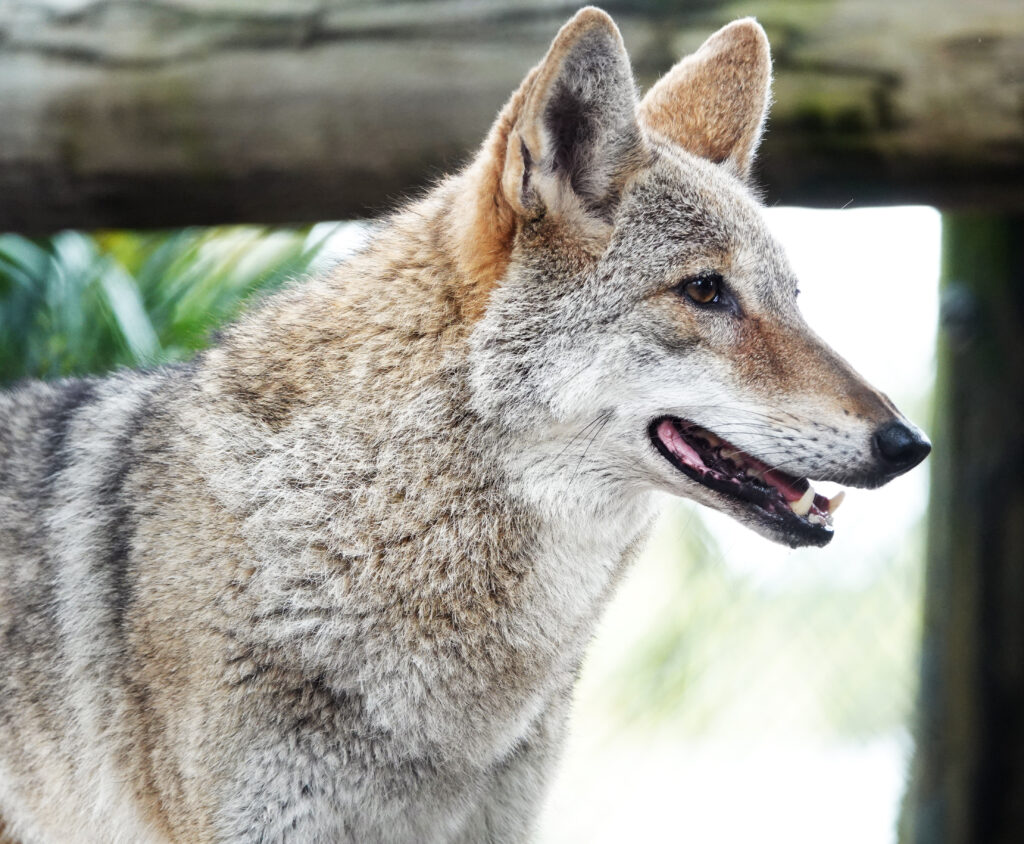
NAPLES ZOO / COURTESY PHOTO
“The zoo shows how coyotes are intelligent and important for creating a balanced ecosystem,” said Courtney Jolly, director of Marketing and Public Relations.
Feeding these animals up close — and building a relationship with a species the public would prefer to avoid — has helped shed light on interactions that could occur outside the confines of the zoo.
Jolly explained that coyotes do not usually attack humans under most normal circumstances.
“In reality, coyotes almost always avoid people. Conflicts with humans can arise if a coyote is ill or has been habituated by people,” she explained.
Despite their passiveness toward humans, coyotes are still hunted for their fur coats — and there are no legal protections against this, according to the Naples Zoo.
As the zoo continues to care for these animals, Jolly has enjoyed learning more and teaching about the wildlife community.
“We love to educate the public on what they can do to support the conservation of different species,” she said, “including ways that humans can better co-exist with wildlife.”
In The KNOW:
Resources regarding coyotes
Florida Fish and Wildlife’s Wildlife (FWC)
Alert Hotline- 1-888-404-3922.
Sanibel Coyote Working Group to Share Proposal for Sea Turtle Protection
Cape Coral coyote safety
Living with Coyotes (FWC)
Fun facts:
Coyotes hunt alone or in small family packs (usually groups of two or three).
Coyotes are primarily nocturnal.
Coyotes are omnivores with a varied diet, such as fruits, insects and, sometimes, garbage.
Coyotes typically sleep in quiet, hidden spots, such as tall grass and under fallen trees.
Coyotes use yips, howls and barks to communicate, having a sound that can sound like multiple coyotes.
Coyotes are canids and come from the same family as dogs, wolves and foxes.
Source: www.worldanimalprotection.us/latest/blogs/20-coyote-facts