
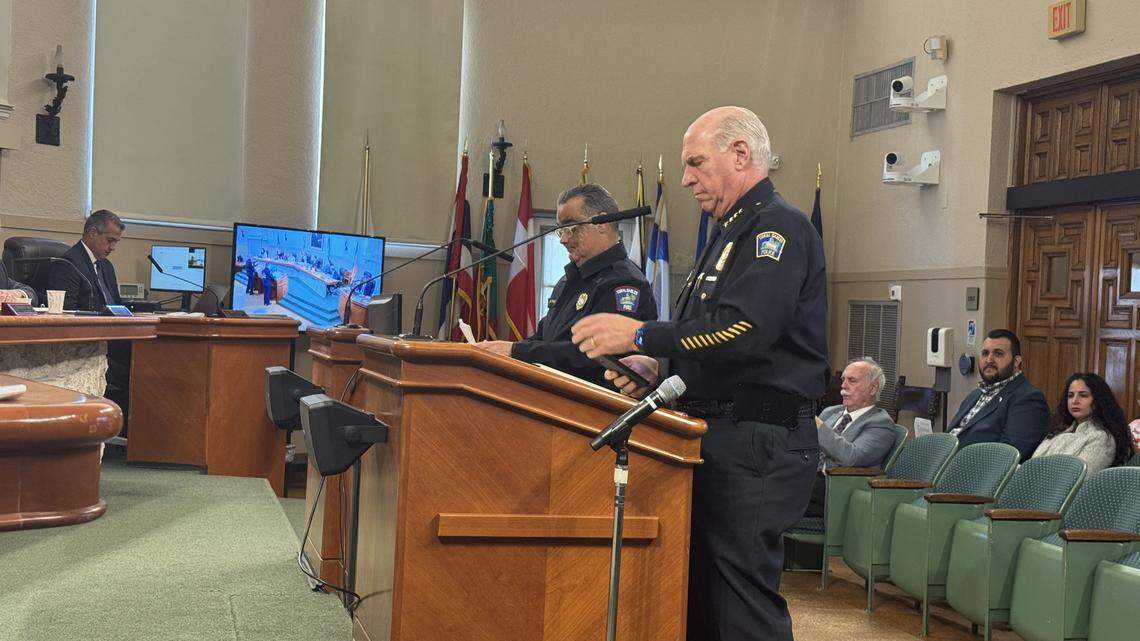
Coral Gables Police Chief Edward Hudak gave a lengthy presentation, alongside Coral Gables Fire Chief Marcos De La Rosa, on the city’s existing training for first responders on Tuesday, Feb. 24, 2026.
Michelle Marchante
mmarchante@miamiherald.com
In Coral Gables, finding a way to expand the city’s efforts to combat human trafficking led to a nearly two-hour discussion during this week’s commission meeting.
The discussion Tuesday, one of the last to be held inside the city chambers before commissioners move out for renovations of the historic City Hall, was sparked by two agenda items sponsored by Commissioner Melissa Castro to expand human trafficking training for first responders. Mayor Vince Lago, Vice Mayor Rhonda Anderson and Commissioner Richard Lara voted to delay the vote to a future meeting to give Castro more time to work on the proposal. The three said they support more education on the topic, but they found Castro’s language too vague.
“I don’t think it moves the needle in any way,” Lara said during the meeting, noting that he wants to work with Castro on updating her proposal. “Why be symbolic when we have an opportunity to be effective by putting some actual real teeth in it?”
The deferral frustrated Castro and Commissioner Ariel Fernandez, who accused the rest of the commission of not supporting the resolution because it was Castro’s idea, a concept Lara denied. Lago, who is often at odds with Castro, said he fully supports having more education efforts to stop human trafficking but said her proposal had “nothing tangible” or “concrete” in it, describing it as a political “trap” for any commissioner who voted against the items as currently written.
Castro disagreed and told the Miami Herald that over the past year she “met with nonprofit organizations, studied best practices and worked closely with professionals in the field to understand how local governments can meaningfully combat human trafficking.” Castro said she was “fully prepared to present a structured, year-round, trauma-informed training model for our firefighters and first responders.”
Castro wants all fire rescue and EMS personnel to undergo mandatory training within the next six months on how to respond to incidents of assault, human trafficking and abuse, with similar training required every two years thereafter.
Both Coral Gables Fire Chief Marcos De La Rosa and Coral Gables Police Chief Edward Hudak, who gave a lengthy presentation, said that the current recurring training is already in line with, and in some cases exceeds, that of other cities and includes how to respond to a variety of vulnerable patients, including those who have been assaulted and abused. But Castro said she wants more specialized anti-human trafficking training, a notion that the two chiefs indicated they would be open to.
Anderson and Lara said they want Miami-Dade State Attorney Katherine Fernandez Rundle’s office to weigh in on what training should be added or improved upon. Commissioners want input from the city’s police and fire departments to craft next plans.
“Training is always a goal that is always evolving and [that] we need to be vigilant to pursue every single day,” Lara told the Herald after the meeting. “But I think that we need to be measured and deliberate … Better to measure twice and cut once.”
Castro’s proposal comes as the city’s police and fire rescue departments are gearing up for a year of crowd-drawing events in South Florida. So is the Miami-Dade State Attorney’s Office, which is preparing to expand enforcement efforts after Miami-Dade was given more than $1 million to combat human trafficking. Florida is ranked No. 3 nationwide for human trafficking cases by the National Human Trafficking Hotline, behind California and Texas.
Castro said she wants the free training to be done by the Miami-Dade Sexual Assault Response Initiative, which says it provides trauma-informed care to survivors of sexual assault, domestic violence and human trafficking. The organization is led by forensic registered nurses and sexual assault nurse examiners Glenda Perez and Marivi Betancourt, who is one of the vice chairs of the Miami-Dade Domestic Violence Oversight Board, an advisory board for county commissioners. The two spoke at the meeting to support Castro’s initiative and say their curriculum is a certified in-person training.
“These are healthcare issues. This is not just a law enforcement issue,” Perez told the Herald after the meeting. “We either work together to solve it, or we continue to make it worse by continuing to fragment the services.”
This is not the first time Coral Gables will try to tackle human trafficking. Lago, who said he’s done over a dozen ride-alongs with Gables and Miami police and Fernandez Rundle’s office on anti-trafficking stints through the years, was behind a 2016 law prohibiting hourly rates at motels and hotels that was meant to curb trafficking, prostitution and drug dealing. He also sponsored legislation that gives Gables police the ability to cross about 100 feet into neighboring Miami along Eighth Street and Douglas Road, when needed, to catch suspects, a partnership the city’s police chief described as useful for efforts to curb human trafficking.
In December, Lago appeared once again in front of Miami city commissioners to show support for an agenda item by Miami Commissioner Ralph Rosado that would set aside money in the city’s budget to purchase motels deemed a public safety risk, mainly along Southwest Eighth Street, to create long-term housing for seniors, people with disabilities, and other vulnerable populations.
Anderson also wants to see more public awareness initiatives and suggested police host a “See Something, Say Something” awareness event at an upcoming farmer’s market to teach people about potential red flags.
“The biggest gap we have is education,” said Anderson. “The public is our eyes and ears.”
Nurses Glenda Perez and Marivi Betancourt, co-founders of the Miami-Dade Sexual Assault Response Initiative, speak in support of Commissioner Melissa Castro’s resolution to expand human trafficking training for first responders. Michelle Marchante mmarchante@miamiherald.com Tips to stop human trafficking
Human trafficking is sometimes known as “modern-day slavery” and can include both sex and labor trafficking, according to the Miami-Dade State Attorney’s Office.
The State Attorney’s Office has a list of red flags to look out for that may indicate someone is a victim of human trafficking. Some of those include if a person is living with an employer or with multiple people in a cramped space, has signs of physical abuse or is unable to speak to anyone alone. They might discuss sexual situations that aren’t age appropriate, have unexcused absences from school, or always be in the company of, or always dating, older men.
Perez, one of the nurses who spoke at Tuesday’s meeting, said many victims of human trafficking also don’t identify as victims.
While there are a variety of different recruiting practices, one of the most popular ones in Miami-Dade is called “Romeo,” she said.
That’s when someone you meet, often online, starts showering you with gifts and money. Then, they suddenly tell you they’re tight on cash and ask you to do something for a “friend” of theirs once or twice, “and that’s where they hook victims in our community,” Perez said.
Another issue is labor trafficking, which may involve people working for free or for little money and being threatened with immigration repercussions or other threats, according to Perez.
To report suspected human trafficking, you can call Florida’s anonymous hotline at 855-FLA-SAFE. The Miami-Dade State Attorney’s Office website also has various hotlines you can call, along with a list of support services for victims, including shelter, counseling and legal services, at humantrafficking.miamisao.com/victim-resources. In case of an emergency, call 911.
Miami Herald
Michelle Marchante covers the pulse of healthcare in South Florida and also the City of Coral Gables. Before that, she covered the COVID-19 pandemic, hurricanes, crime, education, entertainment and other topics in South Florida for the Herald as a breaking news reporter. She recently won first place in the health reporting category in the 2025 Sunshine State Awards for her coverage of Steward Health’s bankruptcy. An investigative series about the abrupt closure of a Miami heart transplant program led Michelle and her colleagues to be recognized as finalists in two 2024 Florida Sunshine State Award categories. She also won second place in the 73rd annual Green Eyeshade Awards for her consumer-focused healthcare stories and was part of the team of reporters who won a 2022 Pulitzer Prize for the Miami Herald’s breaking news coverage of the Surfside building collapse. Michelle graduated with honors from Florida International University and was a 2025 National Press Foundation Covering Workplace Mental Health fellow and a 2020-2021 Poynter-Koch Media & Journalism fellow.
Support my work with a digital subscription