
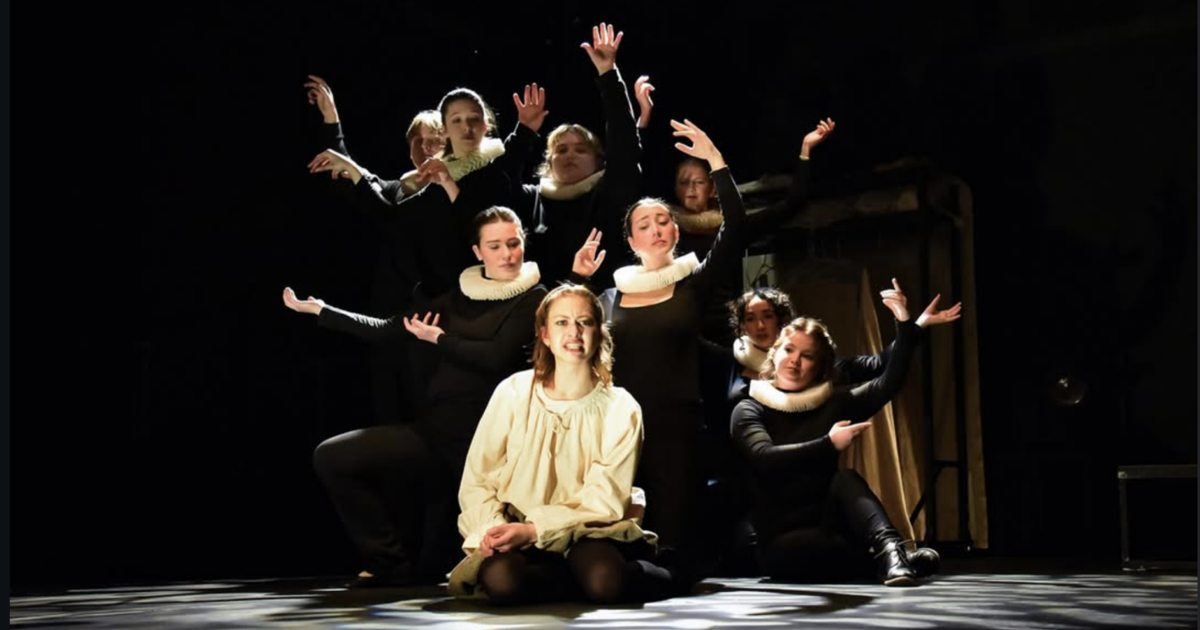
The OU Helmerich School of Drama kicked off showings of “Orlando” Tuesday at the Gilson Lab Theatre inside the Beatrice Carr Wallace Old Science Hall.
The production uses playwright Sarah Ruhl’s adaptation of “Orlando,” a 1928 novel written by Virginia Woolf. The showings will run through Sunday.
According to Penguin Random House, “Orlando” features a protagonist who transforms genders midway through the story.
Orlando begins the story as a nobleman who spends his days working as an aristocrat for Queen Elizabeth and evenings writing poetry. In his 30s, Orlando wakes up in a woman’s body while serving as an ambassador in Constantinople. Over the course of the story Orlando is involved in multiple love affairs with men and women, eventually settling down with her husband.
Dramaturgy sophomore Nola McKee said the crew had to take into account the different time periods experienced in the story, which jumps from the 16th century all the way to the 21st.
“A lot of our research revolved around the costuming. What one wears in the 16th century is very different than what someone would wear now,” McKee said. “There was a lot of attention paid to … the way people would act.”
As with any adaptation, not every detail made it into the final cut of “Orlando.” According to McKee, he played a major role in merging two scripts of the adaptation by Ruhl into one “franken-script.”
“With the book, we would cross-compare to make more sense of the script and certain things that were more meaningful, …” McKee said. “We would go through both of the scripts together as a cast, and talk about which lines were the best to keep and exactly what to merge based on what’s best for the story.”
McKee said the end result of his work on the script was rewarding.
“It was watching them perform, and knowing that funny line they said, I put that in there. This all came together because I was able to mesh it all together,” McKee said. “Sitting in the audience and watching the audience members understand what’s happening onstage was nice because I took part in helping with that.”
Keira Hays, an acting junior who plays the character Orlando, said the role is significant to them because of their personal connection to the show.
“It is such an important story to me because I love Shakespeare and heightened text,” Hays said. “As a nonbinary actor, to be able to do a show that goes through both male and female genders, it is very rewarding for me, and also important for the political standpoint of everything, and to be able to share a story that’s unapologetically itself.”
Hays spoke about the preparation that went into understanding the mindset of Orlando.
“He starts the show as a man at 16, and so (I brought) myself back to when I was 16, and how I felt about life, … the uncertainties that I felt with the future, as well as my dreams for it and allowing those to transform and mutate into what he wants and how he views his life, …” Hays said. “I often see myself as an actor as a vessel for the character.”
One of Orlando’s love interests in the production is the Russian princess Sasha.
Alex Fish, an acting sophomore who plays Sasha, spoke about her goals when it came to portraying the character on stage.
“She’s sultry and very feminine, and she is the second of Orlando’s lovers throughout the show,” Fish said. “Her and Orlando’s relationship represents a very youthful and exciting kind of young love, and I want to be able to capture the whole excitement of it.”
Because Sasha is a Russian character, Fish worked with a dialect coach to enunciate her lines accurately. The dialect coach had a Russian woman record Sasha’s lines, which Fish practiced imitating to prepare for the role.
According to Fish, the production begins with a Greek chorus, which tells the audience the story of Orlando’s life. Throughout the show multiple love interests appear, and actors playing those roles leave the chorus to become those characters.
Fish said it’s important to find your own identity, referencing Orlando’s journey of going through many lovers.
“If you’re trying to discover things about yourself or come to terms with your identity, you’re not going to find the answers in another person,” Fish said. “You’re only going to find the answers within yourself.”
Hays enjoyed the message of vulnerability that Orlando exemplified.
“Vulnerability is a strength. … It’s a story about love and how we love ourselves and how we love the world around us, …” Hays said. “Leaning on others is not weak; it is something that is necessary for human compassion.”
Tickets, $7 with student ID and $9 for adults, can be purchased by calling the Fine Arts Box Office at 405-325-4101 or by arriving at the theater one hour prior to curtain.
This story was edited by Macey Thaxton, Audrey McClour and Madisson Cameron. Larkin Bock and Mary Ann Livingood copy edited this story.
Commenting policy: We value civility and do not tolerate the spreading of misinformation or degrading posts on topics like race, religion or culture. We monitor our comment sections and will delete such when necessary.
Guest columns: Focus on issues, not personalities, in fewer than 500 words. Submissions are published by the editor based on timeliness, relevance and civility after editing for accuracy and style. To submit,
visit our form.