
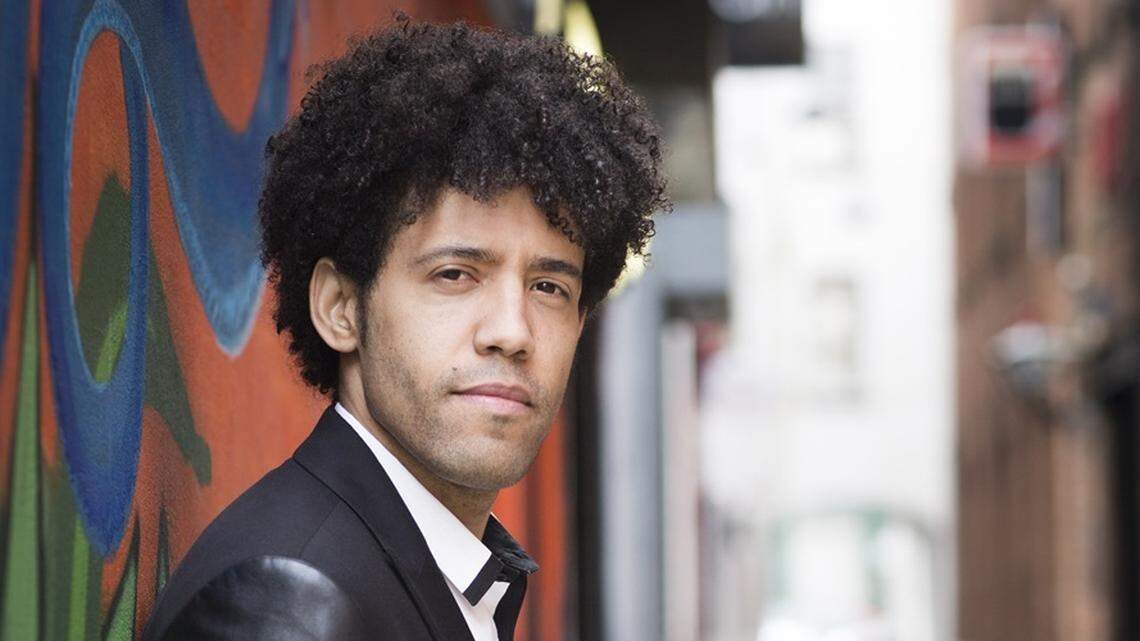
Rafael Payare
Stravinsky’s The Rite of Spring has been called “the most important piece of music of the 20th century” by Leonard Bernstein, described as “sounding like a voice from another planet” by Aaron Copland and proclaimed “the first masterpiece of modern music” by Pierre Boulez.
This spring, The Cleveland Orchestra resumes its 2026 Miami residency in partnership with the Arsht with Stravinsky’s masterwork on March 27 and 28, joined by members of the New World Symphony and conducted by Rafael Payare. The concerts also feature works by Jean Sibelius: the gripping Violin Concerto, with Armenian violinist Sergey Khachatryan, and The Swan of Tuonela, a miniature tone poem depicting a swan gliding on the black river surrounding the underworld of Finnish mythology.
The Cleveland Orchestra then closes its residency with a perfect-for-the-whole-family matinee screening of Rob Reiner’s The Princess Bride, performing Mark Knopfler’s epic fairy-tale score on March 29.
Sibelius and Stravinsky: Music for a New Century
Sibelius’ Violin Concerto premiered in Helsinki in 1904. In 1913, Sergei Diaghilev’s Ballets Russes performed the premiere of The Rite of Spring, choreographed by its legendary star Vaslav Nijinsky and set to Stravinsky’s groundbreaking music.
Both nights were disasters, in very different ways. The soloist in the Sibelius was a mediocre violinist ill-equipped to deal with the concerto’s profound emotions and fiendish technical demands. The critical and audience reception was muted at best and certainly not kind.
The Rite of Spring premiere, on the other hand, caused a riot of booing, yelling, catcalls and face-punching, becoming one of the most infamous nights in the history of music. It didn’t take long, though, for both pieces to emerge triumphant, becoming two of the most often performed, adored and critically acclaimed works of the 20th century.
Following that dreadful first night, Sibelius pulled the concerto’s original publication, revised and rewrote it, and a year later the new version was first heard in Berlin, conducted by none other than Richard Strauss. Ever since, the score’s soaring melodies, technical fireworks, sweep and passion have captivated audiences worldwide.
In similar fashion, Stravinsky’s score was soon recognized as a revolutionary masterpiece. So why the initial violent reaction?
As with the popular music of Rimsky-Korsakov, Borodin and Mussorgsky, Stravinsky was inspired by and appropriated Eastern European folk tunes. But Stravinsky’s genius shattered all norms and expectations, and the folks that filled the Théâtre des Champs-Elysées expecting another fairy-tale night at the ballet (The Firebird had recently been a massive hit) weren’t prepared for the gut-level assault.
Sure, The Adoration of the Earth, which opens the piece, begins with a quiet, eerie bassoon solo, but then there’s a violent explosion. Wild rhythms evoke the rupture of that earth, making way for the pagan rituals that herald the arrival of spring. A pounding beat, shattering brass and manic energy make this about as visceral as music gets. But all that intensity and power unappreciated by that Belle Epoque audience now thrills us to our core. Why?
In his Harvard lectures, collectively titled The Unanswered Question, Bernstein answers the question with total fanboy fervor. That score’s “got the best dissonances anyone ever thought up, the best asymmetries and polytonalities, and polyrhythms, and whatever else you care to name.” Is it any wonder that the Rite sound has left its mark everywhere? Would Orff’s Carina Burana, the Shostakovich symphonies or the Britten Requiem even exist as we know them without it? Think Jaws, Jurassic Park, Edward Scissorhands and countless other movie adventures, and you’re immediately immersed in Stravinsky’s unmistakable musical universe.
The Rite of Spring and the Sibelius Violin Concerto will be performed March 27 and 28 at 8 p.m. Tickets from $41 are on sale at ArshtCenter.org.
Have Fun Stormin’ the Concert Hall!
Whether you were first enchanted by The Princess Bride when you saw it at the multiplex in 1987, memorized every memorable line by watching, rewinding and rewatching your treasured VHS copy or recently streamed it because you heard on a podcast that it’s a cult classic from the before times, it’s inconceivable you’d miss the chance to experience one of the most loved films of all time as never before — with the power of The Cleveland Orchestra, conducted by Lucas Waldin, performing the score live, while the film unfolds upon a giant screen above the stage of the Knight Concert Hall.
Mark Knopfler’s oh-so-‘80s guitars-and-synthesizer music has been fully reimagined as a lush and sweeping orchestral extravaganza, better to underscore all those clashing swords, roaring giants and daring rescues and the timeless romance of farm boy Wesley and Princess Buttercup, radiantly embodied by Cary Elwes and Robin Wright. What a beautiful way to remember Rob Reiner’s boundless gifts to movie lovers.
The Princess Bride will be screened with live orchestra accompaniment March 29 at 3 p.m. Tickets from $53 are on sale at ArshtCenter.org.
McClatchy Commerce
Based in Kansas City, Chase Clements is the Commerce Content Manager for McClatchy.