
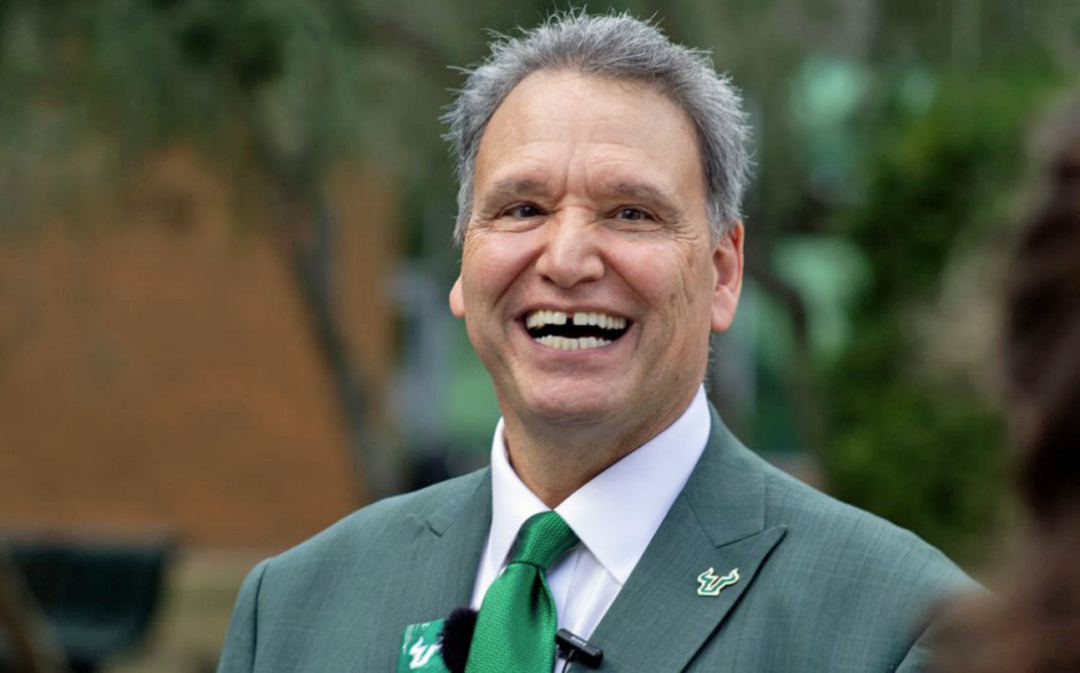
Not that he’s counting, but the President of the University of South Florida knows exactly when he began his important new job.
“Today will be a week and four days … and two hours and three minutes,” Moez Limayem laughed during a Zoom interview with the Catalyst Friday morning. “And I’m enjoying every second.”
From 2012 to ’22, Limayem served as Dean of USF’s Muma College of Business. He left to assume the presidency of the University of North Florida.
“Everybody knew there, I was there to stay,” he said. “With only one condition: If USF called, I just could not say no. And that’s what really happened.”
And so he is now the university’s ninth-ever president, replacing Rhea Law, who announced her retirement last year. Limayem, who’s been in academia for 34 years, and has an MBA and a PhD in Information Systems from the University of Minnesota, raised his children in Tampa. Which makes this an even bigger homecoming.
The challenges, he knows, are many. USF joined the Association of American Universities four years ago, and Limayem has designs on ways he can help make it “the model AAU.”
Among the pressing items discussed in this interview:
The State of Florida’s announced intention to turn USF’s Sarasota-Manatee campus into a branch of the conservative New College;
The ongoing emphasis on athletics, with construction of a $348.5 million on-campus stadium underway;
USF’s future as a key science, technology and health research institution;
The future Bellini College of Artificial Intelligence, Cybersecurity and Computing, established with a $40 million gift from tech entrepreneur Arnie Bellini.
“I think it would have been a mistake for me to come, with a very articulated vision in my briefcase, with specific goals and ways to measure the progress,” he said. “And ask people to take it or leave it. That’s not who I am.
“I am very, more collaborative – and the vision has to be our vision. Within USF, but also outside USF.”
Civil discourse – freedom of speech – is a hot-button issue for Limayem. “One of my dreams is to make USF as a model for a university where people actually know how to disagree with each other. Respectfully, professionally.
“Where people listen to others who don’t agree with them. They listen not to attack. Not to reply. They listen to understand. Where USF is that safe place where people can express their ideas, regardless of where they come from, regardless of how different those ideas.”
Watch the video interview: