
By Sylvie McCarthy
You may not recognize the name Joseph Charles Stehlin, but Ponte Vedra Beach would not be what it is today without his influence and leadership.
Stehlin’s daughter, Patricia Stehlin Boykin of St. Simon’s Island, Georgia, wrote a book about her father’s life and about his vision for Ponte Vedra Beach. The book is titled “Ponte Vedra Beach: How it got the name and The driving force behind the development of Jacksonville Beach 1929-1934.”
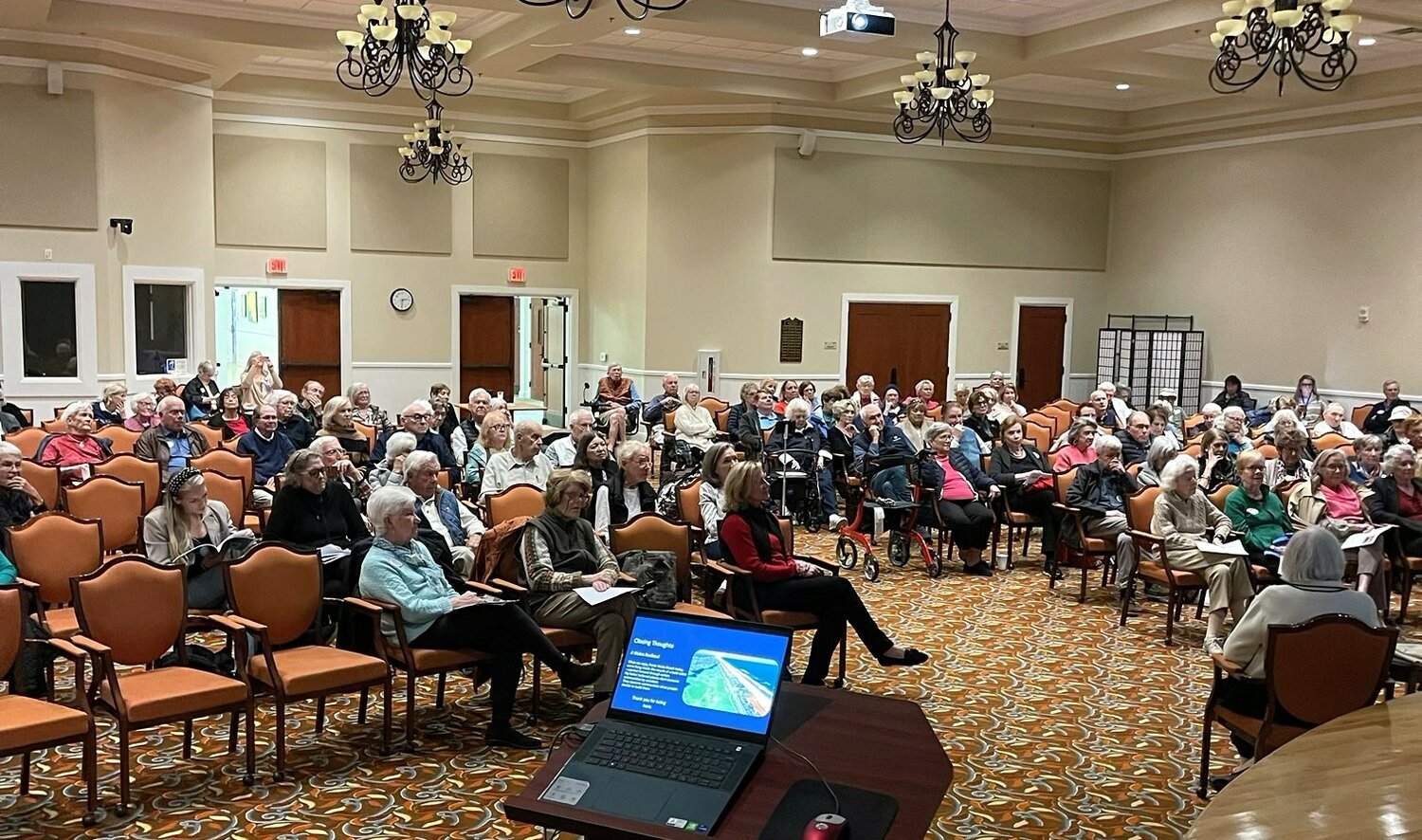
Boykin spoke Jan. 14 about her father at a presentation in the auditorium of the main building in Vicar’s Landing.
Stehlin was a colonel and a former ace aviator prior to World War I. He served in France in the Lafayette Flying Corps. He became a lieutenant colonel at the age of 24 and was the youngest of the war flyers. He received 13 medals including the French Croix de Guerre, the Legion of Honor and the Russian St. Stanislas Cross.
Stehlin and his wife were transferred to Ponte Vedra Beach, which at the time was called Mineral City by the National Lead Company from St. Louis, Missouri, in 1929. The couple moved into the company house, which was located at 423 Ponte Vedra Blvd. The house had no electricity, no water and it was the only one in Ponte Vedra Beach at the time. It was accessible only by the beach road at low tide.
In March 1931, Boykin was born at St. Vincent’s Hospital in Jacksonville. There were no roads in Ponte Vedra Beach during this time, so her mother had to stay in Jacksonville with friends during the weeks leading up to her birth. The only way to get into Jacksonville from Ponte Vedra Beach was by the beach road at low tide. If it had been high tide when her mother went into labor she would not have been able to make it to the hospital. Boykin is considered to be the first baby born in Ponte Vedra Beach.
National Lead Company’s main operation was mining aluminite and rutile out of the sand to make paint. As manager of the company’s interests, Stehlin was put in charge of the development plans of a golf course and resort in Mineral City.
National Lead wanted a more impressive name than Mineral City for their resort, so Stehlin and his wife took a trip to the library in St. Augustine to research some possible name ideas. While at the library, they looked on an old Spanish map and found the name Pontevedra, the capital of a Spanish province on the Atlantic Coast in the Region of Galicia. Stehlin submitted the name to the National Lead Board, and Mineral City became Ponte Vedra Beach.
By April 1931, Stehlin was president of the Chamber of Commerce and president of The Atlantic Coastal Highway Association.
In 1934, construction was completed on the highway that ran from A1A to St. Augustine. Stehlin was the backbone of this project and many others.
“My father had a vision to develop all of Ponte Vedra, and he said it would be a national playground.” said Boykin.
In her book, Boykin recalls her early childhood in Ponte Vedra Beach when there was no one around besides her family.
“There was nothing in site but dunes in either direction,” she said.
She and her brother Joe used to have to run to catch the school bus because it turned around at the Duval/St. Johns County line.
Stehlin was the driving force behind Ponte Vedra Beach and, without his vision and imagination, it might not have become what it is today.
“There was no one here to imagine anything, but he saw what the potential could be,” said Boykin.
Published May 16, 2016, her book is available on Amazon.