

Dr. Mel Stanfill, associate professor of the Texts and Technology Program and the Department of English, won the 2025 Diamond Anniversary Book Award for their book “Fandom is Ugly: Networked Harassment in Participatory Culture.”
Asa Carvajal
When Dr. Mel Stanfill received an email announcing that they had won the 2025 Diamond Anniversary Book Award from the National Communication Association, their first reaction wasn’t celebration, but disbelief.
“I honestly thought that they had sent me the email by accident, and I kept expecting them to be like, just kidding, all the way until I was at the award ceremony,” Stanfill said.
Stanfill, an associate professor of English and Texts and Technology at UCF, won the award for their recently published book “Fandom Is Ugly: Networked Harassment in Participatory Culture.” This annual award recognizes the most outstanding scholarly book published in the previous calendar year, according to the NCA.
“A lot of my work hasn’t been in communication for a while,” Stanfill said, “And so I didn’t know if I would be legible to them as part of their discipline. So when they gave me the award, I was like, are you sure you really meant to give it to me?”
Stanfill said that once the feeling of surprise passed, it felt good for the recognition to sink in and to feel the significance of the accomplishment.
Fan studies, Stanfill said, is a discipline that not many take seriously, especially compared to other areas of communication, media or cultural studies. They say that fans are often seen as “frivolous” and that the things they do are seen as obsolete.
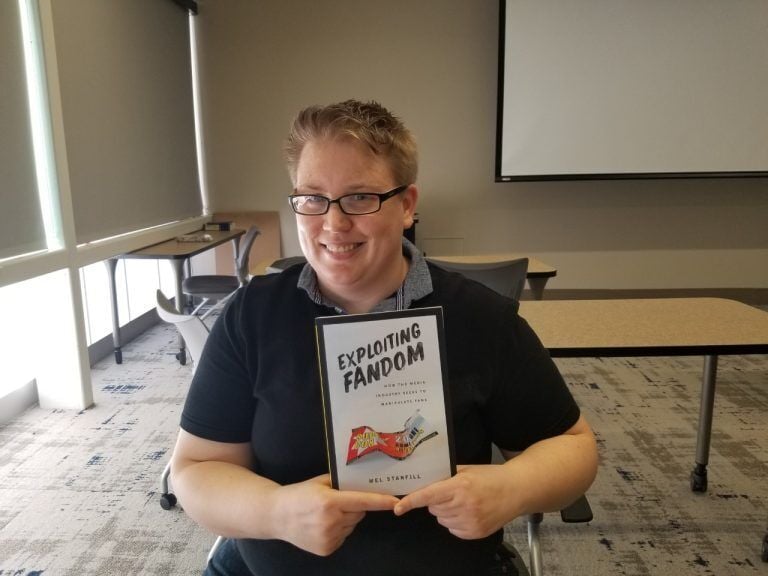
Dr. Mel Stanfill, associate professor of the Texts and Technology Program and the Department of English, holds their book “Exploiting Fandom: How the Media Industry Seeks to Manipulate Fans.” They were recently awarded the 2025 Diamond Anniversary Book Award for a different work.
Courtesy of College of Arts and Humanities
One of the arguments Stanfill poses in their book is that one can use those fans and fandom as a way to understand what’s happening in the world.
Stanfill says that “fandom” can be defined as any emotionally charged, public and oftentimes group interpretation of a text. They used examples to describe fandom’s vast reach, ranging from the Jan. 6 insurrection to fighting about Star Wars lore, as they are different examples of people developing emotional attachments to cultural phenomena.
“They’re collectively doing that, and they’re often sort of working each other up into a frenzy, because they’re in these closed communities where they all agree with each other that whatever has happened in their objective fandom is bad,” Stanfill said.
In the book, they examine the intersection of politics and fan communities, as well as the “dark side” of fandom. Stanfill said that fans can be “destructive,” and that destructiveness was what they wanted to highlight.
Lauren Rouse, one of Stanfill’s former doctoral students, said that internet culture focuses more on the brighter side of fandom and that the negatives are often unilluminated.
“I think that something Mel and I have always looked at is the way that fandom is not beautiful, and often is very messy and yucky and has a lot of racism, sexism, homophobia, ingrained in it, even though it’s supposed to be this, like, beautiful feminist space,” Rouse said.
Rouse, now a postdoctoral teaching fellow at Northwestern University, believes that many people are hesitant to talk about things that are currently happening around the world because they don’t have the framework to engage with them.
“But, you can apply the frameworks of participatory culture, of fair socialness, to these political atmospheres, to these political movements, and have the language to talk about it, which then allows for us to target racism, sexism, homophobia, and begin to break down those boundaries and talk about why those are bad and how we can change,” Rouse said.
Rachel Marks, a lecturer at UCF’s Department of Writing and Rhetoric, was another one of Stanfill’s doctoral students. Initially unfamiliar with the subject, Marks said she got into fan studies after taking one of Stanfill’s classes.
Marks said that seeing her former professor and mentor win an award was amazing, and that all of the attention the book has received is well-deserved.
“They are absolutely a leader in the fan studies space,” Marks said. “Their name constantly comes up when we talk about people who are advancing the fan studies field. I think ‘Fandom Is Ugly’ is a fantastic book, and it absolutely deserves the accolades it’s receiving.”
Dr. Mel Stanfill said that fan studies isn’t an academic discipline taken seriously by most, but receiving recognition by the National Communication Association challenges the belief that it’s unimportant.
Courtesy of Dr. Mel Stanfill
Marks agrees that it’s important to look into the darker side of fandom, because fandoms are far from perfect, even though she said they are often heralded as “safe spaces.” As a significant part of how people interact online and build communities, she said fandom is more than just obsessing over fictional media.
“There’s fandom in politics, there’s fandom in sports, there’s fandom in all these different places, and I think it really shapes our media landscape in an important way, and that’s why it’s important to research it and find out more about it,” Marks said.
Having co-published and worked on multiple projects with their students, Stanfill said they feel rewarded by teaching, as they always end up learning a few things themselves, especially from their dissertations.
Stanfill said that their favorite part about teaching is seeing students suddenly understand something after having spoken and thought about it.
Even though the book is based on scholarly research, Stanfill hopes for it to reach beyond academic audiences.
“The general public, anybody who’s interested in collective fan practices around society, around media, around politics,” Stanfill said. “I hope that those people would pick it up and take a look.”