
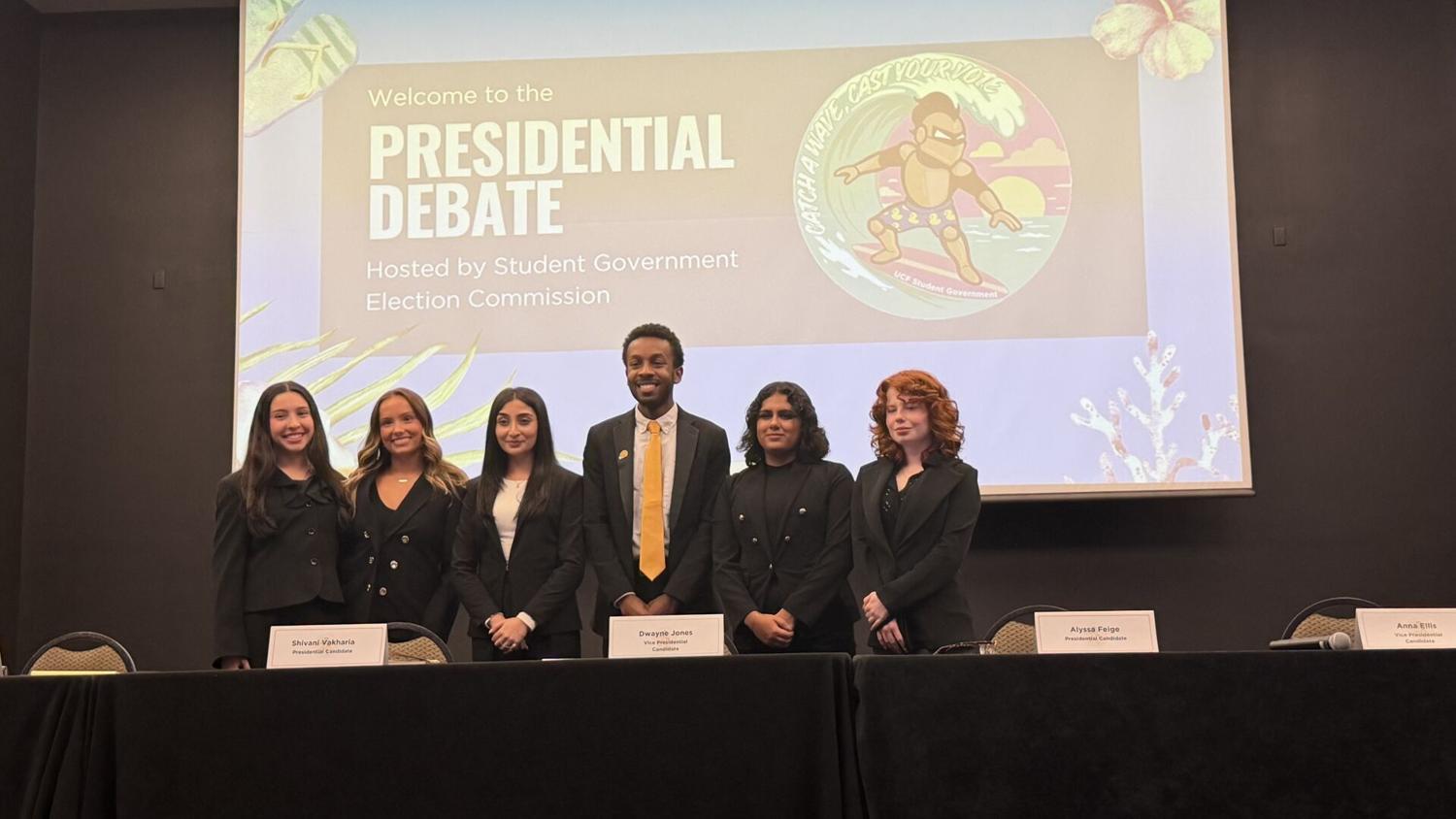
Students filled the Pegasus Ballroom Monday night for the student government presidential ticket debate, eyes fixed on the stage as they prepared to judge which candidates could best represent them.
As outlined in the University of Central Florida’s Student Body Constitution, each ticket pairs a student body president, who leads the organization and selects the cabinet, with a vice president, who supports administrative tasks and manages legislative procedures, like breaking tie votes in the Senate. Both are elected by majority vote for a one-year term focused on upholding campus standards.
The president oversees finances, launches budgets, authorizes expenditures, and can sign or veto legislation, as well as approve student organizations. Both officers represent students through formal updates to the Senate, while the vice president is first in line to assume presidential duties if necessary.
This school year, there are three tickets: junior political science majors Panayiota Laliotis and Athena Dieguez; junior psychology and political science major Shivani Vakharia and junior electronic journalism major Dwayne Jones; and sophomore political science major Alyssa Feige and sophomore legal studies major Anna Ellis.
The debate is an important moment in the election process, giving students the chance to hear from the presidential tickets as they outline their goals and address key issues affecting them and the university.
UCF Supervisor of Elections Andrew Collazo said the debate was designed to emphasize policy over performance.
“What stood out to me most was the candidates’ consistent focus on their policy initiatives,” Collazo said. “Each candidate presented realistic and attainable goals and remained firm in their positions. They appeared genuinely authentic throughout.”
During the debate, students were actively weighing and comparing to see which ticket would best represent the university. The presidential tickets’ experiences, personalities, goals and feasibility of plans were all taken into account.
“Seeing the person in real life, their character and charisma, helps students put a face to the name,” Emily Melo, event manager, said.
To make that in-person evaluation effective, the debate included structured opportunities for students to submit questions through an online form and hear from the candidates directly. These questions were directed toward the president, vice president or both.
With that structure in place, each ticket laid out what they believed set their platform apart from one another.
Vakharia and Jones emphasized their commitment to ensuring that every voice is heard and supported. Jones said their platform is not rooted in what they personally want to change, but in what they gathered directly from talking to other students during the campaign process.
“We want to take every single voice that we have come across and put it into our campaign to make sure that all Knights are well accounted for, supported and heard throughout our campaign,” Vakharia said. “No matter what your background is, you will be well represented under the care of the Vakharia-Jones campaign.”
Vakharia and Jones stated key academic initiatives like increasing the number of success coaches and academic advisors per college to reduce advising wait times, improve graduation rates and provide more individualized academic planning support.
They also plan to implement recruiter fairs for every college to connect students directly with employers in their specific fields of study and host a “T30 Fair” to connect students with the top 30 graduate and professional schools. The campaign also hopes to bring TEDxUCF to campus, providing students with a national platform to showcase their ideas on a broader scale.
Beyond these initiatives, the campaign aims to reduce student costs, expand access to campus events and maintain an open-door policy to ensure consistent communication between student leaders and the broader campus community.
“I think their initiatives are most beneficial to students … and the most realistic to reach,” Ella Bradshaw, freshman finance major, said.
Feige and Ellis highlighted the practicality of their plans by saying that they are actionable and can be implemented quickly. They pointed out that their experiences as UCF students have given them insight into the everyday challenges that students face.
“We created a campaign where we feel we can campaign with an open-door policy,” Feige said. “Hear the average students’ needs and complaints, address them quickly and efficiently and leave room for growth.”
Their short-term goals include implementing a system in which shuttle drivers could stamp “shuttle pardon passes,” giving students a way to show professors if a shuttle breakdown or delay causes them to be late or miss class. They also plan to establish an umbrella rental service, so students and faculty don’t have to walk to class soaking wet.
Campus facilities and employment are another focus. Feige and Ellis plan to reallocate existing student parking closer to main campus facilities and ensure menstrual products are available in all bathrooms. They also aim to improve advertising for campus jobs through centralized bulletin boards and campus-wide emails.
Wellness and reform efforts include placing harassment reporting forms in student wellness kits and expanding anti-hazing campaigns through posters and hotlines. Feige and Ellis also pledge to make the cabinet selection process fully public and more interview-intensive to recruit students outside traditional student government circles.
“I liked how they were mentioning short-term goals … because they’re most likely to be accomplished,” Aniya Charan, junior psychology major, said.
Laliotis and Dieguez centered their platform around shared student experiences, explaining that it was shaped by both their own day-to-day experiences and those of their peers. They said they aim to build initiatives that benefit all students and establish traditions that will have a lasting impact on the university.
“We both get to base our platform not only off of what we walk through day-to-day, but also what you all walk through,” Laliotis said. “From the simplest ideas to building traditions that you all will see for a lifetime. We want to ask for ourselves, what do we leave behind?”
Laliotis and Dieguez emphasized using their student government experience alongside outside leadership perspectives to achieve attainable and lasting goals.
Campus infrastructure and technology are central to their platform. They are planning to propose implementing a “sprinkler revelation plan” to adjust sprinkler timing and placement so students are not sprayed while walking to class. They also plan to work with the administration to expand Wi-fi access by placing boosters in identified “dead spots” across campus to improve connectivity in high-traffic areas.
The library and academic resources are another focus. Laliotis and Dieguez plan to reintroduce 24-hour study spaces during midterms and finals as a trial run to evaluate demand. They also aim to create a library table sharing system to maximize available study space and reduce overcrowding. In addition, they hope to reinstate the Emergency Textbook Fund to support students facing financial hardship.
“Panayiota stood out to me the most tonight because she mentioned that she has student government experience,” Briana Clingan, junior psychology major, said. “It’s nice to know someone who has that in the inner workings as I, like a regular student, do not.”
Overall, students seemed to weigh a combination of factors when evaluating the tickets, including experience, feasibility of plans, relatability and how well candidates listened to and represented their peers. Not only did students notice these qualities, but election officials also praised the candidates’ focus and approach.
After hearing from the candidates and seeing their platforms in action, students can weigh in at the ballot box with voting open from March 9-11.